

continuous cultivation of soybeans dramatically decreased
the seed radiocesium concentration; thus, it is suggested that
this fixation to the soil seems to be slow in these fields
compared with other fields (Hirayama et al. 2018). In the
field where the Ex-K level was not increased sufficiently,
additional K fertilization at the V6 stage (sixth trifoliolate
leaf developmental stage) is effective (Ministry of Agriculture, Forestry and Fisheries, National Agriculture and Food
Research
Organization,
National
Institute
for
Agro-Environmental Sciences 2015b). The soil is thought to
have a strong capacity to fix applied K to make it insoluble
(Hamamoto et al., in the press, Kubo et al. 2018). Topsoil
removal and soil dressing have been performed in formerly
restricted areas, and it is highly necessary to increase the K
fertilization, since the level of exchangeable radiocesium is
high enough to increase the radiocesium transfer from the
soil to plants, especially during the initial cultivation after
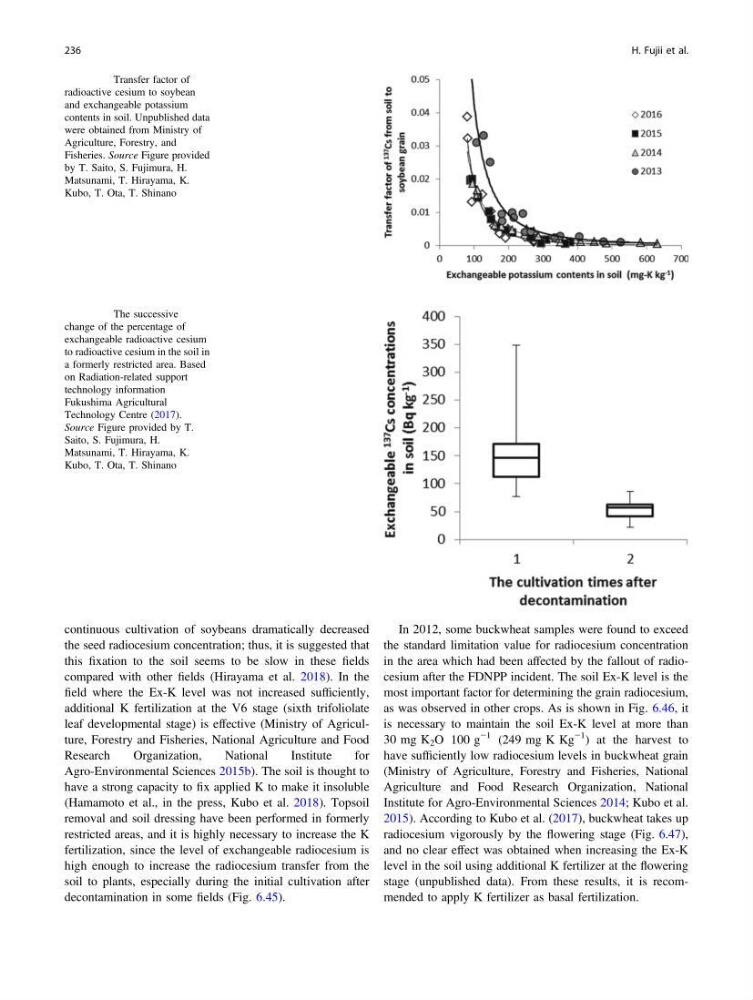
decontamination in some fields (Fig. 6.45).
In 2012, some buckwheat samples were found to exceed
the standard limitation value for radiocesium concentration
in the area which had been affected by the fallout of radiocesium after the FDNPP incident. The soil Ex-K level is the
most important factor for determining the grain radiocesium,
as was observed in other crops. As is shown in Fig. 6.46, it
is necessary to maintain the soil Ex-K level at more than
30 mg K 2 O 100 g
−1 (249 mg K Kg
−1 ) at the harvest to
have sufficiently low radiocesium levels in buckwheat grain
(Ministry of Agriculture, Forestry and Fisheries, National
Agriculture and Food Research Organization, National
Institute for Agro-Environmental Sciences 2014; Kubo et al.
2015). According to Kubo et al. (2017), buckwheat takes up
radiocesium vigorously by the flowering stage (Fig. 6.47),
and no clear effect was obtained when increasing the Ex-K
level in the soil using additional K fertilizer at the flowering
stage (unpublished data). From these results, it is recommended to apply K fertilizer as basal fertilization.
Fig. 6.44 Transfer factor of
radioactive cesium to soybean
and exchangeable potassium
contents in soil. Unpublished data
were obtained from Ministry of
Agriculture, Forestry, and
Fisheries. Source Figure provided
by T. Saito, S. Fujimura, H.
Matsunami, T. Hirayama, K.
Kubo, T. Ota, T. Shinano
Fig. 6.45 The successive
change of the percentage of
exchangeable radioactive cesium
to radioactive cesium in the soil in
a formerly restricted area. Based
on Radiation-related support
technology information
Fukushima Agricultural
Technology Centre (2017).
Source Figure provided by T.
Saito, S. Fujimura, H.
Matsunami, T. Hirayama, K.
Kubo, T. Ota, T. Shinano
236
H. Fujii et al.
the seed radiocesium concentration; thus, it is suggested that
this fixation to the soil seems to be slow in these fields
compared with other fields (Hirayama et al. 2018). In the
field where the Ex-K level was not increased sufficiently,
additional K fertilization at the V6 stage (sixth trifoliolate
leaf developmental stage) is effective (Ministry of Agriculture, Forestry and Fisheries, National Agriculture and Food
Research
Organization,
National
Institute
for
Agro-Environmental Sciences 2015b). The soil is thought to
have a strong capacity to fix applied K to make it insoluble
(Hamamoto et al., in the press, Kubo et al. 2018). Topsoil
removal and soil dressing have been performed in formerly
restricted areas, and it is highly necessary to increase the K
fertilization, since the level of exchangeable radiocesium is
high enough to increase the radiocesium transfer from the
soil to plants, especially during the initial cultivation after
decontamination in some fields (Fig. 6.45).
In 2012, some buckwheat samples were found to exceed
the standard limitation value for radiocesium concentration
in the area which had been affected by the fallout of radiocesium after the FDNPP incident. The soil Ex-K level is the
most important factor for determining the grain radiocesium,
as was observed in other crops. As is shown in Fig. 6.46, it
is necessary to maintain the soil Ex-K level at more than
30 mg K 2 O 100 g
−1 (249 mg K Kg
−1 ) at the harvest to
have sufficiently low radiocesium levels in buckwheat grain
(Ministry of Agriculture, Forestry and Fisheries, National
Agriculture and Food Research Organization, National
Institute for Agro-Environmental Sciences 2014; Kubo et al.
2015). According to Kubo et al. (2017), buckwheat takes up
radiocesium vigorously by the flowering stage (Fig. 6.47),
and no clear effect was obtained when increasing the Ex-K
level in the soil using additional K fertilizer at the flowering
stage (unpublished data). From these results, it is recommended to apply K fertilizer as basal fertilization.
Fig. 6.44 Transfer factor of
radioactive cesium to soybean
and exchangeable potassium
contents in soil. Unpublished data
were obtained from Ministry of
Agriculture, Forestry, and
Fisheries. Source Figure provided
by T. Saito, S. Fujimura, H.
Matsunami, T. Hirayama, K.
Kubo, T. Ota, T. Shinano
Fig. 6.45 The successive
change of the percentage of
exchangeable radioactive cesium
to radioactive cesium in the soil in
a formerly restricted area. Based
on Radiation-related support
technology information
Fukushima Agricultural
Technology Centre (2017).
Source Figure provided by T.
Saito, S. Fujimura, H.
Matsunami, T. Hirayama, K.
Kubo, T. Ota, T. Shinano
236
H. Fujii et al.