

incorporated into the soil, assuming that the rice straw
contained 2% K and the weight of the rice straw was
1.3-fold that of the brown rice yield, according to Fukushima
Prefecture (2015); (3) the K from normal fertilization; and
(4) the K contained in countermeasure fertilization to prevent radiocesium uptake. The soil Ex-K, rice straw K, usual
fertilization K, and countermeasure fertilization K, accounted for 50%, 18%, 7%, and 26% of the K supply, respectively, in the 32 paddy fields in which straw was
incorporated. These results suggested that rice straw incorporation was a significant countermeasure for increasing the
soil Ex-K content and preventing radiocesium uptake by
rice.
(3) Countermeasure to mitigate the transfer of radiocesium from soil to upland crops by potassium
management
During soybean cultivation, the target value of soil Ex-K is
set to 25 mg K 2 O 100 g
−1 (207 mg K Kg
−1 ), except in
areas where high levels of contamination in soybean grain
were observed. In high contamination cases, approximately
50 mg K 2 O 100 g
−1 (415 mg K Kg
−1 ) is recommended,
which is applied by amending the K fertilizer (Ministry of
Agriculture, Forestry and Fisheries, National Agriculture and
Food Research Organization, National Institute for
Agro-Environmental Sciences 2015a). The most effective
timing for K applications is a basal application (Hirayama
and Igarashi 2017). The K application does not change the
taste of the food (Hirayama et al. 2018). In multiple soybean
fields where the radiocesium radioactivity of the soybean
grain exceeded 100 Bq kg
−1 , the grain radioactivity
decreased with an increase in the soil Ex-K level, with the
tendency being different among soil types. In some soils, the
radiocesium transfer factor is significantly higher than in the
soils of other areas with the same Ex-K level, or the increase
in Ex-K due to the application of K fertilizer is limited
(Hirayama et al. 2018). A study found that radiocesium that
was attached to the soil was gradually fixed to the soil solid
phase over time (Takeda et al. 2013) and the transfer factor
to soybeans decreased year by year (Fig. 6.44). As in the
field with a relatively high radiocesium transfer factor, the
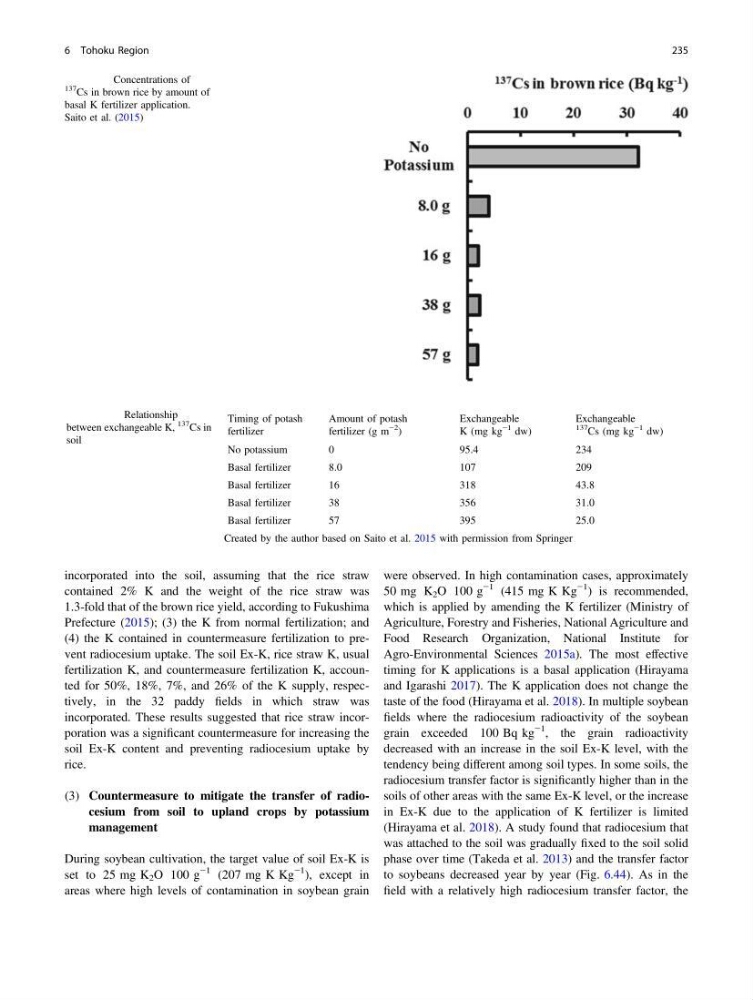
Fig. 6.43 Concentrations of
137
Cs in brown rice by amount of
basal K fertilizer application.
Saito et al. (2015)
Table 6.23 Relationship
between exchangeable K,
137 Cs in
soil
Timing of potash
fertilizer
Amount of potash
fertilizer (g m
−2
)
Exchangeable
K (mg kg
−1 dw)
Exchangeable
137
Cs (mg kg
−1 dw)
No potassium
0
95.4
234
Basal fertilizer
8.0
107
209
Basal fertilizer
16
318
43.8
Basal fertilizer
38
356
31.0
Basal fertilizer
57
395
25.0
Created by the author based on Saito et al. 2015 with permission from Springer
6 Tohoku Region
235
contained 2% K and the weight of the rice straw was
1.3-fold that of the brown rice yield, according to Fukushima
Prefecture (2015); (3) the K from normal fertilization; and
(4) the K contained in countermeasure fertilization to prevent radiocesium uptake. The soil Ex-K, rice straw K, usual
fertilization K, and countermeasure fertilization K, accounted for 50%, 18%, 7%, and 26% of the K supply, respectively, in the 32 paddy fields in which straw was
incorporated. These results suggested that rice straw incorporation was a significant countermeasure for increasing the
soil Ex-K content and preventing radiocesium uptake by
rice.
(3) Countermeasure to mitigate the transfer of radiocesium from soil to upland crops by potassium
management
During soybean cultivation, the target value of soil Ex-K is
set to 25 mg K 2 O 100 g
−1 (207 mg K Kg
−1 ), except in
areas where high levels of contamination in soybean grain
were observed. In high contamination cases, approximately
50 mg K 2 O 100 g
−1 (415 mg K Kg
−1 ) is recommended,
which is applied by amending the K fertilizer (Ministry of
Agriculture, Forestry and Fisheries, National Agriculture and
Food Research Organization, National Institute for
Agro-Environmental Sciences 2015a). The most effective
timing for K applications is a basal application (Hirayama
and Igarashi 2017). The K application does not change the
taste of the food (Hirayama et al. 2018). In multiple soybean
fields where the radiocesium radioactivity of the soybean
grain exceeded 100 Bq kg
−1 , the grain radioactivity
decreased with an increase in the soil Ex-K level, with the
tendency being different among soil types. In some soils, the
radiocesium transfer factor is significantly higher than in the
soils of other areas with the same Ex-K level, or the increase
in Ex-K due to the application of K fertilizer is limited
(Hirayama et al. 2018). A study found that radiocesium that
was attached to the soil was gradually fixed to the soil solid
phase over time (Takeda et al. 2013) and the transfer factor
to soybeans decreased year by year (Fig. 6.44). As in the
field with a relatively high radiocesium transfer factor, the
Fig. 6.43 Concentrations of
137
Cs in brown rice by amount of
basal K fertilizer application.
Saito et al. (2015)
Table 6.23 Relationship
between exchangeable K,
137 Cs in
soil
Timing of potash
fertilizer
Amount of potash
fertilizer (g m
−2
)
Exchangeable
K (mg kg
−1 dw)
Exchangeable
137
Cs (mg kg
−1 dw)
No potassium
0
95.4
234
Basal fertilizer
8.0
107
209
Basal fertilizer
16
318
43.8
Basal fertilizer
38
356
31.0
Basal fertilizer
57
395
25.0
Created by the author based on Saito et al. 2015 with permission from Springer
6 Tohoku Region
235