

(2) Effect of rice straw application for potassium supply
It is also important to consider the balance of the input and
output of K throughout the crop growth period because rice
straw contains approximately 2% K (weight basis), and
incorporating rice straw is one of the sources of K for rice
grown in paddy fields. Approximately 75% of the rice straw
produced in Fukushima Prefecture is plowed into the soil
before the next cultivation season, and other uses include
compost, mulch, forage, and bedding (Fukushima Prefecture
2015). The soil Ex-K level was significantly lower in paddy
fields without rice straw incorporation (n = 146; 62 ± 33
[SD] mg K kg
−1 ) than those with rice straw incorporation
(n = 22; 95 ± 36 [SD] mg K kg
−1 ; p < 0.01 by t-test). The
quantity of supplied K was analyzed for 42 paddy fields in
Fukushima Prefecture using data obtained by the MAFF in
2014 and 2015. The amount of K in 2015 was defined as the
sum of (1) soil Ex-K at harvest in 2014, assuming that the
bulk density was one Mg m
−3 and the plow layer was 15 cm
in depth; (2) the K content of rice straw if the straw was
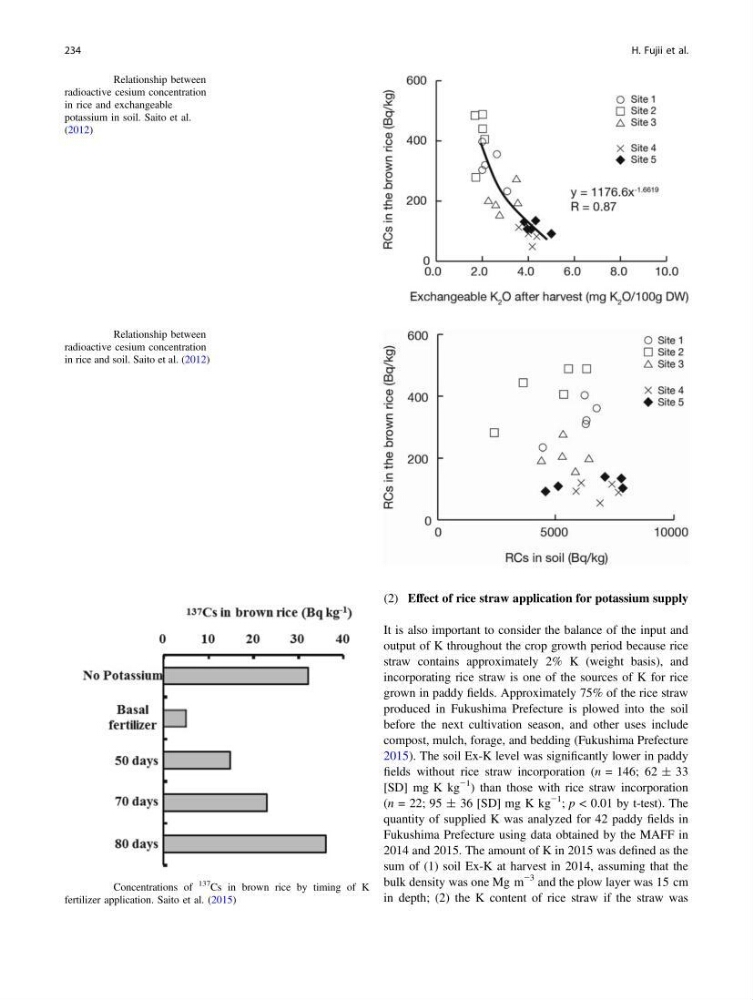
Fig. 6.40 Relationship between
radioactive cesium concentration
in rice and exchangeable
potassium in soil. Saito et al.
(2012)
Fig. 6.41 Relationship between
radioactive cesium concentration
in rice and soil. Saito et al. (2012)
Fig. 6.42 Concentrations of
137
Cs in brown rice by timing of K
fertilizer application. Saito et al. (2015)
234
H. Fujii et al.
It is also important to consider the balance of the input and
output of K throughout the crop growth period because rice
straw contains approximately 2% K (weight basis), and
incorporating rice straw is one of the sources of K for rice
grown in paddy fields. Approximately 75% of the rice straw
produced in Fukushima Prefecture is plowed into the soil
before the next cultivation season, and other uses include
compost, mulch, forage, and bedding (Fukushima Prefecture
2015). The soil Ex-K level was significantly lower in paddy
fields without rice straw incorporation (n = 146; 62 ± 33
[SD] mg K kg
−1 ) than those with rice straw incorporation
(n = 22; 95 ± 36 [SD] mg K kg
−1 ; p < 0.01 by t-test). The
quantity of supplied K was analyzed for 42 paddy fields in
Fukushima Prefecture using data obtained by the MAFF in
2014 and 2015. The amount of K in 2015 was defined as the
sum of (1) soil Ex-K at harvest in 2014, assuming that the
bulk density was one Mg m
−3 and the plow layer was 15 cm
in depth; (2) the K content of rice straw if the straw was
Fig. 6.40 Relationship between
radioactive cesium concentration
in rice and exchangeable
potassium in soil. Saito et al.
(2012)
Fig. 6.41 Relationship between
radioactive cesium concentration
in rice and soil. Saito et al. (2012)
Fig. 6.42 Concentrations of
137
Cs in brown rice by timing of K
fertilizer application. Saito et al. (2015)
234
H. Fujii et al.