

issues persist. We believe that continuous support for the
farmers is critical.
6.6.4 Decontamination of Radioactive Cesium
As early as 2011, the Nuclear Emergency Response Headquarters announced their decontamination methods for
agricultural fields, based on the radioactivity of the soil and
the purpose of the field. The purposes of decontamination
are (1) to reduce the radioactivity of agricultural products;
and (2) to reduce the external radiation exposure of farmers
who are living in the area. Ever since the accident at the
Fukushima Daiichi Nuclear Power Plant (FDNPP) operated
by the Tokyo Electric Power Company (TEPCO), cultivation has not been allowed when the soil radioactivity is high.
Soil radioactivity of 5000 Bq kg
−1 has been considered to
be threshold for the cultivation of rice based on a previous
observation of the transfer of radiocesium from soil to plants
after global fallout since 1960, which showed that the
transfer factor (radiocesium content of brown rice/soil) was
slightly higher than 0.1 at maximum. Notably, some fields
had transfer factor values that were higher than 0.1 and
exceeded the provisional regulation value for radioactivity
(500 Bq kg
−1 ). The reason for this result is that the potassium level in the soil plays a critical role in regulating the
transfer factor. An agricultural field recovery has been performed through a combination of decontamination and
potassium application.
After the topsoil was removed, non-contaminated soil
was added. Because the required amount of soil was too
large, the mountainous soil around the area was collected
and used. This soil was primarily weathered granite and/or
soil containing a large amount of sand, and the fertility was
therefore poor. Even after decontamination, agricultural
activities have been very limited, and thus the manure supply
from animal husbandry is non-existent. Several methods
were examined to improve and maintain the soil fertility, as
shown below.
(1) Physical decontamination methods
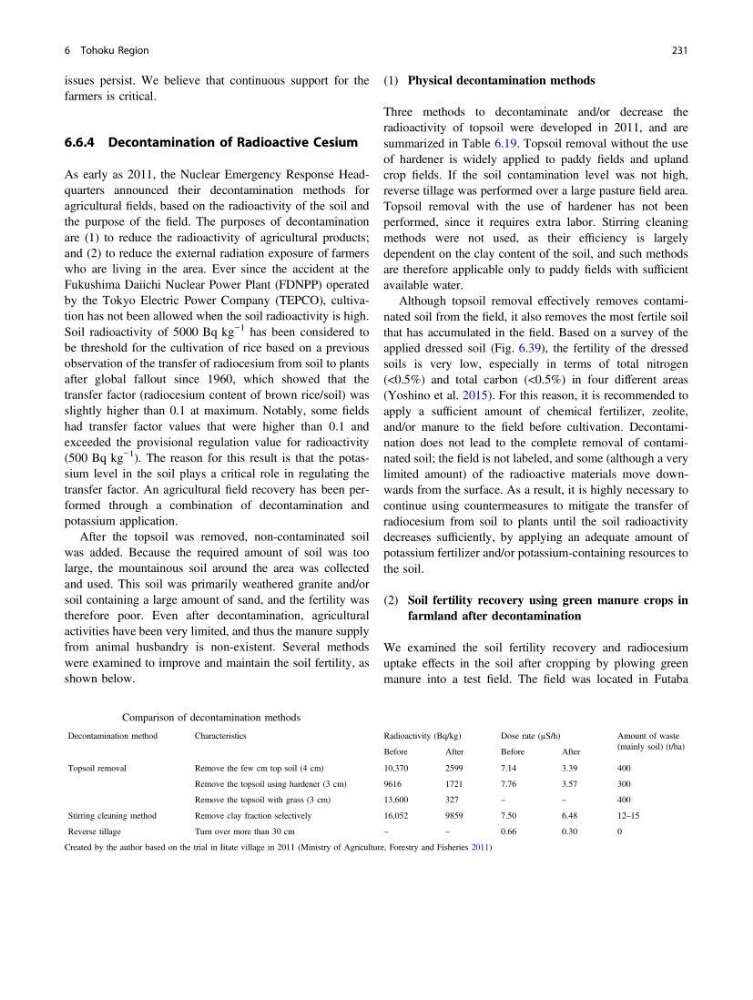
Three methods to decontaminate and/or decrease the
radioactivity of topsoil were developed in 2011, and are
summarized in Table 6.19. Topsoil removal without the use
of hardener is widely applied to paddy fields and upland
crop fields. If the soil contamination level was not high,
reverse tillage was performed over a large pasture field area.
Topsoil removal with the use of hardener has not been
performed, since it requires extra labor. Stirring cleaning
methods were not used, as their efficiency is largely
dependent on the clay content of the soil, and such methods
are therefore applicable only to paddy fields with sufficient
available water.
Although topsoil removal effectively removes contaminated soil from the field, it also removes the most fertile soil
that has accumulated in the field. Based on a survey of the
applied dressed soil (Fig. 6.39), the fertility of the dressed
soils is very low, especially in terms of total nitrogen
(<0.5%) and total carbon (<0.5%) in four different areas
(Yoshino et al. 2015). For this reason, it is recommended to
apply a sufficient amount of chemical fertilizer, zeolite,
and/or manure to the field before cultivation. Decontamination does not lead to the complete removal of contaminated soil; the field is not labeled, and some (although a very
limited amount) of the radioactive materials move downwards from the surface. As a result, it is highly necessary to
continue using countermeasures to mitigate the transfer of
radiocesium from soil to plants until the soil radioactivity
decreases sufficiently, by applying an adequate amount of
potassium fertilizer and/or potassium-containing resources to
the soil.
(2) Soil fertility recovery using green manure crops in
farmland after decontamination
We examined the soil fertility recovery and radiocesium
uptake effects in the soil after cropping by plowing green
manure into a test field. The field was located in Futaba
Table 6.19 Comparison of decontamination methods
Decontamination method
Characteristics
Radioactivity (Bq/kg)
Dose rate (µS/h)
Amount of waste
(mainly soil) (t/ha)
Before
After
Before
After
Topsoil removal
Remove the few cm top soil (4 cm)
10,370
2599
7.14
3.39
400
Remove the topsoil using hardener (3 cm)
9616
1721
7.76
3.57
300
Remove the topsoil with grass (3 cm)
13,600
327
–
–
400
Stirring cleaning method
Remove clay fraction selectively
16,052
9859
7.50
6.48
12–15
Reverse tillage
Turn over more than 30 cm
–
–
0.66
0.30
0
Created by the author based on the trial in Iitate village in 2011 (Ministry of Agriculture, Forestry and Fisheries 2011)
6 Tohoku Region
231
farmers is critical.
6.6.4 Decontamination of Radioactive Cesium
As early as 2011, the Nuclear Emergency Response Headquarters announced their decontamination methods for
agricultural fields, based on the radioactivity of the soil and
the purpose of the field. The purposes of decontamination
are (1) to reduce the radioactivity of agricultural products;
and (2) to reduce the external radiation exposure of farmers
who are living in the area. Ever since the accident at the
Fukushima Daiichi Nuclear Power Plant (FDNPP) operated
by the Tokyo Electric Power Company (TEPCO), cultivation has not been allowed when the soil radioactivity is high.
Soil radioactivity of 5000 Bq kg
−1 has been considered to
be threshold for the cultivation of rice based on a previous
observation of the transfer of radiocesium from soil to plants
after global fallout since 1960, which showed that the
transfer factor (radiocesium content of brown rice/soil) was
slightly higher than 0.1 at maximum. Notably, some fields
had transfer factor values that were higher than 0.1 and
exceeded the provisional regulation value for radioactivity
(500 Bq kg
−1 ). The reason for this result is that the potassium level in the soil plays a critical role in regulating the
transfer factor. An agricultural field recovery has been performed through a combination of decontamination and
potassium application.
After the topsoil was removed, non-contaminated soil
was added. Because the required amount of soil was too
large, the mountainous soil around the area was collected
and used. This soil was primarily weathered granite and/or
soil containing a large amount of sand, and the fertility was
therefore poor. Even after decontamination, agricultural
activities have been very limited, and thus the manure supply
from animal husbandry is non-existent. Several methods
were examined to improve and maintain the soil fertility, as
shown below.
(1) Physical decontamination methods
Three methods to decontaminate and/or decrease the
radioactivity of topsoil were developed in 2011, and are
summarized in Table 6.19. Topsoil removal without the use
of hardener is widely applied to paddy fields and upland
crop fields. If the soil contamination level was not high,
reverse tillage was performed over a large pasture field area.
Topsoil removal with the use of hardener has not been
performed, since it requires extra labor. Stirring cleaning
methods were not used, as their efficiency is largely
dependent on the clay content of the soil, and such methods
are therefore applicable only to paddy fields with sufficient
available water.
Although topsoil removal effectively removes contaminated soil from the field, it also removes the most fertile soil
that has accumulated in the field. Based on a survey of the
applied dressed soil (Fig. 6.39), the fertility of the dressed
soils is very low, especially in terms of total nitrogen
(<0.5%) and total carbon (<0.5%) in four different areas
(Yoshino et al. 2015). For this reason, it is recommended to
apply a sufficient amount of chemical fertilizer, zeolite,
and/or manure to the field before cultivation. Decontamination does not lead to the complete removal of contaminated soil; the field is not labeled, and some (although a very
limited amount) of the radioactive materials move downwards from the surface. As a result, it is highly necessary to
continue using countermeasures to mitigate the transfer of
radiocesium from soil to plants until the soil radioactivity
decreases sufficiently, by applying an adequate amount of
potassium fertilizer and/or potassium-containing resources to
the soil.
(2) Soil fertility recovery using green manure crops in
farmland after decontamination
We examined the soil fertility recovery and radiocesium
uptake effects in the soil after cropping by plowing green
manure into a test field. The field was located in Futaba
Table 6.19 Comparison of decontamination methods
Decontamination method
Characteristics
Radioactivity (Bq/kg)
Dose rate (µS/h)
Amount of waste
(mainly soil) (t/ha)
Before
After
Before
After
Topsoil removal
Remove the few cm top soil (4 cm)
10,370
2599
7.14
3.39
400
Remove the topsoil using hardener (3 cm)
9616
1721
7.76
3.57
300
Remove the topsoil with grass (3 cm)
13,600
327
–
–
400
Stirring cleaning method
Remove clay fraction selectively
16,052
9859
7.50
6.48
12–15
Reverse tillage
Turn over more than 30 cm
–
–
0.66
0.30
0
Created by the author based on the trial in Iitate village in 2011 (Ministry of Agriculture, Forestry and Fisheries 2011)
6 Tohoku Region
231