

town, Fukushima Prefecture, which was designated as an
area in preparation for the lifting of the evacuation order in
May 2013. In the test field, the decontamination work to
remove the top 5 cm of radiocesium-contaminated surface
soil, which was topdressed with mountain sand, involved
plowing to a depth of approximately 15 cm in April 2016.
We set up three plots, each of which was 10 m in length and
7 m in width. At first, Sesbani, Crotarralia, and buckwheat
were sown in each plot, respectively, in June 2016. After
sampling these green manures, we plowed them into the soil
in September 2016. Then, Italian ryegrass was sown in all of
the plots in October 2016. We sampled the Italian ryegrass in
April 2017. The chemical properties and
137 Cs concentrations in the experimental field soil are shown in Table 6.20.
The
137 Cs radio activities in the soils of this field ranged
from 490–1170 Bq kg
−1 dry weight after decontamination.
The aboveground dry weights of Sesbania, Crotarralia,
and buckwheat were 5.2, 2.2, and 1.1 t ha
−1 (Table 6.21). It
is clear that Sesbania cultivation is suitable in farmland with
poor drainage. There was no difference in the total carbon
(T–C) between these green manures. The total nitrogen (T–
N) contents of Sesbania and Crotarralia were higher than
those of buckwheat. In Sesbania, the amounts of T–C, and
T–N that were plowed into the soil were higher than for
other green manure crops. However, the plowing amount
was not influenced by the T–C and T–N in the soil.
The
137 Cs radioactivities of Sesbania, Crotarralia, and
buckwheat were 88, 369, and 121 Bq kg
−1 dry weight
(Table 6.21). The
137 Cs concentration of Crotarralia was
higher than those of Sesbania and buckwheat. For Sesbania
and Crotarralia, the amount of
137
Cs that was plowed into
the soil was higher than it was for buckwheat.
The dry matter weights of Italian ryegrass in the Sesbania
and Crotalaria plots were higher than those in other plots
(Table 6.22). It was thus clear that the effect of soil fertility
recovery by plowing green manure crops into the soil is high
in farmland following decontamination. The
137 Cs concentration of the Italian ryegrass in the Sesbania plot was higher
than that in the other plots. However, plowing green manure
into the soil had little effect on the
137 Cs uptake since the
137 Cs concentration of various green manure crops is low.
Seven years after the FDNPP accident, a large area has
been decontaminated and agriculture has been restarted in
many places. As previously mentioned, “decontamination”
does not indicate the complete removal of radiocesium from
the soil; it is still necessary to continue using countermeasures to mitigate the transfer of radiocesium from soil to
plants through additional applications of potassium fertilizer.
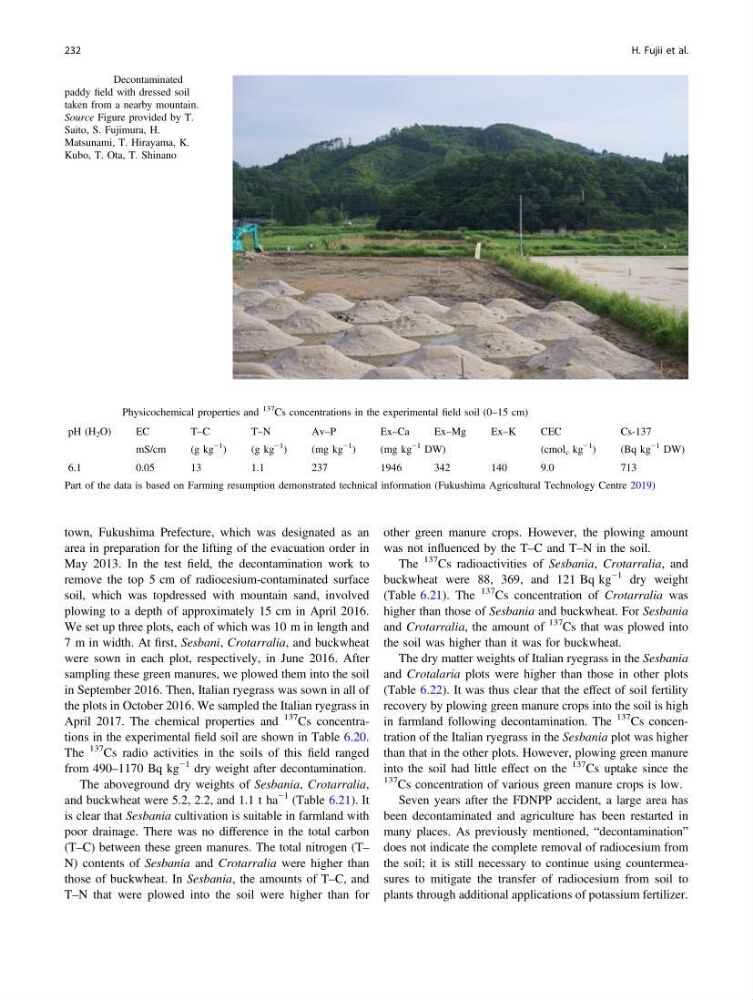
Fig. 6.39 Decontaminated
paddy field with dressed soil
taken from a nearby mountain.
Source Figure provided by T.
Saito, S. Fujimura, H.
Matsunami, T. Hirayama, K.
Kubo, T. Ota, T. Shinano
Table 6.20 Physicochemical properties and
137
Cs concentrations in the experimental field soil (0–15 cm)
pH (H 2 O)
EC
T–C
T –N
A v –P
E x –Ca
Ex–Mg
Ex–K
CEC
Cs-137
mS/cm
(g kg
−1
)
(gkg
−1
)
(mg kg
−1
)
(mg kg
−1 DW)
(cmol c kg
−1
)
(Bq kg
−1 DW)
6.1
0.05
13
1.1
237
1946
342
140
9.0
713
Part of the data is based on Farming resumption demonstrated technical information (Fukushima Agricultural Technology Centre 2019)
232
H. Fujii et al.
area in preparation for the lifting of the evacuation order in
May 2013. In the test field, the decontamination work to
remove the top 5 cm of radiocesium-contaminated surface
soil, which was topdressed with mountain sand, involved
plowing to a depth of approximately 15 cm in April 2016.
We set up three plots, each of which was 10 m in length and
7 m in width. At first, Sesbani, Crotarralia, and buckwheat
were sown in each plot, respectively, in June 2016. After
sampling these green manures, we plowed them into the soil
in September 2016. Then, Italian ryegrass was sown in all of
the plots in October 2016. We sampled the Italian ryegrass in
April 2017. The chemical properties and
137 Cs concentrations in the experimental field soil are shown in Table 6.20.
The
137 Cs radio activities in the soils of this field ranged
from 490–1170 Bq kg
−1 dry weight after decontamination.
The aboveground dry weights of Sesbania, Crotarralia,
and buckwheat were 5.2, 2.2, and 1.1 t ha
−1 (Table 6.21). It
is clear that Sesbania cultivation is suitable in farmland with
poor drainage. There was no difference in the total carbon
(T–C) between these green manures. The total nitrogen (T–
N) contents of Sesbania and Crotarralia were higher than
those of buckwheat. In Sesbania, the amounts of T–C, and
T–N that were plowed into the soil were higher than for
other green manure crops. However, the plowing amount
was not influenced by the T–C and T–N in the soil.
The
137 Cs radioactivities of Sesbania, Crotarralia, and
buckwheat were 88, 369, and 121 Bq kg
−1 dry weight
(Table 6.21). The
137 Cs concentration of Crotarralia was
higher than those of Sesbania and buckwheat. For Sesbania
and Crotarralia, the amount of
137
Cs that was plowed into
the soil was higher than it was for buckwheat.
The dry matter weights of Italian ryegrass in the Sesbania
and Crotalaria plots were higher than those in other plots
(Table 6.22). It was thus clear that the effect of soil fertility
recovery by plowing green manure crops into the soil is high
in farmland following decontamination. The
137 Cs concentration of the Italian ryegrass in the Sesbania plot was higher
than that in the other plots. However, plowing green manure
into the soil had little effect on the
137 Cs uptake since the
137 Cs concentration of various green manure crops is low.
Seven years after the FDNPP accident, a large area has
been decontaminated and agriculture has been restarted in
many places. As previously mentioned, “decontamination”
does not indicate the complete removal of radiocesium from
the soil; it is still necessary to continue using countermeasures to mitigate the transfer of radiocesium from soil to
plants through additional applications of potassium fertilizer.
Fig. 6.39 Decontaminated
paddy field with dressed soil
taken from a nearby mountain.
Source Figure provided by T.
Saito, S. Fujimura, H.
Matsunami, T. Hirayama, K.
Kubo, T. Ota, T. Shinano
Table 6.20 Physicochemical properties and
137
Cs concentrations in the experimental field soil (0–15 cm)
pH (H 2 O)
EC
T–C
T –N
A v –P
E x –Ca
Ex–Mg
Ex–K
CEC
Cs-137
mS/cm
(g kg
−1
)
(gkg
−1
)
(mg kg
−1
)
(mg kg
−1 DW)
(cmol c kg
−1
)
(Bq kg
−1 DW)
6.1
0.05
13
1.1
237
1946
342
140
9.0
713
Part of the data is based on Farming resumption demonstrated technical information (Fukushima Agricultural Technology Centre 2019)
232
H. Fujii et al.