

series of sieves (dry classification). A second method,
whereby rubble was separated by adding water to loosen
sediment clods (wet classification) was also planned, but for
the field cultivation test we used only soil that was sorted by
dry classification.
The results indicated that the rubble-extracted soil had a
higher exchangeable lime content (pH = 7.5–8.0) than the
paddy field soil that is typically found in Iwate Prefecture,
despite the amount of exchangeable sodium originating from
seawater being only slightly higher than typical. Furthermore, the rubble-extracted soil had a sufficient exchangeable
magnesium and available phosphate content, and higher total
carbon and total nitrogen contents than the mountain soil,
which presumably contains both carbon and nitrogen. These
properties indicated that the rubble-extracted soil was
appropriate for rice cultivation in paddies. The exchangeable
potassium content was somewhat low, and electrical conductivity was slightly elevated, but not at levels that were
deemed to require desalination (Table 6.17).
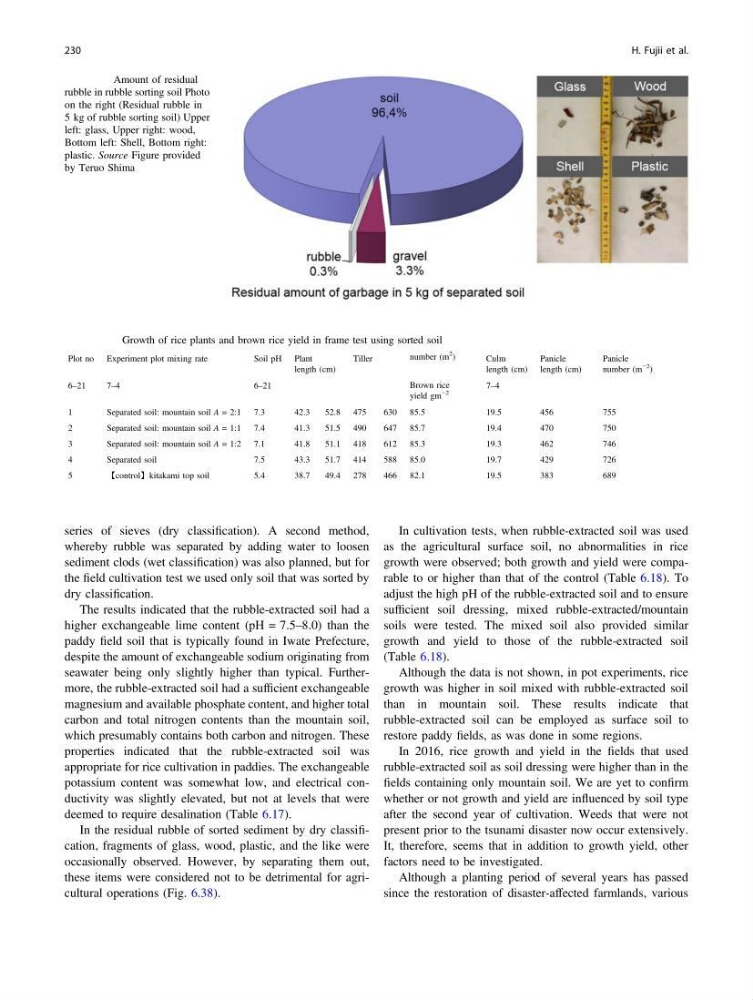
In the residual rubble of sorted sediment by dry classification, fragments of glass, wood, plastic, and the like were
occasionally observed. However, by separating them out,
these items were considered not to be detrimental for agricultural operations (Fig. 6.38).
In cultivation tests, when rubble-extracted soil was used
as the agricultural surface soil, no abnormalities in rice
growth were observed; both growth and yield were comparable to or higher than that of the control (Table 6.18). To
adjust the high pH of the rubble-extracted soil and to ensure
sufficient soil dressing, mixed rubble-extracted/mountain
soils were tested. The mixed soil also provided similar
growth and yield to those of the rubble-extracted soil
(Table 6.18).
Although the data is not shown, in pot experiments, rice
growth was higher in soil mixed with rubble-extracted soil
than in mountain soil. These results indicate that
rubble-extracted soil can be employed as surface soil to
restore paddy fields, as was done in some regions.
In 2016, rice growth and yield in the fields that used
rubble-extracted soil as soil dressing were higher than in the
fields containing only mountain soil. We are yet to confirm
whether or not growth and yield are influenced by soil type
after the second year of cultivation. Weeds that were not
present prior to the tsunami disaster now occur extensively.
It, therefore, seems that in addition to growth yield, other
factors need to be investigated.
Although a planting period of several years has passed
since the restoration of disaster-affected farmlands, various
Fig. 6.38 Amount of residual
rubble in rubble sorting soil Photo
on the right (Residual rubble in
5 kg of rubble sorting soil) Upper
left: glass, Upper right: wood,
Bottom left: Shell, Bottom right:
plastic. Source Figure provided
by Teruo Shima
Table 6.18 Growth of rice plants and brown rice yield in frame test using sorted soil
Plot no Experiment plot mixing rate
Soil pH Plant
length (cm)
Tiller
number (m
2
)
Culm
length (cm)
Panicle
length (cm)
Panicle
number (m
−2
)
Brown rice
yield gm
−2
6–21
7–4
6 –21
7–4
1
Separated soil: mountain soil A = 2:1 7.3
42.3
52.8 475
630 85.5
19.5
456
755
2
Separated soil: mountain soil A = 1:1 7.4
41.3
51.5 490
647 85.7
19.4
470
750
3
Separated soil: mountain soil A = 1:2 7.1
41.8
51.1 418
612 85.3
19.3
462
746
4
Separated soil
7.5
43.3
51.7 414
588 85.0
19.7
429
726
5
【control】kitakami top soil
5.4
38.7
49.4 278
466 82.1
19.5
383
689
230
H. Fujii et al.
whereby rubble was separated by adding water to loosen
sediment clods (wet classification) was also planned, but for
the field cultivation test we used only soil that was sorted by
dry classification.
The results indicated that the rubble-extracted soil had a
higher exchangeable lime content (pH = 7.5–8.0) than the
paddy field soil that is typically found in Iwate Prefecture,
despite the amount of exchangeable sodium originating from
seawater being only slightly higher than typical. Furthermore, the rubble-extracted soil had a sufficient exchangeable
magnesium and available phosphate content, and higher total
carbon and total nitrogen contents than the mountain soil,
which presumably contains both carbon and nitrogen. These
properties indicated that the rubble-extracted soil was
appropriate for rice cultivation in paddies. The exchangeable
potassium content was somewhat low, and electrical conductivity was slightly elevated, but not at levels that were
deemed to require desalination (Table 6.17).
In the residual rubble of sorted sediment by dry classification, fragments of glass, wood, plastic, and the like were
occasionally observed. However, by separating them out,
these items were considered not to be detrimental for agricultural operations (Fig. 6.38).
In cultivation tests, when rubble-extracted soil was used
as the agricultural surface soil, no abnormalities in rice
growth were observed; both growth and yield were comparable to or higher than that of the control (Table 6.18). To
adjust the high pH of the rubble-extracted soil and to ensure
sufficient soil dressing, mixed rubble-extracted/mountain
soils were tested. The mixed soil also provided similar
growth and yield to those of the rubble-extracted soil
(Table 6.18).
Although the data is not shown, in pot experiments, rice
growth was higher in soil mixed with rubble-extracted soil
than in mountain soil. These results indicate that
rubble-extracted soil can be employed as surface soil to
restore paddy fields, as was done in some regions.
In 2016, rice growth and yield in the fields that used
rubble-extracted soil as soil dressing were higher than in the
fields containing only mountain soil. We are yet to confirm
whether or not growth and yield are influenced by soil type
after the second year of cultivation. Weeds that were not
present prior to the tsunami disaster now occur extensively.
It, therefore, seems that in addition to growth yield, other
factors need to be investigated.
Although a planting period of several years has passed
since the restoration of disaster-affected farmlands, various
Fig. 6.38 Amount of residual
rubble in rubble sorting soil Photo
on the right (Residual rubble in
5 kg of rubble sorting soil) Upper
left: glass, Upper right: wood,
Bottom left: Shell, Bottom right:
plastic. Source Figure provided
by Teruo Shima
Table 6.18 Growth of rice plants and brown rice yield in frame test using sorted soil
Plot no Experiment plot mixing rate
Soil pH Plant
length (cm)
Tiller
number (m
2
)
Culm
length (cm)
Panicle
length (cm)
Panicle
number (m
−2
)
Brown rice
yield gm
−2
6–21
7–4
6 –21
7–4
1
Separated soil: mountain soil A = 2:1 7.3
42.3
52.8 475
630 85.5
19.5
456
755
2
Separated soil: mountain soil A = 1:1 7.4
41.3
51.5 490
647 85.7
19.4
470
750
3
Separated soil: mountain soil A = 1:2 7.1
41.8
51.1 418
612 85.3
19.3
462
746
4
Separated soil
7.5
43.3
51.7 414
588 85.0
19.7
429
726
5
【control】kitakami top soil
5.4
38.7
49.4 278
466 82.1
19.5
383
689
230
H. Fujii et al.