

coastal areas of Miyagi Prefecture. In some paddy fields, soil
fertility was decreased after the removal of salt and debris,
and the subsequent rice growth was poor. Generally, in fields
where the soil fertility has declined, CMC is applied to
increase soil fertility. However, in coastal areas from Ishinomaki City to Yamamoto Town, there are few livestock
farmers, and farmers often do not have the machinery necessary for manure spraying. Therefore, in these areas,
another method to increase soil fertility is required instead of
cattle manure application.
We examined the improvement of soil fertility that can be
achieved by introducing green manure to paddy rice cultivation in low-fertility paddy fields that were damaged by the
tsunami (Abe and Honda 2015). The test field was located in
Higashi-Matsushima City and had an area of about 1 ha.
Green manure was sown in October 2012, in the second year
after the tsunami disaster, after cropping paddy rice. The
green manure used was Italian ryegrass (“Hanamiwase”
variety) and hairy vetch (“Kantarou” variety). A green
manure-free seeded area was also set up. The respective
plots names were “HANAMIWASE”, “KANTAROU”, and
“No Seeding”. In the test field, due to the ground subsidence
caused by the earthquake, there is some agricultural water
reflux from the drainage to the field from late April when the
agricultural water flows into the irrigation canal. For this
reason, the growing period of green manure was limited. The
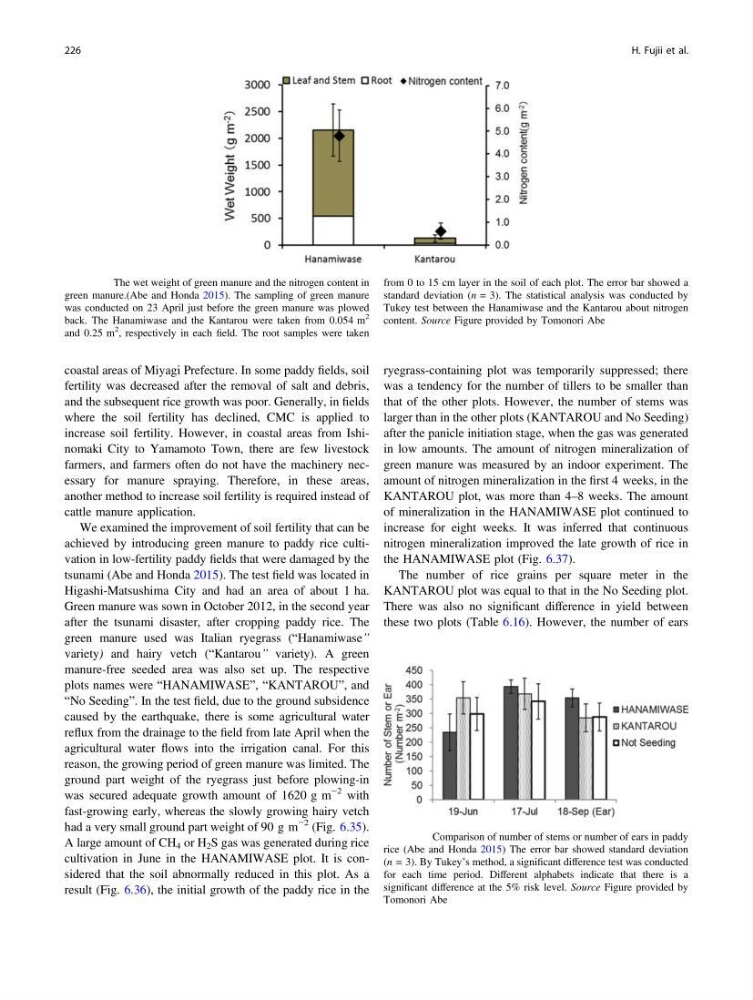
ground part weight of the ryegrass just before plowing-in
was secured adequate growth amount of 1620 g m
−2 with
fast-growing early, whereas the slowly growing hairy vetch
had a very small ground part weight of 90 g m
−2 (Fig. 6.35).
A large amount of CH 4 or H 2 S gas was generated during rice
cultivation in June in the HANAMIWASE plot. It is considered that the soil abnormally reduced in this plot. As a
result (Fig. 6.36), the initial growth of the paddy rice in the
ryegrass-containing plot was temporarily suppressed; there
was a tendency for the number of tillers to be smaller than
that of the other plots. However, the number of stems was
larger than in the other plots (KANTAROU and No Seeding)
after the panicle initiation stage, when the gas was generated
in low amounts. The amount of nitrogen mineralization of
green manure was measured by an indoor experiment. The
amount of nitrogen mineralization in the first 4 weeks, in the
KANTAROU plot, was more than 4–8 weeks. The amount
of mineralization in the HANAMIWASE plot continued to
increase for eight weeks. It was inferred that continuous
nitrogen mineralization improved the late growth of rice in
the HANAMIWASE plot (Fig. 6.37).
The number of rice grains per square meter in the
KANTAROU plot was equal to that in the No Seeding plot.
There was also no significant difference in yield between
these two plots (Table 6.16). However, the number of ears
Fig. 6.35 The wet weight of green manure and the nitrogen content in
green manure.(Abe and Honda 2015). The sampling of green manure
was conducted on 23 April just before the green manure was plowed
back. The Hanamiwase and the Kantarou were taken from 0.054 m
2
and 0.25 m
2
, respectively in each field. The root samples were taken
from 0 to 15 cm layer in the soil of each plot. The error bar showed a
standard deviation (n = 3). The statistical analysis was conducted by
Tukey test between the Hanamiwase and the Kantarou about nitrogen
content. Source Figure provided by Tomonori Abe
Fig. 6.36 Comparison of number of stems or number of ears in paddy
rice (Abe and Honda 2015) The error bar showed standard deviation
(n = 3). By Tukey’s method, a significant difference test was conducted
for each time period. Different alphabets indicate that there is a
significant difference at the 5% risk level. Source Figure provided by
Tomonori Abe
226
H. Fujii et al.
fertility was decreased after the removal of salt and debris,
and the subsequent rice growth was poor. Generally, in fields
where the soil fertility has declined, CMC is applied to
increase soil fertility. However, in coastal areas from Ishinomaki City to Yamamoto Town, there are few livestock
farmers, and farmers often do not have the machinery necessary for manure spraying. Therefore, in these areas,
another method to increase soil fertility is required instead of
cattle manure application.
We examined the improvement of soil fertility that can be
achieved by introducing green manure to paddy rice cultivation in low-fertility paddy fields that were damaged by the
tsunami (Abe and Honda 2015). The test field was located in
Higashi-Matsushima City and had an area of about 1 ha.
Green manure was sown in October 2012, in the second year
after the tsunami disaster, after cropping paddy rice. The
green manure used was Italian ryegrass (“Hanamiwase”
variety) and hairy vetch (“Kantarou” variety). A green
manure-free seeded area was also set up. The respective
plots names were “HANAMIWASE”, “KANTAROU”, and
“No Seeding”. In the test field, due to the ground subsidence
caused by the earthquake, there is some agricultural water
reflux from the drainage to the field from late April when the
agricultural water flows into the irrigation canal. For this
reason, the growing period of green manure was limited. The
ground part weight of the ryegrass just before plowing-in
was secured adequate growth amount of 1620 g m
−2 with
fast-growing early, whereas the slowly growing hairy vetch
had a very small ground part weight of 90 g m
−2 (Fig. 6.35).
A large amount of CH 4 or H 2 S gas was generated during rice
cultivation in June in the HANAMIWASE plot. It is considered that the soil abnormally reduced in this plot. As a
result (Fig. 6.36), the initial growth of the paddy rice in the
ryegrass-containing plot was temporarily suppressed; there
was a tendency for the number of tillers to be smaller than
that of the other plots. However, the number of stems was
larger than in the other plots (KANTAROU and No Seeding)
after the panicle initiation stage, when the gas was generated
in low amounts. The amount of nitrogen mineralization of
green manure was measured by an indoor experiment. The
amount of nitrogen mineralization in the first 4 weeks, in the
KANTAROU plot, was more than 4–8 weeks. The amount
of mineralization in the HANAMIWASE plot continued to
increase for eight weeks. It was inferred that continuous
nitrogen mineralization improved the late growth of rice in
the HANAMIWASE plot (Fig. 6.37).
The number of rice grains per square meter in the
KANTAROU plot was equal to that in the No Seeding plot.
There was also no significant difference in yield between
these two plots (Table 6.16). However, the number of ears
Fig. 6.35 The wet weight of green manure and the nitrogen content in
green manure.(Abe and Honda 2015). The sampling of green manure
was conducted on 23 April just before the green manure was plowed
back. The Hanamiwase and the Kantarou were taken from 0.054 m
2
and 0.25 m
2
, respectively in each field. The root samples were taken
from 0 to 15 cm layer in the soil of each plot. The error bar showed a
standard deviation (n = 3). The statistical analysis was conducted by
Tukey test between the Hanamiwase and the Kantarou about nitrogen
content. Source Figure provided by Tomonori Abe
Fig. 6.36 Comparison of number of stems or number of ears in paddy
rice (Abe and Honda 2015) The error bar showed standard deviation
(n = 3). By Tukey’s method, a significant difference test was conducted
for each time period. Different alphabets indicate that there is a
significant difference at the 5% risk level. Source Figure provided by
Tomonori Abe
226
H. Fujii et al.