

6.5.2 Methane Emission from Paddy Fields
and Its Mitigation Strategy
The Tohoku region is a relatively cold temperate area in
Northeast Japan, having a mean annual temperature of about
10 °C. Since fields are covered by snow during the long
winter season in this region, rice is generally grown from
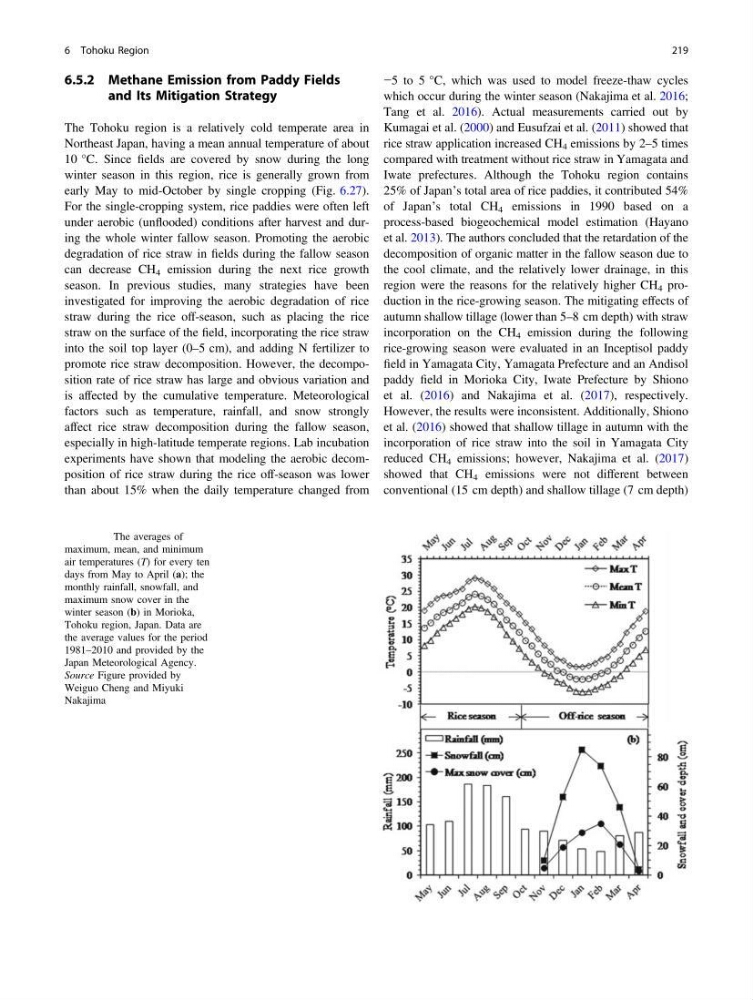
early May to mid-October by single cropping (Fig. 6.27).
For the single-cropping system, rice paddies were often left
under aerobic (unflooded) conditions after harvest and during the whole winter fallow season. Promoting the aerobic
degradation of rice straw in fields during the fallow season
can decrease CH 4 emission during the next rice growth
season. In previous studies, many strategies have been
investigated for improving the aerobic degradation of rice
straw during the rice off-season, such as placing the rice
straw on the surface of the field, incorporating the rice straw
into the soil top layer (0–5 cm), and adding N fertilizer to
promote rice straw decomposition. However, the decomposition rate of rice straw has large and obvious variation and
is affected by the cumulative temperature. Meteorological
factors such as temperature, rainfall, and snow strongly
affect rice straw decomposition during the fallow season,
especially in high-latitude temperate regions. Lab incubation
experiments have shown that modeling the aerobic decomposition of rice straw during the rice off-season was lower
than about 15% when the daily temperature changed from
−5 to 5 °C, which was used to model freeze-thaw cycles
which occur during the winter season (Nakajima et al. 2016;
Tang et al. 2016). Actual measurements carried out by
Kumagai et al. (2000) and Eusufzai et al. (2011) showed that
rice straw application increased CH 4 emissions by 2–5 times
compared with treatment without rice straw in Yamagata and
Iwate prefectures. Although the Tohoku region contains
25% of Japan’s total area of rice paddies, it contributed 54%
of Japan’s total CH 4 emissions in 1990 based on a
process-based biogeochemical model estimation (Hayano
et al. 2013). The authors concluded that the retardation of the
decomposition of organic matter in the fallow season due to
the cool climate, and the relatively lower drainage, in this
region were the reasons for the relatively higher CH 4 production in the rice-growing season. The mitigating effects of
autumn shallow tillage (lower than 5–8 cm depth) with straw
incorporation on the CH 4 emission during the following
rice-growing season were evaluated in an Inceptisol paddy
field in Yamagata City, Yamagata Prefecture and an Andisol
paddy field in Morioka City, Iwate Prefecture by Shiono
et al. (2016) and Nakajima et al. (2017), respectively.
However, the results were inconsistent. Additionally, Shiono
et al. (2016) showed that shallow tillage in autumn with the
incorporation of rice straw into the soil in Yamagata City
reduced CH 4 emissions; however, Nakajima et al. (2017)
showed that CH 4 emissions were not different between
conventional (15 cm depth) and shallow tillage (7 cm depth)
Fig. 6.27 The averages of
maximum, mean, and minimum
air temperatures (T) for every ten
days from May to April (a); the
monthly rainfall, snowfall, and
maximum snow cover in the
winter season (b) in Morioka,
Tohoku region, Japan. Data are
the average values for the period
1981–2010 and provided by the
Japan Meteorological Agency.
Source Figure provided by
Weiguo Cheng and Miyuki
Nakajima
6 Tohoku Region
219
and Its Mitigation Strategy
The Tohoku region is a relatively cold temperate area in
Northeast Japan, having a mean annual temperature of about
10 °C. Since fields are covered by snow during the long
winter season in this region, rice is generally grown from
early May to mid-October by single cropping (Fig. 6.27).
For the single-cropping system, rice paddies were often left
under aerobic (unflooded) conditions after harvest and during the whole winter fallow season. Promoting the aerobic
degradation of rice straw in fields during the fallow season
can decrease CH 4 emission during the next rice growth
season. In previous studies, many strategies have been
investigated for improving the aerobic degradation of rice
straw during the rice off-season, such as placing the rice
straw on the surface of the field, incorporating the rice straw
into the soil top layer (0–5 cm), and adding N fertilizer to
promote rice straw decomposition. However, the decomposition rate of rice straw has large and obvious variation and
is affected by the cumulative temperature. Meteorological
factors such as temperature, rainfall, and snow strongly
affect rice straw decomposition during the fallow season,
especially in high-latitude temperate regions. Lab incubation
experiments have shown that modeling the aerobic decomposition of rice straw during the rice off-season was lower
than about 15% when the daily temperature changed from
−5 to 5 °C, which was used to model freeze-thaw cycles
which occur during the winter season (Nakajima et al. 2016;
Tang et al. 2016). Actual measurements carried out by
Kumagai et al. (2000) and Eusufzai et al. (2011) showed that
rice straw application increased CH 4 emissions by 2–5 times
compared with treatment without rice straw in Yamagata and
Iwate prefectures. Although the Tohoku region contains
25% of Japan’s total area of rice paddies, it contributed 54%
of Japan’s total CH 4 emissions in 1990 based on a
process-based biogeochemical model estimation (Hayano
et al. 2013). The authors concluded that the retardation of the
decomposition of organic matter in the fallow season due to
the cool climate, and the relatively lower drainage, in this
region were the reasons for the relatively higher CH 4 production in the rice-growing season. The mitigating effects of
autumn shallow tillage (lower than 5–8 cm depth) with straw
incorporation on the CH 4 emission during the following
rice-growing season were evaluated in an Inceptisol paddy
field in Yamagata City, Yamagata Prefecture and an Andisol
paddy field in Morioka City, Iwate Prefecture by Shiono
et al. (2016) and Nakajima et al. (2017), respectively.
However, the results were inconsistent. Additionally, Shiono
et al. (2016) showed that shallow tillage in autumn with the
incorporation of rice straw into the soil in Yamagata City
reduced CH 4 emissions; however, Nakajima et al. (2017)
showed that CH 4 emissions were not different between
conventional (15 cm depth) and shallow tillage (7 cm depth)
Fig. 6.27 The averages of
maximum, mean, and minimum
air temperatures (T) for every ten
days from May to April (a); the
monthly rainfall, snowfall, and
maximum snow cover in the
winter season (b) in Morioka,
Tohoku region, Japan. Data are
the average values for the period
1981–2010 and provided by the
Japan Meteorological Agency.
Source Figure provided by
Weiguo Cheng and Miyuki
Nakajima
6 Tohoku Region
219