

in Morioka City. This inconsistency could be due to the
differences in environmental conditions (mostly temperature
and moisture), as well as soil properties, between the two
paddy sites. Compared with rice straw, rice straw compost
clearly decreased CH 4 production and emission from a rice
paddy in the Tohoku region (Kumagai et al. 2000; Cheng
et al. 2016). However, composting rice straw requires much
cost and labor. Developing a simpler method for composting
rice straw is therefore desirable.
In Japan, the area of rice cultivation decreased from
3.3 million ha in the 1960s to 1.6 million ha in 2015, while
rice consumption decreased from a peak of 118 kg per
person per year in 1962 to 55 kg in 2015 (Cheng et al.
2018). The paddy–upland rotation cultivation system (see
Sect. 6.4), which involves cycling between two crops, such
as rice and soybean, for various years at a time, is adopted in
many areas and is increasingly used in the Tohoku region.
Since CH 4 emissions from rotated rice paddy fields have
decreased remarkably in the Tohoku region, as confirmed by
many studies (e.g. Eusufzai et al. 2010), this practice should
be an effective strategy to decrease CH 4 emissions from
Japanese rice paddy fields in the future. The water management of midseason drainage also is an effective strategy
to decrease CH 4 emissions from rice paddies, as confirmed
by Itoh et al. (2011) in the cities of Tsuruoka and Yamagata,
Yamagata Prefecture.
6.5.3 Shallow Fall Tillage for Mitigating
of Methane Emissions
Shallow fall tillage promotes the aerobic decomposition of
rice straw while maintaining the workability of the soil.
Furthermore, the production of organic acids, which is
associated with the anaerobic decomposition of rice straw,
decreases, because of the more aerobic conditions associated
with fall-shallow tillage; this effect reduces the growth
inhibition which is caused by the production of organic acid.
Consequently, an increase in early rice growth is expected
by fall-shallow tillage. To test these hypotheses, we investigated the influence of fall-shallow tillage in paddy fields in
Yamagata Prefecture on methane generation and the subsequent growth of paddy rice crops. Trials were conducted in a
field site (soil type: Gray Fluvic soil) in the Yamagata
Integrated Agriculture Research Center from 2011 to 2013,
using the “Hae-nuki” japonica rice cultivar.
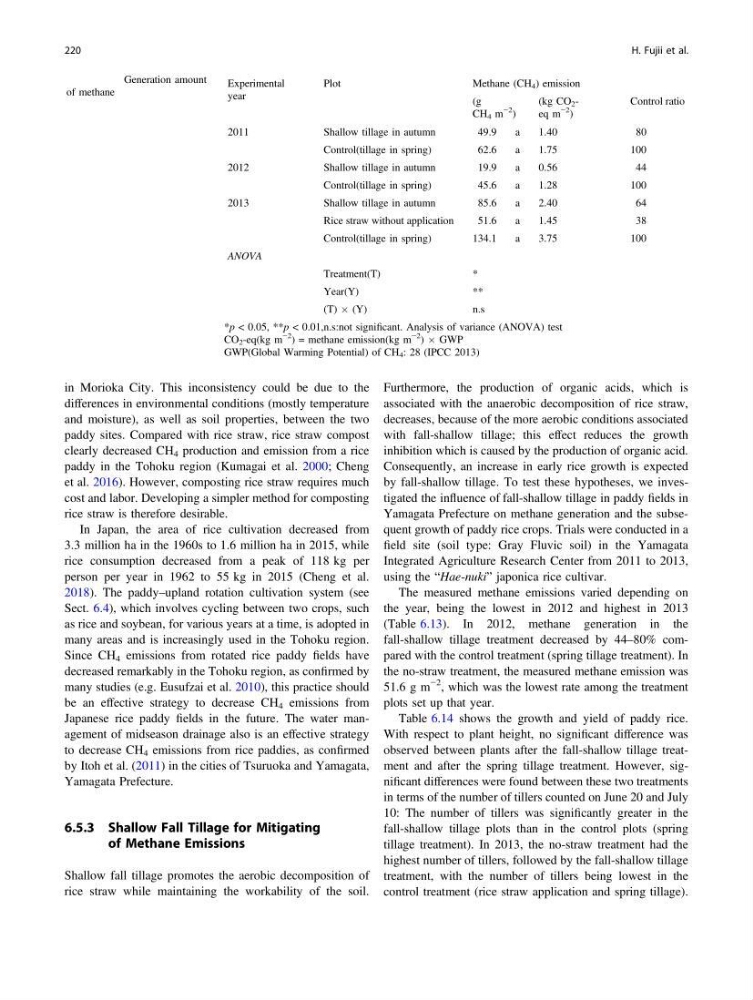
The measured methane emissions varied depending on
the year, being the lowest in 2012 and highest in 2013
(Table 6.13). In 2012, methane generation in the
fall-shallow tillage treatment decreased by 44–80% compared with the control treatment (spring tillage treatment). In
the no-straw treatment, the measured methane emission was
51.6 g m
−2 , which was the lowest rate among the treatment
plots set up that year.
Table 6.14 shows the growth and yield of paddy rice.
With respect to plant height, no significant difference was
observed between plants after the fall-shallow tillage treatment and after the spring tillage treatment. However, significant differences were found between these two treatments
in terms of the number of tillers counted on June 20 and July
10: The number of tillers was significantly greater in the
fall-shallow tillage plots than in the control plots (spring
tillage treatment). In 2013, the no-straw treatment had the
highest number of tillers, followed by the fall-shallow tillage
treatment, with the number of tillers being lowest in the
control treatment (rice straw application and spring tillage).
Table 6.13 Generation amount
of methane
Experimental
year
Plot
Methane (CH 4 ) emission
(g
CH 4 m
−2
)
(kg CO 2 -
eq m
−2
)
Control ratio
2011
Shallow tillage in autumn
49.9
a
1.40
80
Control(tillage in spring)
62.6
a
1.75
100
2012
Shallow tillage in autumn
19.9
a
0.56
44
Control(tillage in spring)
45.6
a
1.28
100
2013
Shallow tillage in autumn
85.6
a
2.40
64
Rice straw without application
51.6
a
1.45
38
Control(tillage in spring)
134.1
a
3.75
100
ANOVA
Treatment(T)
*
Year(Y)
**
(T) Â (Y)
n.s
*p < 0.05, **p < 0.01,n.s:not significant. Analysis of variance (ANOVA) test
CO 2 -eq(kg m
−2
) = methane emission(kg m
−2
) Â GWP
GWP(Global Warming Potential) of CH 4 : 28 (IPCC 2013)
220
H. Fujii et al.
differences in environmental conditions (mostly temperature
and moisture), as well as soil properties, between the two
paddy sites. Compared with rice straw, rice straw compost
clearly decreased CH 4 production and emission from a rice
paddy in the Tohoku region (Kumagai et al. 2000; Cheng
et al. 2016). However, composting rice straw requires much
cost and labor. Developing a simpler method for composting
rice straw is therefore desirable.
In Japan, the area of rice cultivation decreased from
3.3 million ha in the 1960s to 1.6 million ha in 2015, while
rice consumption decreased from a peak of 118 kg per
person per year in 1962 to 55 kg in 2015 (Cheng et al.
2018). The paddy–upland rotation cultivation system (see
Sect. 6.4), which involves cycling between two crops, such
as rice and soybean, for various years at a time, is adopted in
many areas and is increasingly used in the Tohoku region.
Since CH 4 emissions from rotated rice paddy fields have
decreased remarkably in the Tohoku region, as confirmed by
many studies (e.g. Eusufzai et al. 2010), this practice should
be an effective strategy to decrease CH 4 emissions from
Japanese rice paddy fields in the future. The water management of midseason drainage also is an effective strategy
to decrease CH 4 emissions from rice paddies, as confirmed
by Itoh et al. (2011) in the cities of Tsuruoka and Yamagata,
Yamagata Prefecture.
6.5.3 Shallow Fall Tillage for Mitigating
of Methane Emissions
Shallow fall tillage promotes the aerobic decomposition of
rice straw while maintaining the workability of the soil.
Furthermore, the production of organic acids, which is
associated with the anaerobic decomposition of rice straw,
decreases, because of the more aerobic conditions associated
with fall-shallow tillage; this effect reduces the growth
inhibition which is caused by the production of organic acid.
Consequently, an increase in early rice growth is expected
by fall-shallow tillage. To test these hypotheses, we investigated the influence of fall-shallow tillage in paddy fields in
Yamagata Prefecture on methane generation and the subsequent growth of paddy rice crops. Trials were conducted in a
field site (soil type: Gray Fluvic soil) in the Yamagata
Integrated Agriculture Research Center from 2011 to 2013,
using the “Hae-nuki” japonica rice cultivar.
The measured methane emissions varied depending on
the year, being the lowest in 2012 and highest in 2013
(Table 6.13). In 2012, methane generation in the
fall-shallow tillage treatment decreased by 44–80% compared with the control treatment (spring tillage treatment). In
the no-straw treatment, the measured methane emission was
51.6 g m
−2 , which was the lowest rate among the treatment
plots set up that year.
Table 6.14 shows the growth and yield of paddy rice.
With respect to plant height, no significant difference was
observed between plants after the fall-shallow tillage treatment and after the spring tillage treatment. However, significant differences were found between these two treatments
in terms of the number of tillers counted on June 20 and July
10: The number of tillers was significantly greater in the
fall-shallow tillage plots than in the control plots (spring
tillage treatment). In 2013, the no-straw treatment had the
highest number of tillers, followed by the fall-shallow tillage
treatment, with the number of tillers being lowest in the
control treatment (rice straw application and spring tillage).
Table 6.13 Generation amount
of methane
Experimental
year
Plot
Methane (CH 4 ) emission
(g
CH 4 m
−2
)
(kg CO 2 -
eq m
−2
)
Control ratio
2011
Shallow tillage in autumn
49.9
a
1.40
80
Control(tillage in spring)
62.6
a
1.75
100
2012
Shallow tillage in autumn
19.9
a
0.56
44
Control(tillage in spring)
45.6
a
1.28
100
2013
Shallow tillage in autumn
85.6
a
2.40
64
Rice straw without application
51.6
a
1.45
38
Control(tillage in spring)
134.1
a
3.75
100
ANOVA
Treatment(T)
*
Year(Y)
**
(T) Â (Y)
n.s
*p < 0.05, **p < 0.01,n.s:not significant. Analysis of variance (ANOVA) test
CO 2 -eq(kg m
−2
) = methane emission(kg m
−2
) Â GWP
GWP(Global Warming Potential) of CH 4 : 28 (IPCC 2013)
220
H. Fujii et al.