

Although the downstream basins of the mines once
prospered, due to the mining boom these regions have been
forced to take measures against farmland pollution since the
latter half of the twentieth century. This is the negative
legacy of the mining industry.
(1) Measures and challenges
In 1970, the Japanese government enacted the “Act to Prevent Soil Contamination on Agricultural Land”, stipulating
that contaminated rice paddies producing Cd-contaminated
rice (the reference concentration was then 1.0 mg kg
−1 in
paddy rice, but was later revised to 0.4 mg kg
−1 in 2011 in
accordance with the Codex standards) be decontaminated
through “soil dressing”. Soil dressing refers to a civil engineering technique whereby non-contaminated soil from
mountains and other places is transported to the contaminated site, where the contaminated soil is either replaced by
or covered with the non-contaminated soil.
Akita Prefecture implemented soil dressing over 1630 ha
of farmland from the 1970s through 2015, effectively
decontaminating all high Cd-contaminated lands in the
prefecture. The majority of the decontamination was
achieved through coverage soil dressing, with the thickness
of the soil dressing layer being set at 27.5 cm based on the
results of an experiment conducted to reduce Cd
concentrations in brown rice (Table 6.11), and through the
decrease of soil layer thickness by compression. Assuming a
soil bulk density of 1.0 kg L
−1 , this corresponds to a soil
volume of 2750 Mg ha
−1 .
The effect of soil dressing on the contaminated rice
paddies was outstanding, such that today the Cd concentrations in the soil and brown rice produced in this area are
negligible, 40 years after the decontamination. However, the
scarcity of humus, organic compounds, and nutrients in the
dressed soil places a heavy burden on farmers in terms of
soil development and management.
Moreover, around the areas that were subjected to
decontamination
operations,
there
are
many
low-contaminant-concentration farmlands containing concentrations of Cd that are slightly higher than the naturally
occurring levels. Performing soil dressing over all these
areas would require large amounts of non-contaminated soil
to be transported, replaced, and added, which is
cost-prohibitive, time-consuming, and thus impracticable.
To prevent Cd-contaminated rice from being produced in
such farmlands, since the 1970s Akita Prefecture has been
engaged in the development and dissemination of cultivation
techniques for suppressing Cd absorption by crops.
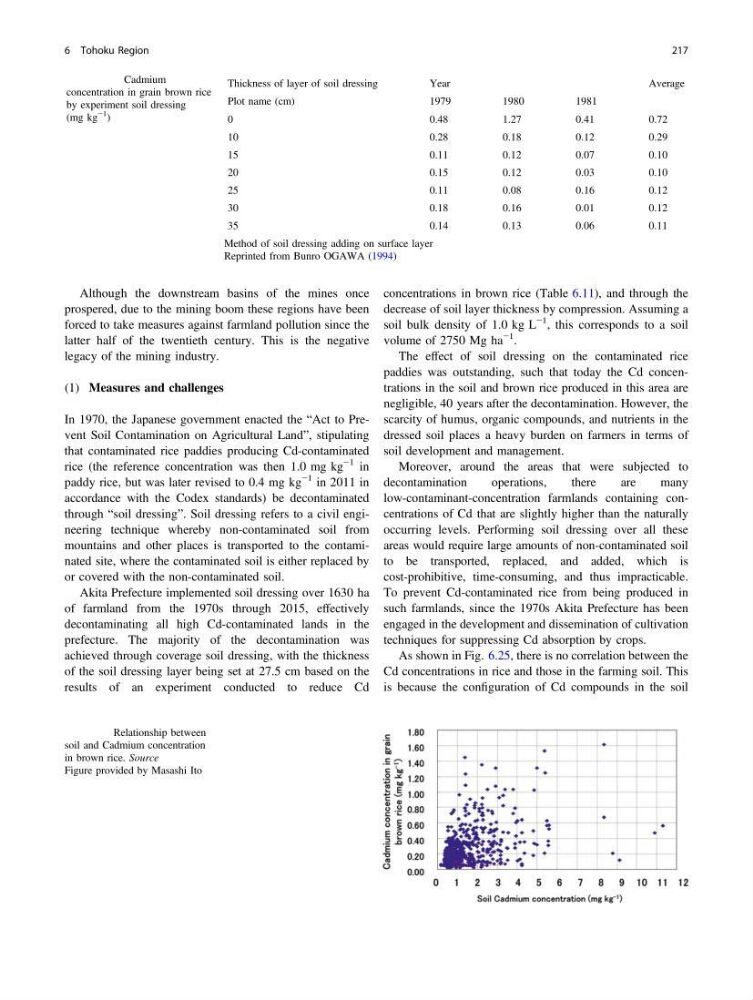
As shown in Fig. 6.25, there is no correlation between the
Cd concentrations in rice and those in the farming soil. This
is because the configuration of Cd compounds in the soil
Table 6.11 Cadmium
concentration in grain brown rice
by experiment soil dressing
(mg kg
−1 )
Thickness of layer of soil dressing
Year
Average
Plot name (cm)
1979
1980
1981
0
0.48
1.27
0.41
0.72
10
0.28
0.18
0.12
0.29
15
0.11
0.12
0.07
0.10
20
0.15
0.12
0.03
0.10
25
0.11
0.08
0.16
0.12
30
0.18
0.16
0.01
0.12
35
0.14
0.13
0.06
0.11
Method of soil dressing adding on surface layer
Reprinted from Bunro OGAWA (1994)
Fig. 6.25 Relationship between
soil and Cadmium concentration
in brown rice. Source
Figure provided by Masashi Ito
6 Tohoku Region
217
prospered, due to the mining boom these regions have been
forced to take measures against farmland pollution since the
latter half of the twentieth century. This is the negative
legacy of the mining industry.
(1) Measures and challenges
In 1970, the Japanese government enacted the “Act to Prevent Soil Contamination on Agricultural Land”, stipulating
that contaminated rice paddies producing Cd-contaminated
rice (the reference concentration was then 1.0 mg kg
−1 in
paddy rice, but was later revised to 0.4 mg kg
−1 in 2011 in
accordance with the Codex standards) be decontaminated
through “soil dressing”. Soil dressing refers to a civil engineering technique whereby non-contaminated soil from
mountains and other places is transported to the contaminated site, where the contaminated soil is either replaced by
or covered with the non-contaminated soil.
Akita Prefecture implemented soil dressing over 1630 ha
of farmland from the 1970s through 2015, effectively
decontaminating all high Cd-contaminated lands in the
prefecture. The majority of the decontamination was
achieved through coverage soil dressing, with the thickness
of the soil dressing layer being set at 27.5 cm based on the
results of an experiment conducted to reduce Cd
concentrations in brown rice (Table 6.11), and through the
decrease of soil layer thickness by compression. Assuming a
soil bulk density of 1.0 kg L
−1 , this corresponds to a soil
volume of 2750 Mg ha
−1 .
The effect of soil dressing on the contaminated rice
paddies was outstanding, such that today the Cd concentrations in the soil and brown rice produced in this area are
negligible, 40 years after the decontamination. However, the
scarcity of humus, organic compounds, and nutrients in the
dressed soil places a heavy burden on farmers in terms of
soil development and management.
Moreover, around the areas that were subjected to
decontamination
operations,
there
are
many
low-contaminant-concentration farmlands containing concentrations of Cd that are slightly higher than the naturally
occurring levels. Performing soil dressing over all these
areas would require large amounts of non-contaminated soil
to be transported, replaced, and added, which is
cost-prohibitive, time-consuming, and thus impracticable.
To prevent Cd-contaminated rice from being produced in
such farmlands, since the 1970s Akita Prefecture has been
engaged in the development and dissemination of cultivation
techniques for suppressing Cd absorption by crops.
As shown in Fig. 6.25, there is no correlation between the
Cd concentrations in rice and those in the farming soil. This
is because the configuration of Cd compounds in the soil
Table 6.11 Cadmium
concentration in grain brown rice
by experiment soil dressing
(mg kg
−1 )
Thickness of layer of soil dressing
Year
Average
Plot name (cm)
1979
1980
1981
0
0.48
1.27
0.41
0.72
10
0.28
0.18
0.12
0.29
15
0.11
0.12
0.07
0.10
20
0.15
0.12
0.03
0.10
25
0.11
0.08
0.16
0.12
30
0.18
0.16
0.01
0.12
35
0.14
0.13
0.06
0.11
Method of soil dressing adding on surface layer
Reprinted from Bunro OGAWA (1994)
Fig. 6.25 Relationship between
soil and Cadmium concentration
in brown rice. Source
Figure provided by Masashi Ito
6 Tohoku Region
217