

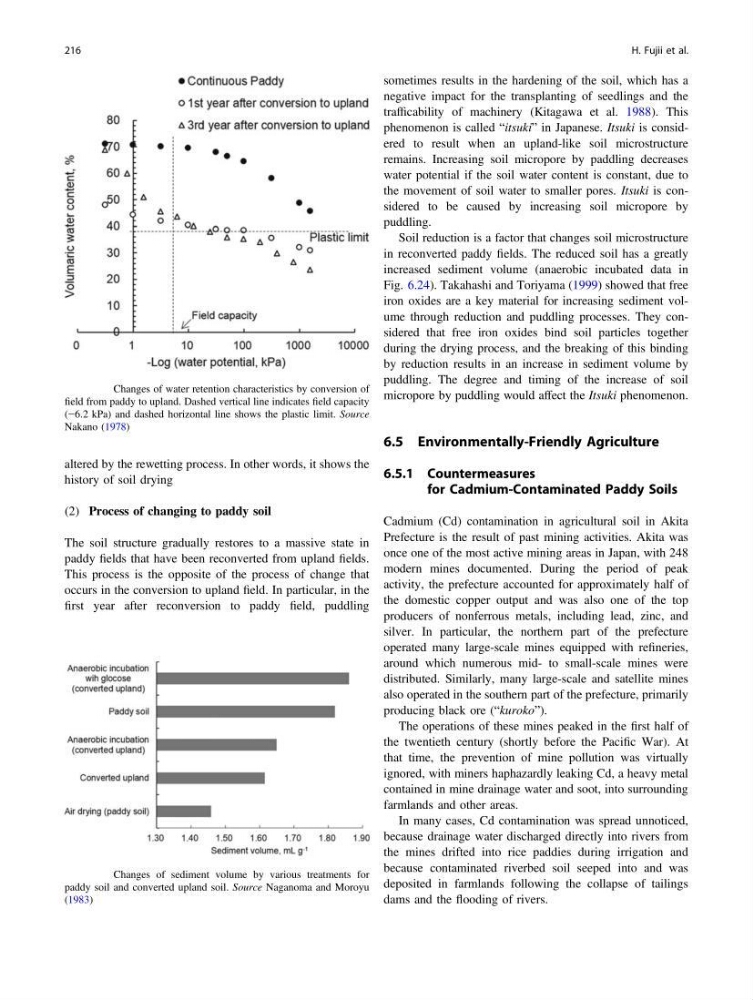
altered by the rewetting process. In other words, it shows the
history of soil drying
(2) Process of changing to paddy soil
The soil structure gradually restores to a massive state in
paddy fields that have been reconverted from upland fields.
This process is the opposite of the process of change that
occurs in the conversion to upland field. In particular, in the
first year after reconversion to paddy field, puddling
sometimes results in the hardening of the soil, which has a
negative impact for the transplanting of seedlings and the
trafficability of machinery (Kitagawa et al. 1988). This
phenomenon is called “itsuki” in Japanese. Itsuki is considered to result when an upland-like soil microstructure
remains. Increasing soil micropore by paddling decreases
water potential if the soil water content is constant, due to
the movement of soil water to smaller pores. Itsuki is considered to be caused by increasing soil micropore by
puddling.
Soil reduction is a factor that changes soil microstructure
in reconverted paddy fields. The reduced soil has a greatly
increased sediment volume (anaerobic incubated data in
Fig. 6.24). Takahashi and Toriyama (1999) showed that free
iron oxides are a key material for increasing sediment volume through reduction and puddling processes. They considered that free iron oxides bind soil particles together
during the drying process, and the breaking of this binding
by reduction results in an increase in sediment volume by
puddling. The degree and timing of the increase of soil
micropore by puddling would affect the Itsuki phenomenon.
6.5 Environmentally-Friendly Agriculture
6.5.1 Countermeasures
for Cadmium-Contaminated Paddy Soils
Cadmium (Cd) contamination in agricultural soil in Akita
Prefecture is the result of past mining activities. Akita was
once one of the most active mining areas in Japan, with 248
modern mines documented. During the period of peak
activity, the prefecture accounted for approximately half of
the domestic copper output and was also one of the top
producers of nonferrous metals, including lead, zinc, and
silver. In particular, the northern part of the prefecture
operated many large-scale mines equipped with refineries,
around which numerous mid- to small-scale mines were
distributed. Similarly, many large-scale and satellite mines
also operated in the southern part of the prefecture, primarily
producing black ore (“kuroko”).
The operations of these mines peaked in the first half of
the twentieth century (shortly before the Pacific War). At
that time, the prevention of mine pollution was virtually
ignored, with miners haphazardly leaking Cd, a heavy metal
contained in mine drainage water and soot, into surrounding
farmlands and other areas.
In many cases, Cd contamination was spread unnoticed,
because drainage water discharged directly into rivers from
the mines drifted into rice paddies during irrigation and
because contaminated riverbed soil seeped into and was
deposited in farmlands following the collapse of tailings
dams and the flooding of rivers.
Fig. 6.23 Changes of water retention characteristics by conversion of
field from paddy to upland. Dashed vertical line indicates field capacity
(−6.2 kPa) and dashed horizontal line shows the plastic limit. Source
Nakano (1978)
Fig. 6.24 Changes of sediment volume by various treatments for
paddy soil and converted upland soil. Source Naganoma and Moroyu
(1983)
216
H. Fujii et al.
history of soil drying
(2) Process of changing to paddy soil
The soil structure gradually restores to a massive state in
paddy fields that have been reconverted from upland fields.
This process is the opposite of the process of change that
occurs in the conversion to upland field. In particular, in the
first year after reconversion to paddy field, puddling
sometimes results in the hardening of the soil, which has a
negative impact for the transplanting of seedlings and the
trafficability of machinery (Kitagawa et al. 1988). This
phenomenon is called “itsuki” in Japanese. Itsuki is considered to result when an upland-like soil microstructure
remains. Increasing soil micropore by paddling decreases
water potential if the soil water content is constant, due to
the movement of soil water to smaller pores. Itsuki is considered to be caused by increasing soil micropore by
puddling.
Soil reduction is a factor that changes soil microstructure
in reconverted paddy fields. The reduced soil has a greatly
increased sediment volume (anaerobic incubated data in
Fig. 6.24). Takahashi and Toriyama (1999) showed that free
iron oxides are a key material for increasing sediment volume through reduction and puddling processes. They considered that free iron oxides bind soil particles together
during the drying process, and the breaking of this binding
by reduction results in an increase in sediment volume by
puddling. The degree and timing of the increase of soil
micropore by puddling would affect the Itsuki phenomenon.
6.5 Environmentally-Friendly Agriculture
6.5.1 Countermeasures
for Cadmium-Contaminated Paddy Soils
Cadmium (Cd) contamination in agricultural soil in Akita
Prefecture is the result of past mining activities. Akita was
once one of the most active mining areas in Japan, with 248
modern mines documented. During the period of peak
activity, the prefecture accounted for approximately half of
the domestic copper output and was also one of the top
producers of nonferrous metals, including lead, zinc, and
silver. In particular, the northern part of the prefecture
operated many large-scale mines equipped with refineries,
around which numerous mid- to small-scale mines were
distributed. Similarly, many large-scale and satellite mines
also operated in the southern part of the prefecture, primarily
producing black ore (“kuroko”).
The operations of these mines peaked in the first half of
the twentieth century (shortly before the Pacific War). At
that time, the prevention of mine pollution was virtually
ignored, with miners haphazardly leaking Cd, a heavy metal
contained in mine drainage water and soot, into surrounding
farmlands and other areas.
In many cases, Cd contamination was spread unnoticed,
because drainage water discharged directly into rivers from
the mines drifted into rice paddies during irrigation and
because contaminated riverbed soil seeped into and was
deposited in farmlands following the collapse of tailings
dams and the flooding of rivers.
Fig. 6.23 Changes of water retention characteristics by conversion of
field from paddy to upland. Dashed vertical line indicates field capacity
(−6.2 kPa) and dashed horizontal line shows the plastic limit. Source
Nakano (1978)
Fig. 6.24 Changes of sediment volume by various treatments for
paddy soil and converted upland soil. Source Naganoma and Moroyu
(1983)
216
H. Fujii et al.