

setting the target silicate absorption quantity, the following
equation was formulated: Silicate supply shortage = target
silicate absorption quantity—estimated silicate absorption
quantity. The soil silica deficiency variable enabled us to
determine the silicate fertilizer application standard by setting
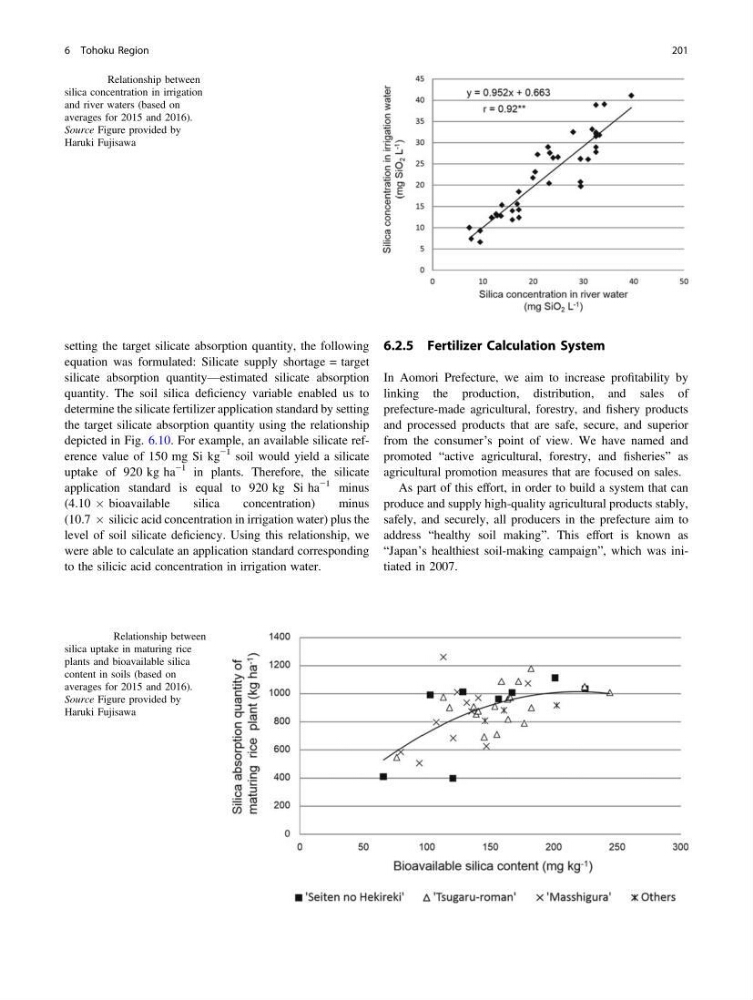
the target silicate absorption quantity using the relationship
depicted in Fig. 6.10. For example, an available silicate reference value of 150 mg Si kg
−1 soil would yield a silicate
uptake of 920 kg ha
−1 in plants. Therefore, the silicate
application standard is equal to 920 kg Si ha
−1 minus
(4.10 Â bioavailable
silica
concentration)
minus
(10.7 Â silicic acid concentration in irrigation water) plus the
level of soil silicate deficiency. Using this relationship, we
were able to calculate an application standard corresponding
to the silicic acid concentration in irrigation water.
6.2.5 Fertilizer Calculation System
In Aomori Prefecture, we aim to increase profitability by
linking the production, distribution, and sales of
prefecture-made agricultural, forestry, and fishery products
and processed products that are safe, secure, and superior
from the consumer’s point of view. We have named and
promoted “active agricultural, forestry, and fisheries” as
agricultural promotion measures that are focused on sales.
As part of this effort, in order to build a system that can
produce and supply high-quality agricultural products stably,
safely, and securely, all producers in the prefecture aim to
address “healthy soil making”. This effort is known as
“Japan’s healthiest soil-making campaign”, which was initiated in 2007.
Fig. 6.9 Relationship between
silica concentration in irrigation
and river waters (based on
averages for 2015 and 2016).
Source Figure provided by
Haruki Fujisawa
Fig. 6.10 Relationship between
silica uptake in maturing rice
plants and bioavailable silica
content in soils (based on
averages for 2015 and 2016).
Source Figure provided by
Haruki Fujisawa
6 Tohoku Region
201
equation was formulated: Silicate supply shortage = target
silicate absorption quantity—estimated silicate absorption
quantity. The soil silica deficiency variable enabled us to
determine the silicate fertilizer application standard by setting
the target silicate absorption quantity using the relationship
depicted in Fig. 6.10. For example, an available silicate reference value of 150 mg Si kg
−1 soil would yield a silicate
uptake of 920 kg ha
−1 in plants. Therefore, the silicate
application standard is equal to 920 kg Si ha
−1 minus
(4.10 Â bioavailable
silica
concentration)
minus
(10.7 Â silicic acid concentration in irrigation water) plus the
level of soil silicate deficiency. Using this relationship, we
were able to calculate an application standard corresponding
to the silicic acid concentration in irrigation water.
6.2.5 Fertilizer Calculation System
In Aomori Prefecture, we aim to increase profitability by
linking the production, distribution, and sales of
prefecture-made agricultural, forestry, and fishery products
and processed products that are safe, secure, and superior
from the consumer’s point of view. We have named and
promoted “active agricultural, forestry, and fisheries” as
agricultural promotion measures that are focused on sales.
As part of this effort, in order to build a system that can
produce and supply high-quality agricultural products stably,
safely, and securely, all producers in the prefecture aim to
address “healthy soil making”. This effort is known as
“Japan’s healthiest soil-making campaign”, which was initiated in 2007.
Fig. 6.9 Relationship between
silica concentration in irrigation
and river waters (based on
averages for 2015 and 2016).
Source Figure provided by
Haruki Fujisawa
Fig. 6.10 Relationship between
silica uptake in maturing rice
plants and bioavailable silica
content in soils (based on
averages for 2015 and 2016).
Source Figure provided by
Haruki Fujisawa
6 Tohoku Region
201