

Aomori Prefecture has defined “healthy soil making” as
follows (Aomori Prefecture 2017): An appropriate application of organic soil improvement materials, such as composts and composted animal manures, on the basis of soil
analysis for achieving soil with balanced physical, chemical,
and biological properties by conducting appropriate soil
management strategies that combine deep tillage with crop
rotation.
In 2016, the Aomori Prefecture Industrial Technology
Center developed an internet application, “Sehi Navi”,
which can be used to easily calculate the amounts of fertilizer and soil improvement materials that need to be applied
to soil. This application takes into account the appropriate
amount of soil improvement materials to be applied
according to the soil analysis results and the amount of plant
nutrients that are already present in the soil and present in the
soil improvement materials to be applied. Sehi Navi has
been released on our homepage at the following URL and
can be used free of charge: http://www.aomori-itc.or.jp/
sehisekkei/.
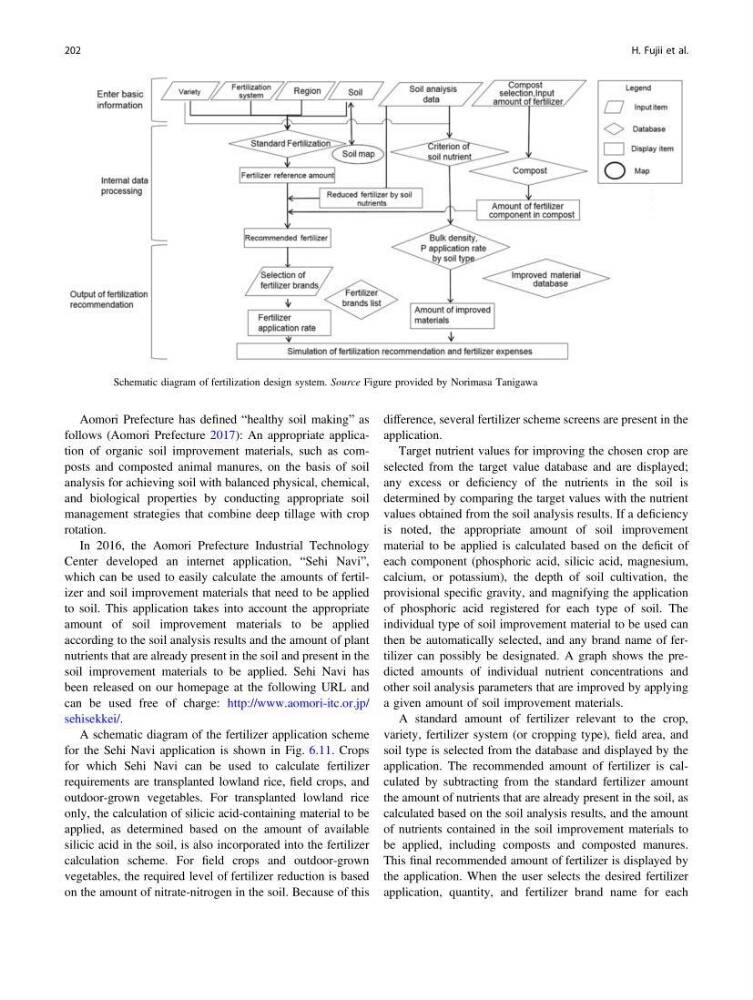
A schematic diagram of the fertilizer application scheme
for the Sehi Navi application is shown in Fig. 6.11. Crops
for which Sehi Navi can be used to calculate fertilizer
requirements are transplanted lowland rice, field crops, and
outdoor-grown vegetables. For transplanted lowland rice
only, the calculation of silicic acid-containing material to be
applied, as determined based on the amount of available
silicic acid in the soil, is also incorporated into the fertilizer
calculation scheme. For field crops and outdoor-grown
vegetables, the required level of fertilizer reduction is based
on the amount of nitrate-nitrogen in the soil. Because of this
difference, several fertilizer scheme screens are present in the
application.
Target nutrient values for improving the chosen crop are
selected from the target value database and are displayed;
any excess or deficiency of the nutrients in the soil is
determined by comparing the target values with the nutrient
values obtained from the soil analysis results. If a deficiency
is noted, the appropriate amount of soil improvement
material to be applied is calculated based on the deficit of
each component (phosphoric acid, silicic acid, magnesium,
calcium, or potassium), the depth of soil cultivation, the
provisional specific gravity, and magnifying the application
of phosphoric acid registered for each type of soil. The
individual type of soil improvement material to be used can
then be automatically selected, and any brand name of fertilizer can possibly be designated. A graph shows the predicted amounts of individual nutrient concentrations and
other soil analysis parameters that are improved by applying
a given amount of soil improvement materials.
A standard amount of fertilizer relevant to the crop,
variety, fertilizer system (or cropping type), field area, and
soil type is selected from the database and displayed by the
application. The recommended amount of fertilizer is calculated by subtracting from the standard fertilizer amount
the amount of nutrients that are already present in the soil, as
calculated based on the soil analysis results, and the amount
of nutrients contained in the soil improvement materials to
be applied, including composts and composted manures.
This final recommended amount of fertilizer is displayed by
the application. When the user selects the desired fertilizer
application, quantity, and fertilizer brand name for each
Fig. 6.11 Schematic diagram of fertilization design system. Source Figure provided by Norimasa Tanigawa
202
H. Fujii et al.
follows (Aomori Prefecture 2017): An appropriate application of organic soil improvement materials, such as composts and composted animal manures, on the basis of soil
analysis for achieving soil with balanced physical, chemical,
and biological properties by conducting appropriate soil
management strategies that combine deep tillage with crop
rotation.
In 2016, the Aomori Prefecture Industrial Technology
Center developed an internet application, “Sehi Navi”,
which can be used to easily calculate the amounts of fertilizer and soil improvement materials that need to be applied
to soil. This application takes into account the appropriate
amount of soil improvement materials to be applied
according to the soil analysis results and the amount of plant
nutrients that are already present in the soil and present in the
soil improvement materials to be applied. Sehi Navi has
been released on our homepage at the following URL and
can be used free of charge: http://www.aomori-itc.or.jp/
sehisekkei/.
A schematic diagram of the fertilizer application scheme
for the Sehi Navi application is shown in Fig. 6.11. Crops
for which Sehi Navi can be used to calculate fertilizer
requirements are transplanted lowland rice, field crops, and
outdoor-grown vegetables. For transplanted lowland rice
only, the calculation of silicic acid-containing material to be
applied, as determined based on the amount of available
silicic acid in the soil, is also incorporated into the fertilizer
calculation scheme. For field crops and outdoor-grown
vegetables, the required level of fertilizer reduction is based
on the amount of nitrate-nitrogen in the soil. Because of this
difference, several fertilizer scheme screens are present in the
application.
Target nutrient values for improving the chosen crop are
selected from the target value database and are displayed;
any excess or deficiency of the nutrients in the soil is
determined by comparing the target values with the nutrient
values obtained from the soil analysis results. If a deficiency
is noted, the appropriate amount of soil improvement
material to be applied is calculated based on the deficit of
each component (phosphoric acid, silicic acid, magnesium,
calcium, or potassium), the depth of soil cultivation, the
provisional specific gravity, and magnifying the application
of phosphoric acid registered for each type of soil. The
individual type of soil improvement material to be used can
then be automatically selected, and any brand name of fertilizer can possibly be designated. A graph shows the predicted amounts of individual nutrient concentrations and
other soil analysis parameters that are improved by applying
a given amount of soil improvement materials.
A standard amount of fertilizer relevant to the crop,
variety, fertilizer system (or cropping type), field area, and
soil type is selected from the database and displayed by the
application. The recommended amount of fertilizer is calculated by subtracting from the standard fertilizer amount
the amount of nutrients that are already present in the soil, as
calculated based on the soil analysis results, and the amount
of nutrients contained in the soil improvement materials to
be applied, including composts and composted manures.
This final recommended amount of fertilizer is displayed by
the application. When the user selects the desired fertilizer
application, quantity, and fertilizer brand name for each
Fig. 6.11 Schematic diagram of fertilization design system. Source Figure provided by Norimasa Tanigawa
202
H. Fujii et al.