

sulfate was applied by direct contact with the seedlings, an
abnormally high concentration occurred, but there was still
no injury by the CAF (coating urea), and the nitrogen
recovery rate improved significantly by 83% (Kaneta 1995).
(4) Characteristics of growth and yield
In the single application of fertilizer in a nursery box, since
the initial absorption of nitrogen by plant roots just after
transplantation is reduced, the number of tillers per plant is
lower by 10–20% compared to that in the conventional
method of fertilizer application. However, the panicle number is equivalent to that obtained in conventional fertilizer
use because of the percentage of productive tillers increases.
Therefore, excessive dressing should be avoided when using
a single application of fertilizer in a nursery box. As a result,
the yield and the esthetic quality of rice are almost the same
as those obtained in the conventional method of fertilizer
application, even if the amount of fertilizer is decreased for
the single application of fertilizer in a nursery box (Kaneta
1996; Kaneta and Tsuchiya 1997b). In the future, the spread
of technologies allowing labor-saving and low-cost, stable,
and high-quality yields, such as the single application of
fertilizer in a nursery box, is expected.
6.2.3 Effective Silicate Application Technique
In recent years, annual fluctuations in the yield and quality of
paddy rice have been increasing, and climate change is one
of the factors responsible for such fluctuations. The presence
of silicate reduces various stresses on rice plants, and it can
be expected to reduce the stress caused by climate change.
Here, we report the absorption characteristics of silicate in
paddy rice, the application technique for silicate material
based on its characteristics, and the effect of the application
of silicate material on one effect of climate change
(salt-adhesion damage).
(1) Silica application and adsorption of rice plant
This analysis of the silicate absorption rate was based on the
amount of silicate absorbed by rice plants over several
growth phases. The study was conducted in paddy fields
with soils containing different amounts of silicate in the
Shonai area of Yamagata Prefecture.
Considering the silicate absorption rate of paddy rice at
each growth stage, the absorption rate increases after the
panicle formation stage. The silicate absorption rate at each
stage is arranged in descending order as follows: Panicle
formation stage–full heading stage> Full heading stage–
maturing stage> Bearing tiller stage–panicle formation
stage> Early stage of tillering–bearing tiller stage> Transplantation stage–early stage of tillering
The silicate absorption rate of the paddy rice increases
after the panicle formation stage. This is thought to correspond to the formation of rice husks, which are the accumulation site of silicate, and also to the time when the
amount and number of roots reaches a maximum. Additionally, the amount of absorbed silicate increases after the
panicle formation stage, as the amount of silicate supplied
from the soil increases. Thus, if the supply of silicate after
the panicle formation stage is insufficient (i.e., in fields
where the content of silicate in the soil is low), it is critical to
efficiently supply silicate after this stage.
(2) Silicate application technique during the panicle
formation stage
In farmland where the supply of silicate from the soil after
the panicle formation stage is insufficient, an efficient silicate
application technology is needed that includes the topdressing of silicate material. A topdressing application of
silicate material is necessary as it is difficult to spray a large
amount of such material via basal fertilization.
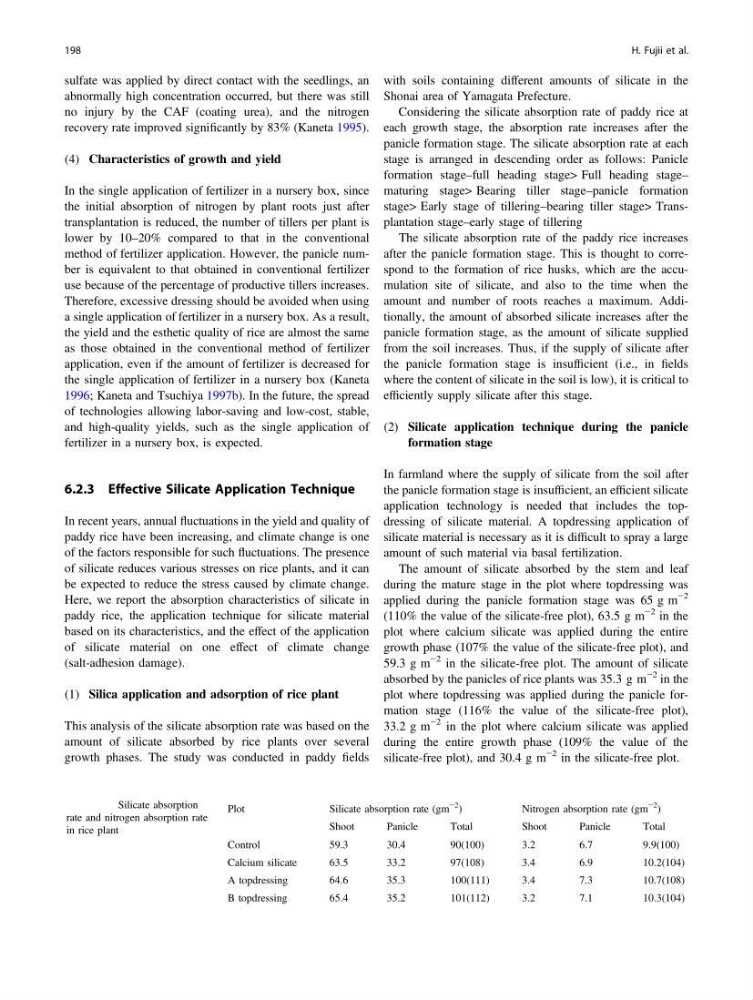
The amount of silicate absorbed by the stem and leaf
during the mature stage in the plot where topdressing was
applied during the panicle formation stage was 65 g m
−2
(110% the value of the silicate-free plot), 63.5 g m
−2 in the
plot where calcium silicate was applied during the entire
growth phase (107% the value of the silicate-free plot), and
59.3 g m
−2 in the silicate-free plot. The amount of silicate
absorbed by the panicles of rice plants was 35.3 g m
−2 in the
plot where topdressing was applied during the panicle formation stage (116% the value of the silicate-free plot),
33.2 g m
−2 in the plot where calcium silicate was applied
during the entire growth phase (109% the value of the
silicate-free plot), and 30.4 g m
−2 in the silicate-free plot.
Table 6.4 Silicate absorption
rate and nitrogen absorption rate
in rice plant
Plot
Silicate absorption rate (gm
−2
)
Nitrogen absorption rate (gm
−2
)
Shoot
Panicle
Total
Shoot
Panicle
Total
Control
59.3
30.4
90(100)
3.2
6.7
9.9(100)
Calcium silicate
63.5
33.2
97(108)
3.4
6.9
10.2(104)
A topdressing
64.6
35.3
100(111)
3.4
7.3
10.7(108)
B topdressing
65.4
35.2
101(112)
3.2
7.1
10.3(104)
198
H. Fujii et al.
abnormally high concentration occurred, but there was still
no injury by the CAF (coating urea), and the nitrogen
recovery rate improved significantly by 83% (Kaneta 1995).
(4) Characteristics of growth and yield
In the single application of fertilizer in a nursery box, since
the initial absorption of nitrogen by plant roots just after
transplantation is reduced, the number of tillers per plant is
lower by 10–20% compared to that in the conventional
method of fertilizer application. However, the panicle number is equivalent to that obtained in conventional fertilizer
use because of the percentage of productive tillers increases.
Therefore, excessive dressing should be avoided when using
a single application of fertilizer in a nursery box. As a result,
the yield and the esthetic quality of rice are almost the same
as those obtained in the conventional method of fertilizer
application, even if the amount of fertilizer is decreased for
the single application of fertilizer in a nursery box (Kaneta
1996; Kaneta and Tsuchiya 1997b). In the future, the spread
of technologies allowing labor-saving and low-cost, stable,
and high-quality yields, such as the single application of
fertilizer in a nursery box, is expected.
6.2.3 Effective Silicate Application Technique
In recent years, annual fluctuations in the yield and quality of
paddy rice have been increasing, and climate change is one
of the factors responsible for such fluctuations. The presence
of silicate reduces various stresses on rice plants, and it can
be expected to reduce the stress caused by climate change.
Here, we report the absorption characteristics of silicate in
paddy rice, the application technique for silicate material
based on its characteristics, and the effect of the application
of silicate material on one effect of climate change
(salt-adhesion damage).
(1) Silica application and adsorption of rice plant
This analysis of the silicate absorption rate was based on the
amount of silicate absorbed by rice plants over several
growth phases. The study was conducted in paddy fields
with soils containing different amounts of silicate in the
Shonai area of Yamagata Prefecture.
Considering the silicate absorption rate of paddy rice at
each growth stage, the absorption rate increases after the
panicle formation stage. The silicate absorption rate at each
stage is arranged in descending order as follows: Panicle
formation stage–full heading stage> Full heading stage–
maturing stage> Bearing tiller stage–panicle formation
stage> Early stage of tillering–bearing tiller stage> Transplantation stage–early stage of tillering
The silicate absorption rate of the paddy rice increases
after the panicle formation stage. This is thought to correspond to the formation of rice husks, which are the accumulation site of silicate, and also to the time when the
amount and number of roots reaches a maximum. Additionally, the amount of absorbed silicate increases after the
panicle formation stage, as the amount of silicate supplied
from the soil increases. Thus, if the supply of silicate after
the panicle formation stage is insufficient (i.e., in fields
where the content of silicate in the soil is low), it is critical to
efficiently supply silicate after this stage.
(2) Silicate application technique during the panicle
formation stage
In farmland where the supply of silicate from the soil after
the panicle formation stage is insufficient, an efficient silicate
application technology is needed that includes the topdressing of silicate material. A topdressing application of
silicate material is necessary as it is difficult to spray a large
amount of such material via basal fertilization.
The amount of silicate absorbed by the stem and leaf
during the mature stage in the plot where topdressing was
applied during the panicle formation stage was 65 g m
−2
(110% the value of the silicate-free plot), 63.5 g m
−2 in the
plot where calcium silicate was applied during the entire
growth phase (107% the value of the silicate-free plot), and
59.3 g m
−2 in the silicate-free plot. The amount of silicate
absorbed by the panicles of rice plants was 35.3 g m
−2 in the
plot where topdressing was applied during the panicle formation stage (116% the value of the silicate-free plot),
33.2 g m
−2 in the plot where calcium silicate was applied
during the entire growth phase (109% the value of the
silicate-free plot), and 30.4 g m
−2 in the silicate-free plot.
Table 6.4 Silicate absorption
rate and nitrogen absorption rate
in rice plant
Plot
Silicate absorption rate (gm
−2
)
Nitrogen absorption rate (gm
−2
)
Shoot
Panicle
Total
Shoot
Panicle
Total
Control
59.3
30.4
90(100)
3.2
6.7
9.9(100)
Calcium silicate
63.5
33.2
97(108)
3.4
6.9
10.2(104)
A topdressing
64.6
35.3
100(111)
3.4
7.3
10.7(108)
B topdressing
65.4
35.2
101(112)
3.2
7.1
10.3(104)
198
H. Fujii et al.