

cumulative temperature reached approximately 3500 °C.
The cumulative nitrogen release from the CAF amounted to
about 80% of its total nitrogen content at a cumulative
temperature of 2500 °C, and 92% at the maturing stage at
about 3500 °C.
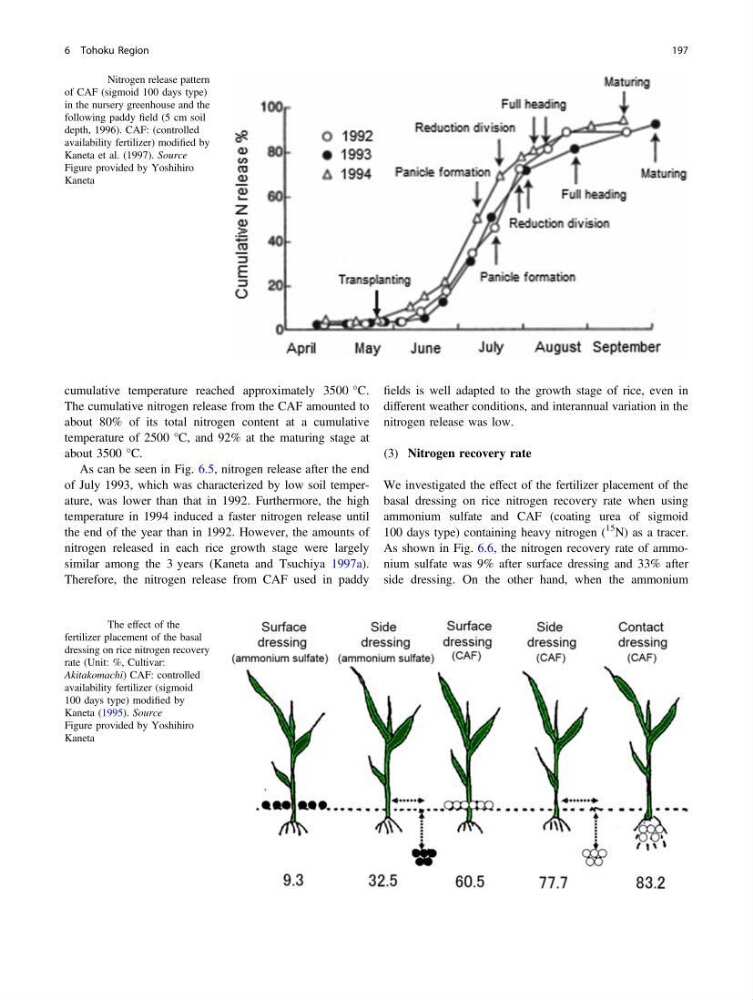
As can be seen in Fig. 6.5, nitrogen release after the end
of July 1993, which was characterized by low soil temperature, was lower than that in 1992. Furthermore, the high
temperature in 1994 induced a faster nitrogen release until
the end of the year than in 1992. However, the amounts of
nitrogen released in each rice growth stage were largely
similar among the 3 years (Kaneta and Tsuchiya 1997a).
Therefore, the nitrogen release from CAF used in paddy
fields is well adapted to the growth stage of rice, even in
different weather conditions, and interannual variation in the
nitrogen release was low.
(3) Nitrogen recovery rate
We investigated the effect of the fertilizer placement of the
basal dressing on rice nitrogen recovery rate when using
ammonium sulfate and CAF (coating urea of sigmoid
100 days type) containing heavy nitrogen (
15 N) as a tracer.
As shown in Fig. 6.6, the nitrogen recovery rate of ammonium sulfate was 9% after surface dressing and 33% after
side dressing. On the other hand, when the ammonium
Fig. 6.5 Nitrogen release pattern
of CAF (sigmoid 100 days type)
in the nursery greenhouse and the
following paddy field (5 cm soil
depth, 1996). CAF: (controlled
availability fertilizer) modified by
Kaneta et al. (1997). Source
Figure provided by Yoshihiro
Kaneta
Fig. 6.6 The effect of the
fertilizer placement of the basal
dressing on rice nitrogen recovery
rate (Unit: %, Cultivar:
Akitakomachi) CAF: controlled
availability fertilizer (sigmoid
100 days type) modified by
Kaneta (1995). Source
Figure provided by Yoshihiro
Kaneta
6 Tohoku Region
197
The cumulative nitrogen release from the CAF amounted to
about 80% of its total nitrogen content at a cumulative
temperature of 2500 °C, and 92% at the maturing stage at
about 3500 °C.
As can be seen in Fig. 6.5, nitrogen release after the end
of July 1993, which was characterized by low soil temperature, was lower than that in 1992. Furthermore, the high
temperature in 1994 induced a faster nitrogen release until
the end of the year than in 1992. However, the amounts of
nitrogen released in each rice growth stage were largely
similar among the 3 years (Kaneta and Tsuchiya 1997a).
Therefore, the nitrogen release from CAF used in paddy
fields is well adapted to the growth stage of rice, even in
different weather conditions, and interannual variation in the
nitrogen release was low.
(3) Nitrogen recovery rate
We investigated the effect of the fertilizer placement of the
basal dressing on rice nitrogen recovery rate when using
ammonium sulfate and CAF (coating urea of sigmoid
100 days type) containing heavy nitrogen (
15 N) as a tracer.
As shown in Fig. 6.6, the nitrogen recovery rate of ammonium sulfate was 9% after surface dressing and 33% after
side dressing. On the other hand, when the ammonium
Fig. 6.5 Nitrogen release pattern
of CAF (sigmoid 100 days type)
in the nursery greenhouse and the
following paddy field (5 cm soil
depth, 1996). CAF: (controlled
availability fertilizer) modified by
Kaneta et al. (1997). Source
Figure provided by Yoshihiro
Kaneta
Fig. 6.6 The effect of the
fertilizer placement of the basal
dressing on rice nitrogen recovery
rate (Unit: %, Cultivar:
Akitakomachi) CAF: controlled
availability fertilizer (sigmoid
100 days type) modified by
Kaneta (1995). Source
Figure provided by Yoshihiro
Kaneta
6 Tohoku Region
197