

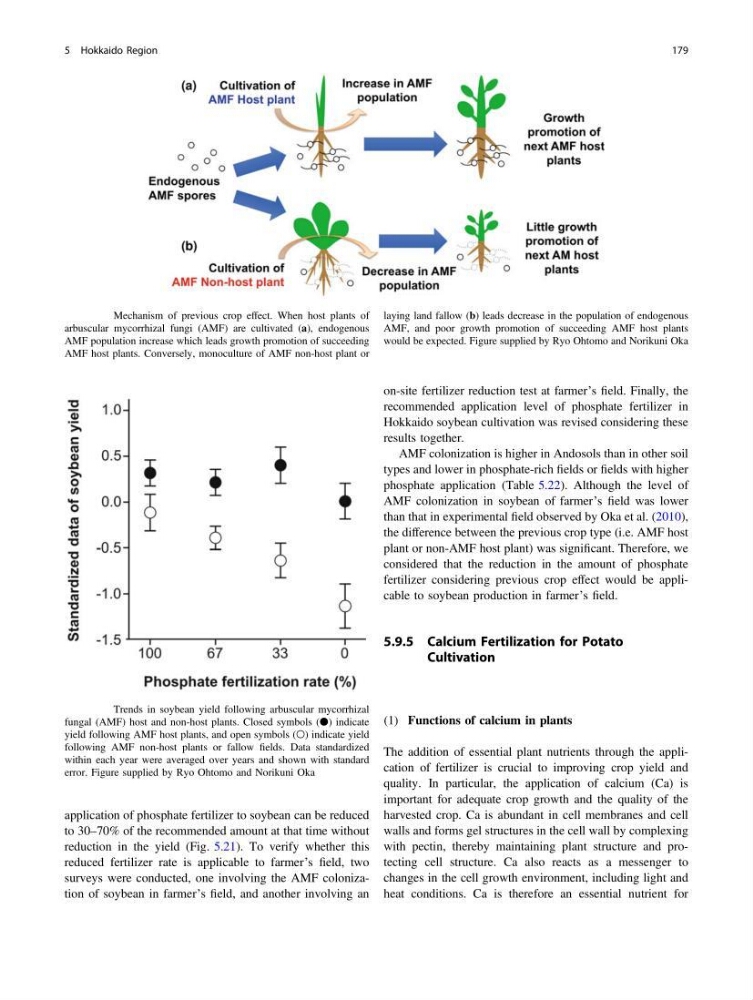
application of phosphate fertilizer to soybean can be reduced
to 30–70% of the recommended amount at that time without
reduction in the yield (Fig. 5.21). To verify whether this
reduced fertilizer rate is applicable to farmer’s field, two
surveys were conducted, one involving the AMF colonization of soybean in farmer’s field, and another involving an
on-site fertilizer reduction test at farmer’s field. Finally, the
recommended application level of phosphate fertilizer in
Hokkaido soybean cultivation was revised considering these
results together.
AMF colonization is higher in Andosols than in other soil
types and lower in phosphate-rich fields or fields with higher
phosphate application (Table 5.22). Although the level of
AMF colonization in soybean of farmer’s field was lower
than that in experimental field observed by Oka et al. (2010),
the difference between the previous crop type (i.e. AMF host
plant or non-AMF host plant) was significant. Therefore, we
considered that the reduction in the amount of phosphate
fertilizer considering previous crop effect would be applicable to soybean production in farmer’s field.
5.9.5 Calcium Fertilization for Potato
Cultivation
(1) Functions of calcium in plants
The addition of essential plant nutrients through the application of fertilizer is crucial to improving crop yield and
quality. In particular, the application of calcium (Ca) is
important for adequate crop growth and the quality of the
harvested crop. Ca is abundant in cell membranes and cell
walls and forms gel structures in the cell wall by complexing
with pectin, thereby maintaining plant structure and protecting cell structure. Ca also reacts as a messenger to
changes in the cell growth environment, including light and
heat conditions. Ca is therefore an essential nutrient for
Fig. 5.20 Mechanism of previous crop effect. When host plants of
arbuscular mycorrhizal fungi (AMF) are cultivated (a), endogenous
AMF population increase which leads growth promotion of succeeding
AMF host plants. Conversely, monoculture of AMF non-host plant or
laying land fallow (b) leads decrease in the population of endogenous
AMF, and poor growth promotion of succeeding AMF host plants
would be expected. Figure supplied by Ryo Ohtomo and Norikuni Oka
Fig. 5.21 Trends in soybean yield following arbuscular mycorrhizal
fungal (AMF) host and non-host plants. Closed symbols (●) indicate
yield following AMF host plants, and open symbols (○) indicate yield
following AMF non-host plants or fallow fields. Data standardized
within each year were averaged over years and shown with standard
error. Figure supplied by Ryo Ohtomo and Norikuni Oka
5 Hokkaido Region
179
to 30–70% of the recommended amount at that time without
reduction in the yield (Fig. 5.21). To verify whether this
reduced fertilizer rate is applicable to farmer’s field, two
surveys were conducted, one involving the AMF colonization of soybean in farmer’s field, and another involving an
on-site fertilizer reduction test at farmer’s field. Finally, the
recommended application level of phosphate fertilizer in
Hokkaido soybean cultivation was revised considering these
results together.
AMF colonization is higher in Andosols than in other soil
types and lower in phosphate-rich fields or fields with higher
phosphate application (Table 5.22). Although the level of
AMF colonization in soybean of farmer’s field was lower
than that in experimental field observed by Oka et al. (2010),
the difference between the previous crop type (i.e. AMF host
plant or non-AMF host plant) was significant. Therefore, we
considered that the reduction in the amount of phosphate
fertilizer considering previous crop effect would be applicable to soybean production in farmer’s field.
5.9.5 Calcium Fertilization for Potato
Cultivation
(1) Functions of calcium in plants
The addition of essential plant nutrients through the application of fertilizer is crucial to improving crop yield and
quality. In particular, the application of calcium (Ca) is
important for adequate crop growth and the quality of the
harvested crop. Ca is abundant in cell membranes and cell
walls and forms gel structures in the cell wall by complexing
with pectin, thereby maintaining plant structure and protecting cell structure. Ca also reacts as a messenger to
changes in the cell growth environment, including light and
heat conditions. Ca is therefore an essential nutrient for
Fig. 5.20 Mechanism of previous crop effect. When host plants of
arbuscular mycorrhizal fungi (AMF) are cultivated (a), endogenous
AMF population increase which leads growth promotion of succeeding
AMF host plants. Conversely, monoculture of AMF non-host plant or
laying land fallow (b) leads decrease in the population of endogenous
AMF, and poor growth promotion of succeeding AMF host plants
would be expected. Figure supplied by Ryo Ohtomo and Norikuni Oka
Fig. 5.21 Trends in soybean yield following arbuscular mycorrhizal
fungal (AMF) host and non-host plants. Closed symbols (●) indicate
yield following AMF host plants, and open symbols (○) indicate yield
following AMF non-host plants or fallow fields. Data standardized
within each year were averaged over years and shown with standard
error. Figure supplied by Ryo Ohtomo and Norikuni Oka
5 Hokkaido Region
179