

(2) Soil frost control
This method needs to balance (i.e. optimize) the following
two conflicting objectives: (1) allow sufficiently deep frost
penetration to kill the potato tubers and (2) keep the frost
depth shallow enough so that it does not cause a delay in
seeding or negatively impact the growth of overwintering
crops. To solve this optimization problem, a method was
developed to manipulate soil frost depths, by artificially
controlling snow cover thickness; this was guided by a
simple numerical model that simulates the soil
freezing-thawing processes using daily mean air temperature
and snow cover thickness as input variables. The optimum
soil frost depth was founded to be 0.3 m, which is a compromise between the elimination of volunteer potatoes and a
minimum frost depth to prevent negative effects on agriculture. Soil frost depth can be controlled by adjusting the
timing and duration of thick snow cover that insulates the
soil surface during cold periods. To achieve the optimal frost
depth, the duration of treatment (i.e. snow removal and
subsequent re-deposition or natural accumulation) was predicted using a simple numerical soil temperature model that
required only daily mean air temperature and snow depth as
input variables. The soil frost control remarkably decreased
potato tuber survival to less than 0.5% of unharvested tubers.
This soil frost control method is expected to be most
effective in regions which have a mean air temperature
during December to February of between −12 and −5 °C. In
the Tokachi area, a Web-based decision-making system for
soil frost control for volunteer potato management has been
disseminated. Snow plowing has been used widely by producers in Tokachi, and the large-scale operation of this
practice can now be optimized by the real-time prediction of
frost depths using the efficient and robust soil frost model
(Hirota et al. 2011; Hirota et al. 2013; Yazaki et al. 2013).
5.9.4 Use of Arbuscular Mycorrhizal Fungi
Arbuscular mycorrhizal fungi (AMF) colonize plant roots as
obligate symbionts and enhance the water and nutrient
uptake of their host. The Japanese Government has designated AMF inoculum as a soil improvement material to
improve soil function by providing phosphate nutrition to
plants. The maximum utilization of AMF in agriculture is
expected.
In soybean or field corn cultivation in Hokkaido, it has
been recognized that yield of the crop grown after AMF host
plants is generally higher than that grown after non-AMF
host plants. This phenomenon is known as the previous crop
effect (Arihara and Karasawa 2000; Fig. 5.20). Using this
previous crop effect, Oka et al. (2010) indicated that the
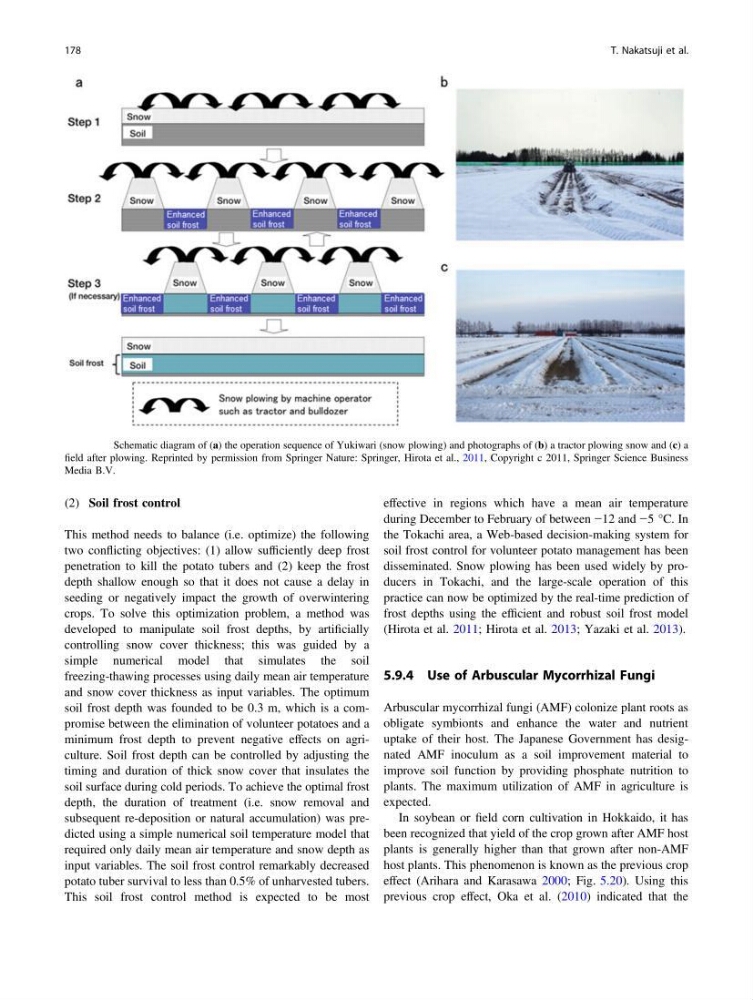
Fig. 5.19 Schematic diagram of (a) the operation sequence of Yukiwari (snow plowing) and photographs of (b) a tractor plowing snow and (c) a
field after plowing. Reprinted by permission from Springer Nature: Springer, Hirota et al., 2011, Copyright c 2011, Springer Science Business
Media B.V.
178
T. Nakatsuji et al.
This method needs to balance (i.e. optimize) the following
two conflicting objectives: (1) allow sufficiently deep frost
penetration to kill the potato tubers and (2) keep the frost
depth shallow enough so that it does not cause a delay in
seeding or negatively impact the growth of overwintering
crops. To solve this optimization problem, a method was
developed to manipulate soil frost depths, by artificially
controlling snow cover thickness; this was guided by a
simple numerical model that simulates the soil
freezing-thawing processes using daily mean air temperature
and snow cover thickness as input variables. The optimum
soil frost depth was founded to be 0.3 m, which is a compromise between the elimination of volunteer potatoes and a
minimum frost depth to prevent negative effects on agriculture. Soil frost depth can be controlled by adjusting the
timing and duration of thick snow cover that insulates the
soil surface during cold periods. To achieve the optimal frost
depth, the duration of treatment (i.e. snow removal and
subsequent re-deposition or natural accumulation) was predicted using a simple numerical soil temperature model that
required only daily mean air temperature and snow depth as
input variables. The soil frost control remarkably decreased
potato tuber survival to less than 0.5% of unharvested tubers.
This soil frost control method is expected to be most
effective in regions which have a mean air temperature
during December to February of between −12 and −5 °C. In
the Tokachi area, a Web-based decision-making system for
soil frost control for volunteer potato management has been
disseminated. Snow plowing has been used widely by producers in Tokachi, and the large-scale operation of this
practice can now be optimized by the real-time prediction of
frost depths using the efficient and robust soil frost model
(Hirota et al. 2011; Hirota et al. 2013; Yazaki et al. 2013).
5.9.4 Use of Arbuscular Mycorrhizal Fungi
Arbuscular mycorrhizal fungi (AMF) colonize plant roots as
obligate symbionts and enhance the water and nutrient
uptake of their host. The Japanese Government has designated AMF inoculum as a soil improvement material to
improve soil function by providing phosphate nutrition to
plants. The maximum utilization of AMF in agriculture is
expected.
In soybean or field corn cultivation in Hokkaido, it has
been recognized that yield of the crop grown after AMF host
plants is generally higher than that grown after non-AMF
host plants. This phenomenon is known as the previous crop
effect (Arihara and Karasawa 2000; Fig. 5.20). Using this
previous crop effect, Oka et al. (2010) indicated that the
Fig. 5.19 Schematic diagram of (a) the operation sequence of Yukiwari (snow plowing) and photographs of (b) a tractor plowing snow and (c) a
field after plowing. Reprinted by permission from Springer Nature: Springer, Hirota et al., 2011, Copyright c 2011, Springer Science Business
Media B.V.
178
T. Nakatsuji et al.