

manure for many years. However, the continuous application of manure can allow the supplementary application rates
of chemical fertilizer to be reduced over the years in the
manure plots because of increasing soil nitrogen availability.
This may mitigate N 2 O emissions (Mori and Hojito 2012).
(4) The effect of manure application on GWP
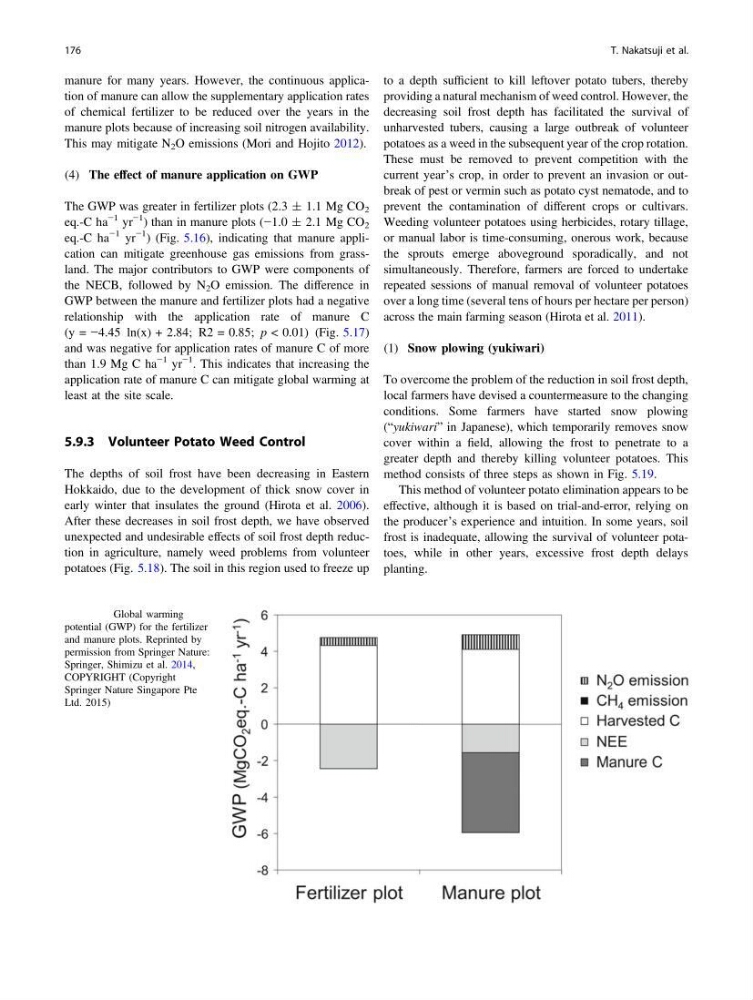
The GWP was greater in fertilizer plots (2.3 ± 1.1 Mg CO 2
eq.-C ha
−1 yr
−1 ) than in manure plots (−1.0 ± 2.1 Mg CO 2
eq.-C ha
−1 yr
−1 ) (Fig. 5.16), indicating that manure application can mitigate greenhouse gas emissions from grassland. The major contributors to GWP were components of
the NECB, followed by N 2 O emission. The difference in
GWP between the manure and fertilizer plots had a negative
relationship with the application rate of manure C
(y = −4.45 ln(x) + 2.84; R2 = 0.85; p < 0.01) (Fig. 5.17)
and was negative for application rates of manure C of more
than 1.9 Mg C ha
−1 yr
−1 . This indicates that increasing the
application rate of manure C can mitigate global warming at
least at the site scale.
5.9.3 Volunteer Potato Weed Control
The depths of soil frost have been decreasing in Eastern
Hokkaido, due to the development of thick snow cover in
early winter that insulates the ground (Hirota et al. 2006).
After these decreases in soil frost depth, we have observed
unexpected and undesirable effects of soil frost depth reduction in agriculture, namely weed problems from volunteer
potatoes (Fig. 5.18). The soil in this region used to freeze up
to a depth sufficient to kill leftover potato tubers, thereby
providing a natural mechanism of weed control. However, the
decreasing soil frost depth has facilitated the survival of
unharvested tubers, causing a large outbreak of volunteer
potatoes as a weed in the subsequent year of the crop rotation.
These must be removed to prevent competition with the
current year’s crop, in order to prevent an invasion or outbreak of pest or vermin such as potato cyst nematode, and to
prevent the contamination of different crops or cultivars.
Weeding volunteer potatoes using herbicides, rotary tillage,
or manual labor is time-consuming, onerous work, because
the sprouts emerge aboveground sporadically, and not
simultaneously. Therefore, farmers are forced to undertake
repeated sessions of manual removal of volunteer potatoes
over a long time (several tens of hours per hectare per person)
across the main farming season (Hirota et al. 2011).
(1) Snow plowing (yukiwari)
To overcome the problem of the reduction in soil frost depth,
local farmers have devised a countermeasure to the changing
conditions. Some farmers have started snow plowing
(“yukiwari” in Japanese), which temporarily removes snow
cover within a field, allowing the frost to penetrate to a
greater depth and thereby killing volunteer potatoes. This
method consists of three steps as shown in Fig. 5.19.
This method of volunteer potato elimination appears to be
effective, although it is based on trial-and-error, relying on
the producer’s experience and intuition. In some years, soil
frost is inadequate, allowing the survival of volunteer potatoes, while in other years, excessive frost depth delays
planting.
Fig. 5.16 Global warming
potential (GWP) for the fertilizer
and manure plots. Reprinted by
permission from Springer Nature:
Springer, Shimizu et al. 2014,
COPYRIGHT (Copyright
Springer Nature Singapore Pte
Ltd. 2015)
176
T. Nakatsuji et al.
of chemical fertilizer to be reduced over the years in the
manure plots because of increasing soil nitrogen availability.
This may mitigate N 2 O emissions (Mori and Hojito 2012).
(4) The effect of manure application on GWP
The GWP was greater in fertilizer plots (2.3 ± 1.1 Mg CO 2
eq.-C ha
−1 yr
−1 ) than in manure plots (−1.0 ± 2.1 Mg CO 2
eq.-C ha
−1 yr
−1 ) (Fig. 5.16), indicating that manure application can mitigate greenhouse gas emissions from grassland. The major contributors to GWP were components of
the NECB, followed by N 2 O emission. The difference in
GWP between the manure and fertilizer plots had a negative
relationship with the application rate of manure C
(y = −4.45 ln(x) + 2.84; R2 = 0.85; p < 0.01) (Fig. 5.17)
and was negative for application rates of manure C of more
than 1.9 Mg C ha
−1 yr
−1 . This indicates that increasing the
application rate of manure C can mitigate global warming at
least at the site scale.
5.9.3 Volunteer Potato Weed Control
The depths of soil frost have been decreasing in Eastern
Hokkaido, due to the development of thick snow cover in
early winter that insulates the ground (Hirota et al. 2006).
After these decreases in soil frost depth, we have observed
unexpected and undesirable effects of soil frost depth reduction in agriculture, namely weed problems from volunteer
potatoes (Fig. 5.18). The soil in this region used to freeze up
to a depth sufficient to kill leftover potato tubers, thereby
providing a natural mechanism of weed control. However, the
decreasing soil frost depth has facilitated the survival of
unharvested tubers, causing a large outbreak of volunteer
potatoes as a weed in the subsequent year of the crop rotation.
These must be removed to prevent competition with the
current year’s crop, in order to prevent an invasion or outbreak of pest or vermin such as potato cyst nematode, and to
prevent the contamination of different crops or cultivars.
Weeding volunteer potatoes using herbicides, rotary tillage,
or manual labor is time-consuming, onerous work, because
the sprouts emerge aboveground sporadically, and not
simultaneously. Therefore, farmers are forced to undertake
repeated sessions of manual removal of volunteer potatoes
over a long time (several tens of hours per hectare per person)
across the main farming season (Hirota et al. 2011).
(1) Snow plowing (yukiwari)
To overcome the problem of the reduction in soil frost depth,
local farmers have devised a countermeasure to the changing
conditions. Some farmers have started snow plowing
(“yukiwari” in Japanese), which temporarily removes snow
cover within a field, allowing the frost to penetrate to a
greater depth and thereby killing volunteer potatoes. This
method consists of three steps as shown in Fig. 5.19.
This method of volunteer potato elimination appears to be
effective, although it is based on trial-and-error, relying on
the producer’s experience and intuition. In some years, soil
frost is inadequate, allowing the survival of volunteer potatoes, while in other years, excessive frost depth delays
planting.
Fig. 5.16 Global warming
potential (GWP) for the fertilizer
and manure plots. Reprinted by
permission from Springer Nature:
Springer, Shimizu et al. 2014,
COPYRIGHT (Copyright
Springer Nature Singapore Pte
Ltd. 2015)
176
T. Nakatsuji et al.