

(170) and paddy fields (159). Additionally, the average
amount of nitrogen input from municipal fertilizer, manure,
and so on was found to be 185 kg N ha
−1 for the whole of
Hokkaido. The highest average nitrogen input was found in
mixed upland crop/dairy areas (224 kg N ha
−1 ), followed by
grassland (213), upland crop (190), and paddy field (151).
The excess amount of nitrogen, which is the difference
between nitrogen input and nitrogen assimilation capacity,
was on the order of 2 kg N ha
−1 on average for the whole of
Hokkaido. The largest amount of excess nitrogen was
observed in mixed upland field/dairy areas (24 kg N ha
−1 ),
followed by upland farming (20), paddy field (−8), and
grassland (−12). Furthermore, the authors considered the
relationship between the NO 3 -N concentration in the
groundwater and the excess nitrogen amount with reference
to the above well measurement result. No significant relationship was found for the grassland and paddy field areas,
whereas a significant positive relationship was found for the
upland field areas. This indicates that agriculture affects
groundwater NO 3 -N concentrations in upland field areas.
(3) Impact of heavy metals
(1) Heavy metal concentrations of soils and soil
amendments
The cadmium concentration in non-polluted soils in Japan is
0.30 mg kg
−1 (Asami et al. 1988), and the median value of
typical domestic soil is 0.27 mg kg
−1 (Yamazaki et al.
2009). Compared to these, the cadmium concentrations in
soils in Hokkaido are lower (Table 5.16). Comparing heavy
metal concentrations of cultivated soils and non-cultivated
soils in Hokkaido, most of the levels are higher in cultivated
soils, especially orchard soils (Table 5.16). This can be
attributed to the loading of heavy metals from the application
of agricultural materials.
The concentrations of heavy metals in organic materials
used for agriculture and fertilizers have been determined
(Table 5.17). Zinc and copper are present in high amounts in
pig manure, sewage sludge, and compost made from these
materials. Copper is also contained in pesticides such as
Bordeaux mixture. The main loads of cadmium are due to
phosphate fertilizer, compost, and sewage sludge. Large
amounts of squid and scallop are fished in Hokkaido, and a
large amount of fishery waste is generated; this waste
includes the digestive glands of squid and mid-gut glands of
scallop, which have high cadmium concentrations. Starfish,
which are caught together with scallops, also contain high
levels of cadmium. As such, compost and fertilizer which
use such fishery wastes as raw materials also have high
cadmium concentrations (Furudate and Otobe 2009). The
load of lead (Pb) is due to paint and leaded gasoline. Lead
concentrations in orchard soil may have increased as a result
of the application of lead-containing pesticide in the past.
Arsenic (in the form of lead arsenate, calcium arsenate, and
organoarsenic compounds) was also used in pesticides in the
past. Currently, it seems that the arsenic load derived from
pesticide is small. However, organoarsenic compounds are
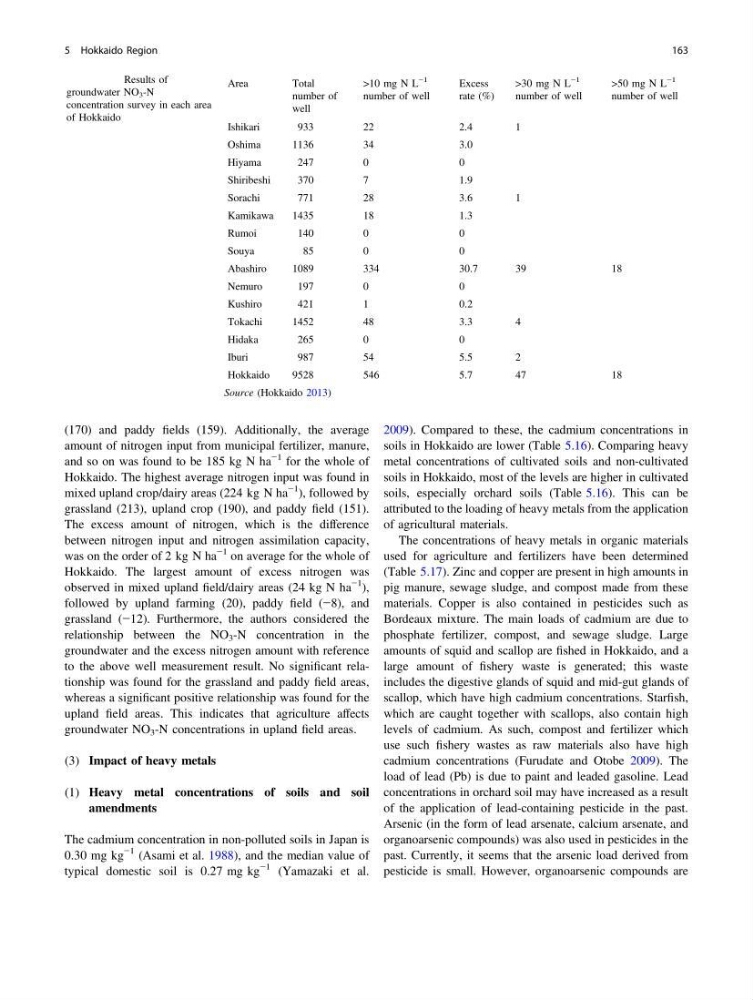
Table 5.15 Results of
groundwater NO 3 -N
concentration survey in each area
of Hokkaido
Area
Total
number of
well
>10 mg N L
−1
number of well
Excess
rate (%)
>30 mg N L
−1
number of well
>50 mg N L
−1
number of well
Ishikari
933
22
2.4
1
Oshima
1136
34
3.0
Hiyama
247
0
0
Shiribeshi
370
7
1.9
Sorachi
771
28
3.6
1
Kamikawa
1435
18
1.3
Rumoi
140
0
0
Souya
85
0
0
Abashiro
1089
334
30.7
39
18
Nemuro
197
0
0
Kushiro
421
1
0.2
Tokachi
1452
48
3.3
4
Hidaka
265
0
0
Iburi
987
54
5.5
2
Hokkaido
9528
546
5.7
47
18
Source (Hokkaido 2013)
5 Hokkaido Region
163
amount of nitrogen input from municipal fertilizer, manure,
and so on was found to be 185 kg N ha
−1 for the whole of
Hokkaido. The highest average nitrogen input was found in
mixed upland crop/dairy areas (224 kg N ha
−1 ), followed by
grassland (213), upland crop (190), and paddy field (151).
The excess amount of nitrogen, which is the difference
between nitrogen input and nitrogen assimilation capacity,
was on the order of 2 kg N ha
−1 on average for the whole of
Hokkaido. The largest amount of excess nitrogen was
observed in mixed upland field/dairy areas (24 kg N ha
−1 ),
followed by upland farming (20), paddy field (−8), and
grassland (−12). Furthermore, the authors considered the
relationship between the NO 3 -N concentration in the
groundwater and the excess nitrogen amount with reference
to the above well measurement result. No significant relationship was found for the grassland and paddy field areas,
whereas a significant positive relationship was found for the
upland field areas. This indicates that agriculture affects
groundwater NO 3 -N concentrations in upland field areas.
(3) Impact of heavy metals
(1) Heavy metal concentrations of soils and soil
amendments
The cadmium concentration in non-polluted soils in Japan is
0.30 mg kg
−1 (Asami et al. 1988), and the median value of
typical domestic soil is 0.27 mg kg
−1 (Yamazaki et al.
2009). Compared to these, the cadmium concentrations in
soils in Hokkaido are lower (Table 5.16). Comparing heavy
metal concentrations of cultivated soils and non-cultivated
soils in Hokkaido, most of the levels are higher in cultivated
soils, especially orchard soils (Table 5.16). This can be
attributed to the loading of heavy metals from the application
of agricultural materials.
The concentrations of heavy metals in organic materials
used for agriculture and fertilizers have been determined
(Table 5.17). Zinc and copper are present in high amounts in
pig manure, sewage sludge, and compost made from these
materials. Copper is also contained in pesticides such as
Bordeaux mixture. The main loads of cadmium are due to
phosphate fertilizer, compost, and sewage sludge. Large
amounts of squid and scallop are fished in Hokkaido, and a
large amount of fishery waste is generated; this waste
includes the digestive glands of squid and mid-gut glands of
scallop, which have high cadmium concentrations. Starfish,
which are caught together with scallops, also contain high
levels of cadmium. As such, compost and fertilizer which
use such fishery wastes as raw materials also have high
cadmium concentrations (Furudate and Otobe 2009). The
load of lead (Pb) is due to paint and leaded gasoline. Lead
concentrations in orchard soil may have increased as a result
of the application of lead-containing pesticide in the past.
Arsenic (in the form of lead arsenate, calcium arsenate, and
organoarsenic compounds) was also used in pesticides in the
past. Currently, it seems that the arsenic load derived from
pesticide is small. However, organoarsenic compounds are
Table 5.15 Results of
groundwater NO 3 -N
concentration survey in each area
of Hokkaido
Area
Total
number of
well
>10 mg N L
−1
number of well
Excess
rate (%)
>30 mg N L
−1
number of well
>50 mg N L
−1
number of well
Ishikari
933
22
2.4
1
Oshima
1136
34
3.0
Hiyama
247
0
0
Shiribeshi
370
7
1.9
Sorachi
771
28
3.6
1
Kamikawa
1435
18
1.3
Rumoi
140
0
0
Souya
85
0
0
Abashiro
1089
334
30.7
39
18
Nemuro
197
0
0
Kushiro
421
1
0.2
Tokachi
1452
48
3.3
4
Hidaka
265
0
0
Iburi
987
54
5.5
2
Hokkaido
9528
546
5.7
47
18
Source (Hokkaido 2013)
5 Hokkaido Region
163