

(3) Nitrous oxide (N 2 O)
In cultivated lands, N 2 O is produced by soil microbial processes (nitrification and denitrification) and is directly
emitted to the atmosphere (Fig. 5.10). Nitrous oxide produced in soil is also indirectly emitted through soil water
drainage (Fig. 5.10). The factors controlling N 2 O production
are soil moisture, soil temperature, mineral N content in the
soil, N fertilization rate, and so on.
The area of upland field (for crops and vegetables) and
grassland in Hokkaido is 416,000 ha (36.5% of the total upland field area in Japan) and 503,000 ha (83.8% of the total
grassland area in Japan), respectively. Emission factors (kg
N 2 O-N/kg N) for direct N 2 O emission are estimated to be
0.0062 ± 0.0048 for all the fields (excluding rice paddy
fields) in Japan and are relatively higher for poorly drained
fields (Akiyama et al. 2006). In Hokkaido, high N 2 O emissions have been observed in summer and autumn, probably
due to the denitrification process triggered by abundant rainfall
(Kusa et al. 2002; Katayanagi et al. 2008). Some measures
have been proposed to mitigate N 2 O emission by the efficient
application of N without reducing crop production.
(4) Ammonia (NH 3 )
In Hokkaido, it is estimated that as much as 112 Gg N
(36.5% of the total in Japan) is emitted annually through
livestock animal waste, which is equal to a load of 96 kg N
per hectare of cultivated land.
Ammonia volatilization from N in chemical fertilizer is
negligible in Hokkaido because alkali soils are not widely
distributed there. Thus, almost all ammonia volatilization in
Hokkaido originates from livestock manure. The volatilization rate can be controlled by the manure application
method, manure pH, type of manure, wind speed, temperature, and soil moisture. Mitigating ammonia volatilization is
important for environmental conservation. Management for
enhancing the nutrient utilization is also essential because
the NH 3 remaining in the manure may lead to higher nitrate
leaching and N 2 O emissions.
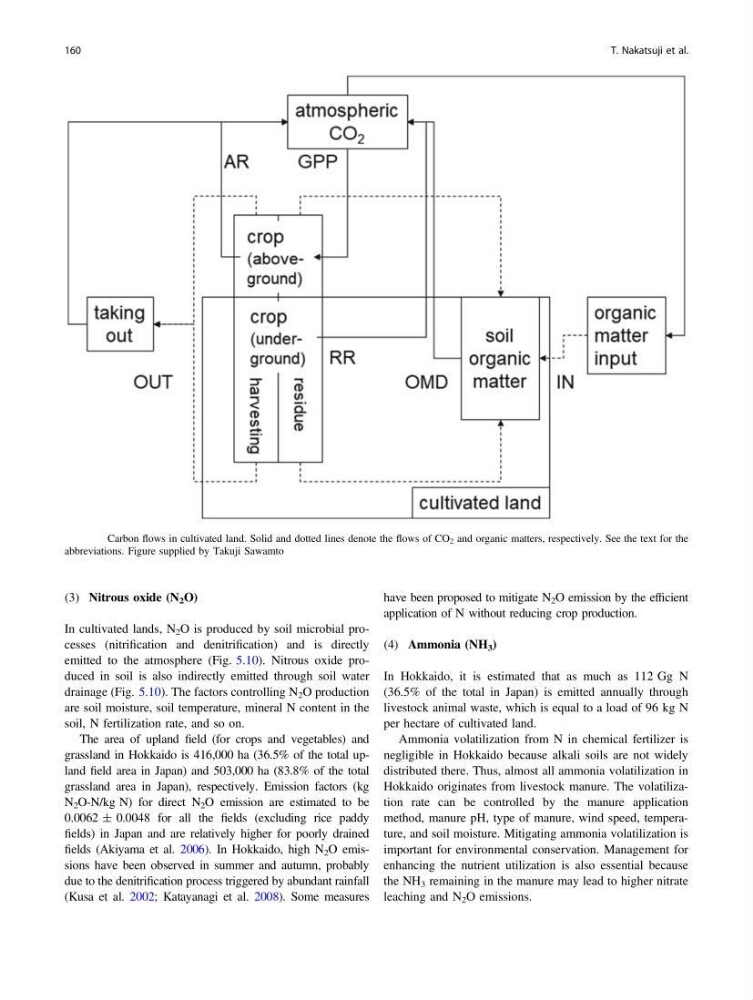
Fig. 5.9 Carbon flows in cultivated land. Solid and dotted lines denote the flows of CO 2 and organic matters, respectively. See the text for the
abbreviations. Figure supplied by Takuji Sawamto
160
T. Nakatsuji et al.
In cultivated lands, N 2 O is produced by soil microbial processes (nitrification and denitrification) and is directly
emitted to the atmosphere (Fig. 5.10). Nitrous oxide produced in soil is also indirectly emitted through soil water
drainage (Fig. 5.10). The factors controlling N 2 O production
are soil moisture, soil temperature, mineral N content in the
soil, N fertilization rate, and so on.
The area of upland field (for crops and vegetables) and
grassland in Hokkaido is 416,000 ha (36.5% of the total upland field area in Japan) and 503,000 ha (83.8% of the total
grassland area in Japan), respectively. Emission factors (kg
N 2 O-N/kg N) for direct N 2 O emission are estimated to be
0.0062 ± 0.0048 for all the fields (excluding rice paddy
fields) in Japan and are relatively higher for poorly drained
fields (Akiyama et al. 2006). In Hokkaido, high N 2 O emissions have been observed in summer and autumn, probably
due to the denitrification process triggered by abundant rainfall
(Kusa et al. 2002; Katayanagi et al. 2008). Some measures
have been proposed to mitigate N 2 O emission by the efficient
application of N without reducing crop production.
(4) Ammonia (NH 3 )
In Hokkaido, it is estimated that as much as 112 Gg N
(36.5% of the total in Japan) is emitted annually through
livestock animal waste, which is equal to a load of 96 kg N
per hectare of cultivated land.
Ammonia volatilization from N in chemical fertilizer is
negligible in Hokkaido because alkali soils are not widely
distributed there. Thus, almost all ammonia volatilization in
Hokkaido originates from livestock manure. The volatilization rate can be controlled by the manure application
method, manure pH, type of manure, wind speed, temperature, and soil moisture. Mitigating ammonia volatilization is
important for environmental conservation. Management for
enhancing the nutrient utilization is also essential because
the NH 3 remaining in the manure may lead to higher nitrate
leaching and N 2 O emissions.
Fig. 5.9 Carbon flows in cultivated land. Solid and dotted lines denote the flows of CO 2 and organic matters, respectively. See the text for the
abbreviations. Figure supplied by Takuji Sawamto
160
T. Nakatsuji et al.