

the nitrogen environmental capacity when a crop with a high
nitrogen demand is successively cultivated. In Hokkaido, the
reduction in soil organic matter levels is continuing. Based
on soil survey data from about 6000 points conducted
between 1959 and 2003, the carbon content of upland field
soils in Hokkaido decreased by 35% between 1970 (4.8%)
and 2000 (3.9%). The Hokkaido Clean Agriculture System
is promoted to increase soil carbon levels and reduce
groundwater contamination. This system is based on
reducing the amount of inorganic nitrogen derived from
compost (assuming 1 kg N per ton of compost) from the
application amount of nitrogen chemical fertilizer by
applying more than 10 tons of compost per hectare per year.
Also, since N 2 O emission from upland fields strongly
depends on the application rate of nitrogen chemical fertilizer (Shimizu et al. 2013), reducing the application rate of
nitrogen chemical fertilizer contributes to environmental
conservation. Methane emissions from paddy fields can be
reduced by 43% by intermittent irrigation, and a reduction of
over 30% is possible by the incorporation of rice straw into
soil in autumn (Goto et al. 2004).
5.7.2 Greenhouse Gas Emissions, Nutrient
Loads, and Heavy Metal Contamination
(1) Impact on the atmosphere
(1) Carbon dioxide (CO 2 )
The flows of carbon and CO 2 in cultivated lands are shown
in Fig. 5.9. Crops absorb CO 2 from the atmosphere (gross
primary production [GPP]) and emit CO 2 as aboveground
respiration (AR) and root respiration (RR). The difference,
GPP—(AR + RR), is called the net primary production
(NPP). Some of the NPP is moved outside of the field
(OUT) during harvesting, and the rest is put back into the
soil as residue. Organic matter is input as manure (IN). In
addition, CO 2 is emitted in the atmosphere by soil organic
matter decomposition (OMD). The net CO 2 emission from
cultivated land is calculated by AR + RR + OMD + OUT −
GPP − IN, or, OMD − (NPP − OUT) − IN, which shows
that the decrease in the soil organic matter content is equal to
the net CO 2 emission.
The area of cultivated land in Hokkaido is 1,145,000 ha
(25.8% of the total area of cultivated land in Japan), in which
Andosols, which have a high soil organic matter content, are
widely distributed. Reducing the decomposition of soil organic matter and increasing soil carbon sequestration
through the appropriate application of manure is needed both
for the maintenance of soil fertility and as a measure against
global warming.
(2) Methane (CH 4 )
Under anaerobic conditions, such as in rice paddy fields,
CH 4 is produced by methanogens in the soil and emitted
through rice stems to the atmosphere. The factors controlling
methane emissions are water management, the application of
organic matter and nitrogen (N), and so on.
The area of rice paddy field in Hokkaido is 222,000 ha
(9.2% of the total rice paddy area in Japan). Under regional
conditions (e.g. a very slow decomposition rate of paddy
straw due to low temperature in winter), some measures
have been proposed to mitigate CH 4 emissions by maintaining stable rice production in Hokkaido.
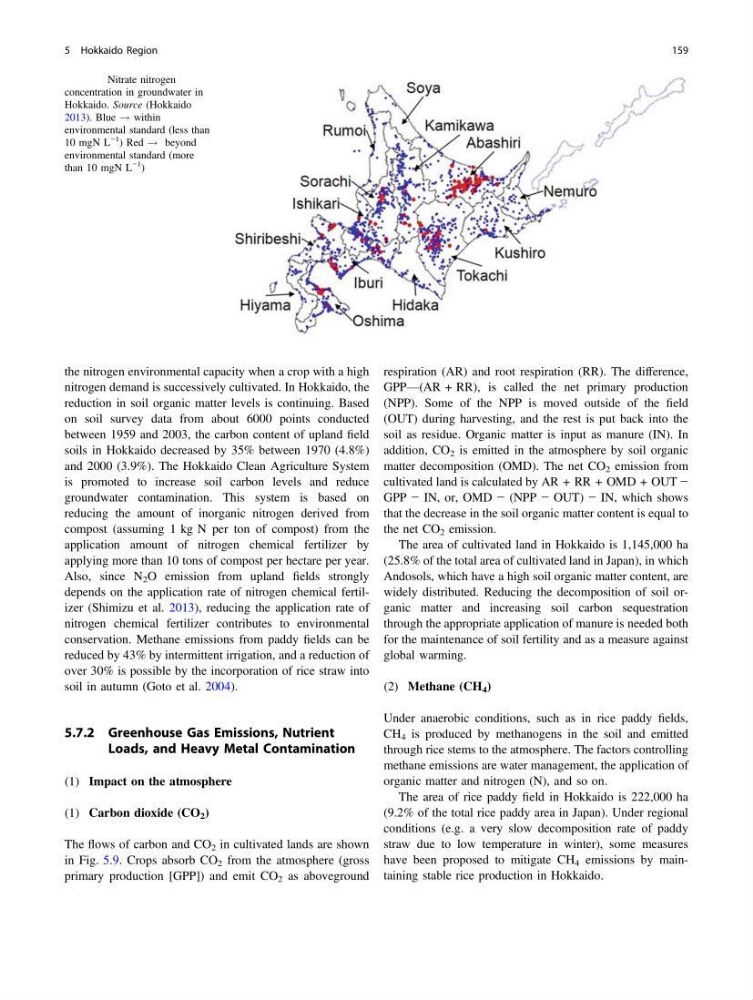
Fig. 5.8 Nitrate nitrogen
concentration in groundwater in
Hokkaido. Source (Hokkaido
2013). Blue ! within
environmental standard (less than
10 mgN L
−1
) Red ! beyond
environmental standard (more
than 10 mgN L
−1
)
5 Hokkaido Region
159
nitrogen demand is successively cultivated. In Hokkaido, the
reduction in soil organic matter levels is continuing. Based
on soil survey data from about 6000 points conducted
between 1959 and 2003, the carbon content of upland field
soils in Hokkaido decreased by 35% between 1970 (4.8%)
and 2000 (3.9%). The Hokkaido Clean Agriculture System
is promoted to increase soil carbon levels and reduce
groundwater contamination. This system is based on
reducing the amount of inorganic nitrogen derived from
compost (assuming 1 kg N per ton of compost) from the
application amount of nitrogen chemical fertilizer by
applying more than 10 tons of compost per hectare per year.
Also, since N 2 O emission from upland fields strongly
depends on the application rate of nitrogen chemical fertilizer (Shimizu et al. 2013), reducing the application rate of
nitrogen chemical fertilizer contributes to environmental
conservation. Methane emissions from paddy fields can be
reduced by 43% by intermittent irrigation, and a reduction of
over 30% is possible by the incorporation of rice straw into
soil in autumn (Goto et al. 2004).
5.7.2 Greenhouse Gas Emissions, Nutrient
Loads, and Heavy Metal Contamination
(1) Impact on the atmosphere
(1) Carbon dioxide (CO 2 )
The flows of carbon and CO 2 in cultivated lands are shown
in Fig. 5.9. Crops absorb CO 2 from the atmosphere (gross
primary production [GPP]) and emit CO 2 as aboveground
respiration (AR) and root respiration (RR). The difference,
GPP—(AR + RR), is called the net primary production
(NPP). Some of the NPP is moved outside of the field
(OUT) during harvesting, and the rest is put back into the
soil as residue. Organic matter is input as manure (IN). In
addition, CO 2 is emitted in the atmosphere by soil organic
matter decomposition (OMD). The net CO 2 emission from
cultivated land is calculated by AR + RR + OMD + OUT −
GPP − IN, or, OMD − (NPP − OUT) − IN, which shows
that the decrease in the soil organic matter content is equal to
the net CO 2 emission.
The area of cultivated land in Hokkaido is 1,145,000 ha
(25.8% of the total area of cultivated land in Japan), in which
Andosols, which have a high soil organic matter content, are
widely distributed. Reducing the decomposition of soil organic matter and increasing soil carbon sequestration
through the appropriate application of manure is needed both
for the maintenance of soil fertility and as a measure against
global warming.
(2) Methane (CH 4 )
Under anaerobic conditions, such as in rice paddy fields,
CH 4 is produced by methanogens in the soil and emitted
through rice stems to the atmosphere. The factors controlling
methane emissions are water management, the application of
organic matter and nitrogen (N), and so on.
The area of rice paddy field in Hokkaido is 222,000 ha
(9.2% of the total rice paddy area in Japan). Under regional
conditions (e.g. a very slow decomposition rate of paddy
straw due to low temperature in winter), some measures
have been proposed to mitigate CH 4 emissions by maintaining stable rice production in Hokkaido.
Fig. 5.8 Nitrate nitrogen
concentration in groundwater in
Hokkaido. Source (Hokkaido
2013). Blue ! within
environmental standard (less than
10 mgN L
−1
) Red ! beyond
environmental standard (more
than 10 mgN L
−1
)
5 Hokkaido Region
159