

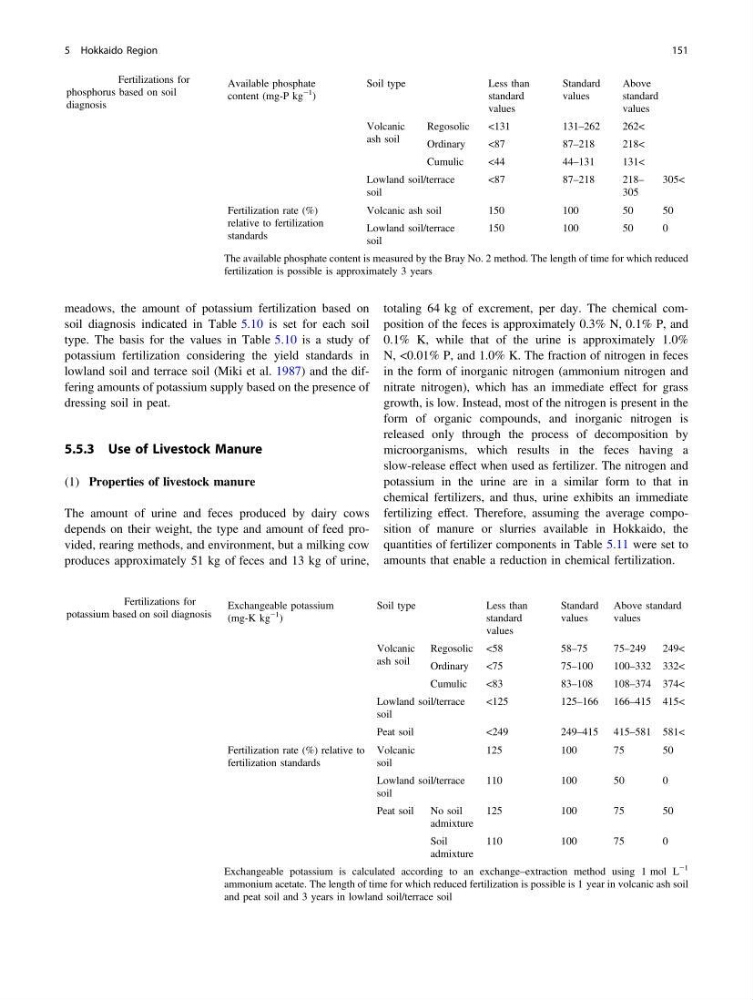
meadows, the amount of potassium fertilization based on
soil diagnosis indicated in Table 5.10 is set for each soil
type. The basis for the values in Table 5.10 is a study of
potassium fertilization considering the yield standards in
lowland soil and terrace soil (Miki et al. 1987) and the differing amounts of potassium supply based on the presence of
dressing soil in peat.
5.5.3 Use of Livestock Manure
(1) Properties of livestock manure
The amount of urine and feces produced by dairy cows
depends on their weight, the type and amount of feed provided, rearing methods, and environment, but a milking cow
produces approximately 51 kg of feces and 13 kg of urine,
totaling 64 kg of excrement, per day. The chemical composition of the feces is approximately 0.3% N, 0.1% P, and
0.1% K, while that of the urine is approximately 1.0%
N, <0.01% P, and 1.0% K. The fraction of nitrogen in feces
in the form of inorganic nitrogen (ammonium nitrogen and
nitrate nitrogen), which has an immediate effect for grass
growth, is low. Instead, most of the nitrogen is present in the
form of organic compounds, and inorganic nitrogen is
released only through the process of decomposition by
microorganisms, which results in the feces having a
slow-release effect when used as fertilizer. The nitrogen and
potassium in the urine are in a similar form to that in
chemical fertilizers, and thus, urine exhibits an immediate
fertilizing effect. Therefore, assuming the average composition of manure or slurries available in Hokkaido, the
quantities of fertilizer components in Table 5.11 were set to
amounts that enable a reduction in chemical fertilization.
Table 5.9 Fertilizations for
phosphorus based on soil
diagnosis
Available phosphate
content (mg-P kg
−1
)
Soil type
Less than
standard
values
Standard
values
Above
standard
values
Volcanic
ash soil
Regosolic
<131
131–262
262<
Ordinary
<87
87–218
218<
Cumulic
<44
44–131
131<
Lowland soil/terrace
soil
<87
87–218
218–
305
305<
Fertilization rate (%)
relative to fertilization
standards
Volcanic ash soil
150
100
50
50
Lowland soil/terrace
soil
150
100
50
0
The available phosphate content is measured by the Bray No. 2 method. The length of time for which reduced
fertilization is possible is approximately 3 years
Table 5.10 Fertilizations for
potassium based on soil diagnosis
Exchangeable potassium
(mg-K kg
−1
)
Soil type
Less than
standard
values
Standard
values
Above standard
values
Volcanic
ash soil
Regosolic <58
58–75
75–249
249<
Ordinary
<75
75–100
100–332 332<
Cumulic
<83
83–108
108–374 374<
Lowland soil/terrace
soil
<125
125–166 166–415 415<
Peat soil
<249
249–415 415–581 581<
Fertilization rate (%) relative to
fertilization standards
Volcanic
soil
125
100
75
50
Lowland soil/terrace
soil
110
100
50
0
Peat soil
No soil
admixture
125
100
75
50
Soil
admixture
110
100
75
0
Exchangeable potassium is calculated according to an exchange–extraction method using 1 mol L
−1
ammonium acetate. The length of time for which reduced fertilization is possible is 1 year in volcanic ash soil
and peat soil and 3 years in lowland soil/terrace soil
5 Hokkaido Region
151
soil diagnosis indicated in Table 5.10 is set for each soil
type. The basis for the values in Table 5.10 is a study of
potassium fertilization considering the yield standards in
lowland soil and terrace soil (Miki et al. 1987) and the differing amounts of potassium supply based on the presence of
dressing soil in peat.
5.5.3 Use of Livestock Manure
(1) Properties of livestock manure
The amount of urine and feces produced by dairy cows
depends on their weight, the type and amount of feed provided, rearing methods, and environment, but a milking cow
produces approximately 51 kg of feces and 13 kg of urine,
totaling 64 kg of excrement, per day. The chemical composition of the feces is approximately 0.3% N, 0.1% P, and
0.1% K, while that of the urine is approximately 1.0%
N, <0.01% P, and 1.0% K. The fraction of nitrogen in feces
in the form of inorganic nitrogen (ammonium nitrogen and
nitrate nitrogen), which has an immediate effect for grass
growth, is low. Instead, most of the nitrogen is present in the
form of organic compounds, and inorganic nitrogen is
released only through the process of decomposition by
microorganisms, which results in the feces having a
slow-release effect when used as fertilizer. The nitrogen and
potassium in the urine are in a similar form to that in
chemical fertilizers, and thus, urine exhibits an immediate
fertilizing effect. Therefore, assuming the average composition of manure or slurries available in Hokkaido, the
quantities of fertilizer components in Table 5.11 were set to
amounts that enable a reduction in chemical fertilization.
Table 5.9 Fertilizations for
phosphorus based on soil
diagnosis
Available phosphate
content (mg-P kg
−1
)
Soil type
Less than
standard
values
Standard
values
Above
standard
values
Volcanic
ash soil
Regosolic
<131
131–262
262<
Ordinary
<87
87–218
218<
Cumulic
<44
44–131
131<
Lowland soil/terrace
soil
<87
87–218
218–
305
305<
Fertilization rate (%)
relative to fertilization
standards
Volcanic ash soil
150
100
50
50
Lowland soil/terrace
soil
150
100
50
0
The available phosphate content is measured by the Bray No. 2 method. The length of time for which reduced
fertilization is possible is approximately 3 years
Table 5.10 Fertilizations for
potassium based on soil diagnosis
Exchangeable potassium
(mg-K kg
−1
)
Soil type
Less than
standard
values
Standard
values
Above standard
values
Volcanic
ash soil
Regosolic <58
58–75
75–249
249<
Ordinary
<75
75–100
100–332 332<
Cumulic
<83
83–108
108–374 374<
Lowland soil/terrace
soil
<125
125–166 166–415 415<
Peat soil
<249
249–415 415–581 581<
Fertilization rate (%) relative to
fertilization standards
Volcanic
soil
125
100
75
50
Lowland soil/terrace
soil
110
100
50
0
Peat soil
No soil
admixture
125
100
75
50
Soil
admixture
110
100
75
0
Exchangeable potassium is calculated according to an exchange–extraction method using 1 mol L
−1
ammonium acetate. The length of time for which reduced fertilization is possible is 1 year in volcanic ash soil
and peat soil and 3 years in lowland soil/terrace soil
5 Hokkaido Region
151