

Research has shown that maintaining high productivity in peat
soils requires agricultural land improvement every few years.
5.5.2 Fertility Management
(1) Approach to fertility management in the grasslands
Field productivity is affected by botanical composition, and
hence, the fertilizer recommendations for grasslands in
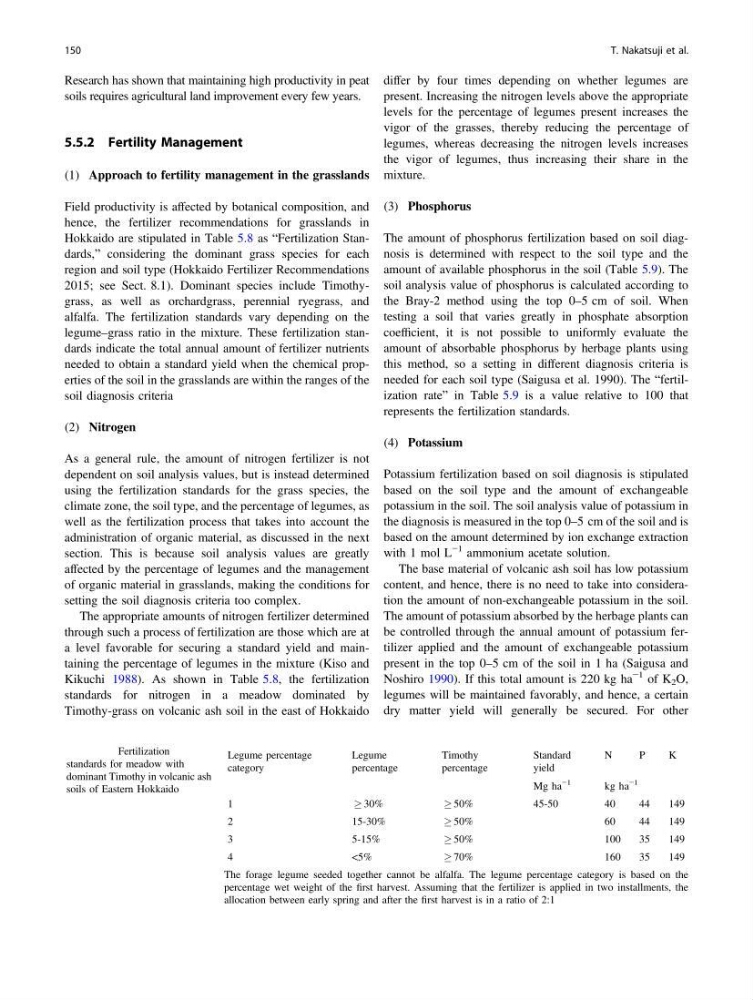
Hokkaido are stipulated in Table 5.8 as “Fertilization Standards,” considering the dominant grass species for each
region and soil type (Hokkaido Fertilizer Recommendations
2015; see Sect. 8.1). Dominant species include Timothygrass, as well as orchardgrass, perennial ryegrass, and
alfalfa. The fertilization standards vary depending on the
legume–grass ratio in the mixture. These fertilization standards indicate the total annual amount of fertilizer nutrients
needed to obtain a standard yield when the chemical properties of the soil in the grasslands are within the ranges of the
soil diagnosis criteria
(2) Nitrogen
As a general rule, the amount of nitrogen fertilizer is not
dependent on soil analysis values, but is instead determined
using the fertilization standards for the grass species, the
climate zone, the soil type, and the percentage of legumes, as
well as the fertilization process that takes into account the
administration of organic material, as discussed in the next
section. This is because soil analysis values are greatly
affected by the percentage of legumes and the management
of organic material in grasslands, making the conditions for
setting the soil diagnosis criteria too complex.
The appropriate amounts of nitrogen fertilizer determined
through such a process of fertilization are those which are at
a level favorable for securing a standard yield and maintaining the percentage of legumes in the mixture (Kiso and
Kikuchi 1988). As shown in Table 5.8, the fertilization
standards for nitrogen in a meadow dominated by
Timothy-grass on volcanic ash soil in the east of Hokkaido
differ by four times depending on whether legumes are
present. Increasing the nitrogen levels above the appropriate
levels for the percentage of legumes present increases the
vigor of the grasses, thereby reducing the percentage of
legumes, whereas decreasing the nitrogen levels increases
the vigor of legumes, thus increasing their share in the
mixture.
(3) Phosphorus
The amount of phosphorus fertilization based on soil diagnosis is determined with respect to the soil type and the
amount of available phosphorus in the soil (Table 5.9). The
soil analysis value of phosphorus is calculated according to
the Bray-2 method using the top 0–5 cm of soil. When
testing a soil that varies greatly in phosphate absorption
coefficient, it is not possible to uniformly evaluate the
amount of absorbable phosphorus by herbage plants using
this method, so a setting in different diagnosis criteria is
needed for each soil type (Saigusa et al. 1990). The “fertilization rate” in Table 5.9 is a value relative to 100 that
represents the fertilization standards.
(4) Potassium
Potassium fertilization based on soil diagnosis is stipulated
based on the soil type and the amount of exchangeable
potassium in the soil. The soil analysis value of potassium in
the diagnosis is measured in the top 0–5 cm of the soil and is
based on the amount determined by ion exchange extraction
with 1 mol L
−1 ammonium acetate solution.
The base material of volcanic ash soil has low potassium
content, and hence, there is no need to take into consideration the amount of non-exchangeable potassium in the soil.
The amount of potassium absorbed by the herbage plants can
be controlled through the annual amount of potassium fertilizer applied and the amount of exchangeable potassium
present in the top 0–5 cm of the soil in 1 ha (Saigusa and
Noshiro 1990). If this total amount is 220 kg ha
−1 of K 2 O,
legumes will be maintained favorably, and hence, a certain
dry matter yield will generally be secured. For other
Table 5.8 Fertilization
standards for meadow with
dominant Timothy in volcanic ash
soils of Eastern Hokkaido
Legume percentage
category
Legume
percentage
Timothy
percentage
Standard
yield
N
P
K
Mg ha
−1
kg ha
−1
1
! 30%
! 50%
45-50
40
44
149
2
15-30%
! 50%
60
44
149
3
5-15%
! 50%
100
35
149
4
<5%
! 70%
160
35
149
The forage legume seeded together cannot be alfalfa. The legume percentage category is based on the
percentage wet weight of the first harvest. Assuming that the fertilizer is applied in two installments, the
allocation between early spring and after the first harvest is in a ratio of 2:1
150
T. Nakatsuji et al.
soils requires agricultural land improvement every few years.
5.5.2 Fertility Management
(1) Approach to fertility management in the grasslands
Field productivity is affected by botanical composition, and
hence, the fertilizer recommendations for grasslands in
Hokkaido are stipulated in Table 5.8 as “Fertilization Standards,” considering the dominant grass species for each
region and soil type (Hokkaido Fertilizer Recommendations
2015; see Sect. 8.1). Dominant species include Timothygrass, as well as orchardgrass, perennial ryegrass, and
alfalfa. The fertilization standards vary depending on the
legume–grass ratio in the mixture. These fertilization standards indicate the total annual amount of fertilizer nutrients
needed to obtain a standard yield when the chemical properties of the soil in the grasslands are within the ranges of the
soil diagnosis criteria
(2) Nitrogen
As a general rule, the amount of nitrogen fertilizer is not
dependent on soil analysis values, but is instead determined
using the fertilization standards for the grass species, the
climate zone, the soil type, and the percentage of legumes, as
well as the fertilization process that takes into account the
administration of organic material, as discussed in the next
section. This is because soil analysis values are greatly
affected by the percentage of legumes and the management
of organic material in grasslands, making the conditions for
setting the soil diagnosis criteria too complex.
The appropriate amounts of nitrogen fertilizer determined
through such a process of fertilization are those which are at
a level favorable for securing a standard yield and maintaining the percentage of legumes in the mixture (Kiso and
Kikuchi 1988). As shown in Table 5.8, the fertilization
standards for nitrogen in a meadow dominated by
Timothy-grass on volcanic ash soil in the east of Hokkaido
differ by four times depending on whether legumes are
present. Increasing the nitrogen levels above the appropriate
levels for the percentage of legumes present increases the
vigor of the grasses, thereby reducing the percentage of
legumes, whereas decreasing the nitrogen levels increases
the vigor of legumes, thus increasing their share in the
mixture.
(3) Phosphorus
The amount of phosphorus fertilization based on soil diagnosis is determined with respect to the soil type and the
amount of available phosphorus in the soil (Table 5.9). The
soil analysis value of phosphorus is calculated according to
the Bray-2 method using the top 0–5 cm of soil. When
testing a soil that varies greatly in phosphate absorption
coefficient, it is not possible to uniformly evaluate the
amount of absorbable phosphorus by herbage plants using
this method, so a setting in different diagnosis criteria is
needed for each soil type (Saigusa et al. 1990). The “fertilization rate” in Table 5.9 is a value relative to 100 that
represents the fertilization standards.
(4) Potassium
Potassium fertilization based on soil diagnosis is stipulated
based on the soil type and the amount of exchangeable
potassium in the soil. The soil analysis value of potassium in
the diagnosis is measured in the top 0–5 cm of the soil and is
based on the amount determined by ion exchange extraction
with 1 mol L
−1 ammonium acetate solution.
The base material of volcanic ash soil has low potassium
content, and hence, there is no need to take into consideration the amount of non-exchangeable potassium in the soil.
The amount of potassium absorbed by the herbage plants can
be controlled through the annual amount of potassium fertilizer applied and the amount of exchangeable potassium
present in the top 0–5 cm of the soil in 1 ha (Saigusa and
Noshiro 1990). If this total amount is 220 kg ha
−1 of K 2 O,
legumes will be maintained favorably, and hence, a certain
dry matter yield will generally be secured. For other
Table 5.8 Fertilization
standards for meadow with
dominant Timothy in volcanic ash
soils of Eastern Hokkaido
Legume percentage
category
Legume
percentage
Timothy
percentage
Standard
yield
N
P
K
Mg ha
−1
kg ha
−1
1
! 30%
! 50%
45-50
40
44
149
2
15-30%
! 50%
60
44
149
3
5-15%
! 50%
100
35
149
4
<5%
! 70%
160
35
149
The forage legume seeded together cannot be alfalfa. The legume percentage category is based on the
percentage wet weight of the first harvest. Assuming that the fertilizer is applied in two installments, the
allocation between early spring and after the first harvest is in a ratio of 2:1
150
T. Nakatsuji et al.