

5.5 Grassland
5.5.1 Grassland Soils
(1) Dairy farming and sown grass in Hokkaido
In Hokkaido, the dominant climate is subarctic humid, and
forest is the climax vegetation. For this reason, almost all of
Hokkaido’s grasslands, which are used mainly for dairy
farming, are artificial grasslands sown with temperate
grasses. In 2014, the total area of grassland stood at
541,000 ha, representing 73% of Japan’s total grassland area
of 739,000 ha and 47% of Hokkaido’s total cropland area of
1,148,000 ha. In the same year, the number of dairy cows
being raised in Hokkaido stood at 792,400, representing
58% of the national total of 1,371,000.
Climatic conditions in Hokkaido vary according to
region, with the eastern region in particular experiencing
extremely cold winters during which the soil freezes, causing winter injury to even temperate grasses. Therefore, different grass species and cultivars are sown in different
regions according to weather conditions. Currently, the most
commonly sown species is Timothy-grass (Phleum pratense
L.), but orchardgrass (Dactylis glomerata L.), meadow fescue (Festuca pratensis Huds.), perennial ryegrass (Lolium
perenne L.), and others are also sown according to usage and
weather conditions. Additionally, legumes, such as white
clover (Trifolium repens L.), red clover (Trifolium pratense
L.), and alfalfa (Medicago sativa L.), are often mixed in.
(2) Characteristics of soils and respective fertilization
improvement
Grasslands in Hokkaido are located in volcanic ash soils,
lowland soils, terrace soils, and peat soils at an estimated
frequency of 50%, 22%, 21%, and 7%, respectively. Common characteristics in all of these grassland soils are the
surface accumulation of nutrients and roots owing to surface
fertilizer application and acidification owing to the leaching
of minerals due to high precipitation.
(1) Volcanic Ash soils
Volcanic ash soil grasslands are widespread in Eastern and
Southern Hokkaido. Although volcanic ash soils have good
physical properties, their high phosphate retention capacity
and the low nutrient content of their parent material have
prompted research on the use of fertilizers to control the
botanical composition of these soils. Interim results of an
ongoing long-term grassland NPK field study launched in
1967 indicate that a good botanical composition can be
maintained by low amounts of nitrogen, adequate amounts
of phosphorus, potassium and magnesium, and also calcium
to prevent soil acidification (Ohmura et al. 1985).
(2) Terrace and Lowland soils
Grasslands on terrace and lowland soils are widespread in
Northern and Central Hokkaido. Although their parent
material is rich in nutrients, clayey soils have inferior
physical properties, including poor water retention, drainage,
and crushability, and are accordingly susceptible to damage
from excessive moisture and drought.
The yield of such grasslands depends on soil acidity and
moisture content. Miki (1993) studied the effect of precipitation and soil pH on the process of accumulation and decomposition of soil organic matter. Soil acidification inhibits
the growth of grass by solubilizing aluminum and also
reduces the effectiveness of fertilizer owing to the increased
absorption and fixation of phosphorus. Hojito (1994) conducted research on the acid resistance of grasses that quantified the effect of the above factors according to grass species.
(3) Peat soils
Land improvement for grasslands located on Peat soils must
increase the bearing capacity of the soil through such means as
soil-dressing, open ditch drainage, and underdrainage. Because
excessive drainage promotes drought and nutrient runoff,
maintaining a groundwater level of 30–50 cm is advised.
Improving the drainage of peat soils promotes the drying and
decomposition of peat together causing irregular subsidence.
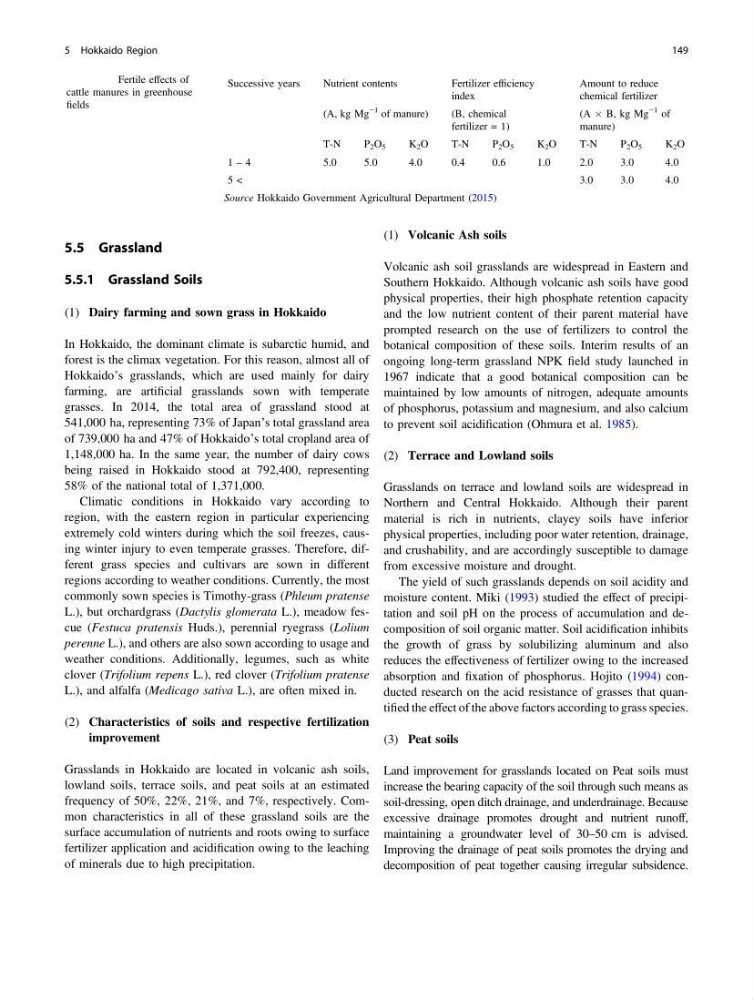
Table 5.7 Fertile effects of
cattle manures in greenhouse
fields
Successive years
Nutrient contents
Fertilizer efficiency
index
Amount to reduce
chemical fertilizer
(A, kg Mg
−1 of manure)
(B, chemical
fertilizer = 1)
(A Â B, kg Mg
−1 of
manure)
T-N
P 2 O 5
K 2 O
T-N
P 2 O 5
K 2 O
T-N
P 2 O 5
K 2 O
1 – 4
5.0
5.0
4.0
0.4
0.6
1.0
2.0
3.0
4.0
5 <
3.0
3.0
4.0
Source Hokkaido Government Agricultural Department (2015)
5 Hokkaido Region
149
5.5.1 Grassland Soils
(1) Dairy farming and sown grass in Hokkaido
In Hokkaido, the dominant climate is subarctic humid, and
forest is the climax vegetation. For this reason, almost all of
Hokkaido’s grasslands, which are used mainly for dairy
farming, are artificial grasslands sown with temperate
grasses. In 2014, the total area of grassland stood at
541,000 ha, representing 73% of Japan’s total grassland area
of 739,000 ha and 47% of Hokkaido’s total cropland area of
1,148,000 ha. In the same year, the number of dairy cows
being raised in Hokkaido stood at 792,400, representing
58% of the national total of 1,371,000.
Climatic conditions in Hokkaido vary according to
region, with the eastern region in particular experiencing
extremely cold winters during which the soil freezes, causing winter injury to even temperate grasses. Therefore, different grass species and cultivars are sown in different
regions according to weather conditions. Currently, the most
commonly sown species is Timothy-grass (Phleum pratense
L.), but orchardgrass (Dactylis glomerata L.), meadow fescue (Festuca pratensis Huds.), perennial ryegrass (Lolium
perenne L.), and others are also sown according to usage and
weather conditions. Additionally, legumes, such as white
clover (Trifolium repens L.), red clover (Trifolium pratense
L.), and alfalfa (Medicago sativa L.), are often mixed in.
(2) Characteristics of soils and respective fertilization
improvement
Grasslands in Hokkaido are located in volcanic ash soils,
lowland soils, terrace soils, and peat soils at an estimated
frequency of 50%, 22%, 21%, and 7%, respectively. Common characteristics in all of these grassland soils are the
surface accumulation of nutrients and roots owing to surface
fertilizer application and acidification owing to the leaching
of minerals due to high precipitation.
(1) Volcanic Ash soils
Volcanic ash soil grasslands are widespread in Eastern and
Southern Hokkaido. Although volcanic ash soils have good
physical properties, their high phosphate retention capacity
and the low nutrient content of their parent material have
prompted research on the use of fertilizers to control the
botanical composition of these soils. Interim results of an
ongoing long-term grassland NPK field study launched in
1967 indicate that a good botanical composition can be
maintained by low amounts of nitrogen, adequate amounts
of phosphorus, potassium and magnesium, and also calcium
to prevent soil acidification (Ohmura et al. 1985).
(2) Terrace and Lowland soils
Grasslands on terrace and lowland soils are widespread in
Northern and Central Hokkaido. Although their parent
material is rich in nutrients, clayey soils have inferior
physical properties, including poor water retention, drainage,
and crushability, and are accordingly susceptible to damage
from excessive moisture and drought.
The yield of such grasslands depends on soil acidity and
moisture content. Miki (1993) studied the effect of precipitation and soil pH on the process of accumulation and decomposition of soil organic matter. Soil acidification inhibits
the growth of grass by solubilizing aluminum and also
reduces the effectiveness of fertilizer owing to the increased
absorption and fixation of phosphorus. Hojito (1994) conducted research on the acid resistance of grasses that quantified the effect of the above factors according to grass species.
(3) Peat soils
Land improvement for grasslands located on Peat soils must
increase the bearing capacity of the soil through such means as
soil-dressing, open ditch drainage, and underdrainage. Because
excessive drainage promotes drought and nutrient runoff,
maintaining a groundwater level of 30–50 cm is advised.
Improving the drainage of peat soils promotes the drying and
decomposition of peat together causing irregular subsidence.
Table 5.7 Fertile effects of
cattle manures in greenhouse
fields
Successive years
Nutrient contents
Fertilizer efficiency
index
Amount to reduce
chemical fertilizer
(A, kg Mg
−1 of manure)
(B, chemical
fertilizer = 1)
(A Â B, kg Mg
−1 of
manure)
T-N
P 2 O 5
K 2 O
T-N
P 2 O 5
K 2 O
T-N
P 2 O 5
K 2 O
1 – 4
5.0
5.0
4.0
0.4
0.6
1.0
2.0
3.0
4.0
5 <
3.0
3.0
4.0
Source Hokkaido Government Agricultural Department (2015)
5 Hokkaido Region
149