

Just before vegetable cultivation, there is insufficient soil
inorganic nitrogen to grow the crops, due to the leaching of
some inorganic nitrogen by snowmelt. Therefore, the
amount of nitrogen fertilizer to be applied is decided based
on the level of soil available organic nitrogen. In the cases of
open vegetable fields in Hokkaido, organic nitrogen is tested
as the soluble nitrogen extracted by autoclave. The amount
of nitrogen fertilizer to be applied to each crop is determined
using the Hokkaido Fertilizer Recommendations 2015
handbook (Sect. 8.1). Three standards for the soil available
organic nitrogen content are set in this manual. The relations
with the soil nitrogen and the nitrogen fertilization amounts
vary based on the cultivation period and date of planting of
each crop. Some nitrogen fertilization methods for major
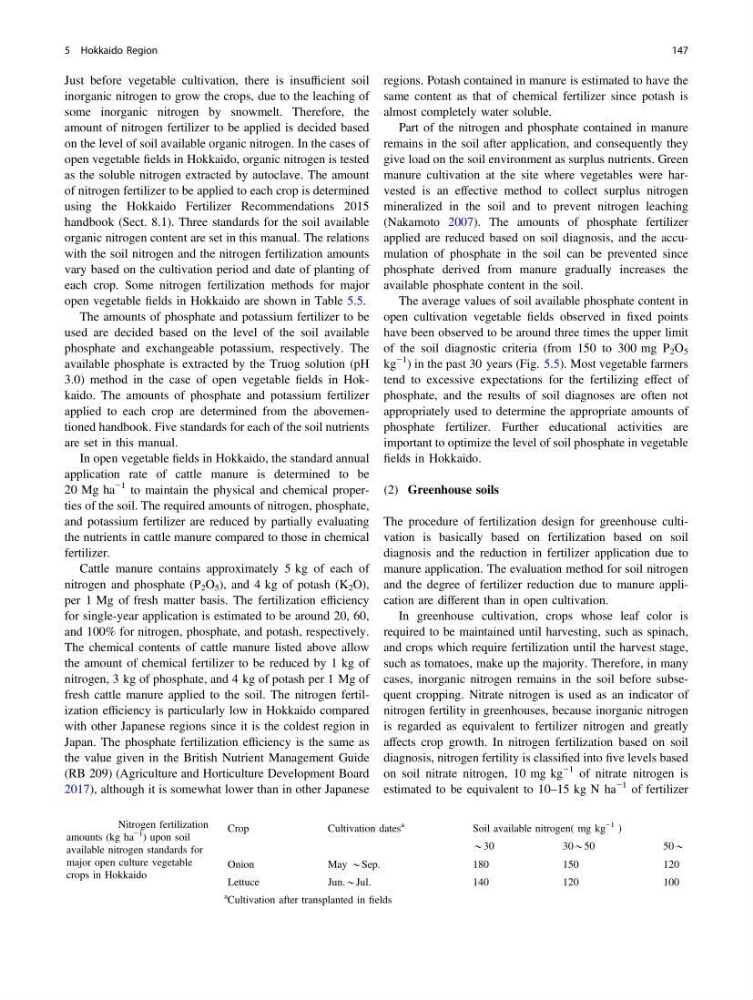
open vegetable fields in Hokkaido are shown in Table 5.5.
The amounts of phosphate and potassium fertilizer to be
used are decided based on the level of the soil available
phosphate and exchangeable potassium, respectively. The
available phosphate is extracted by the Truog solution (pH
3.0) method in the case of open vegetable fields in Hokkaido. The amounts of phosphate and potassium fertilizer
applied to each crop are determined from the abovementioned handbook. Five standards for each of the soil nutrients
are set in this manual.
In open vegetable fields in Hokkaido, the standard annual
application rate of cattle manure is determined to be
20 Mg ha
−1 to maintain the physical and chemical properties of the soil. The required amounts of nitrogen, phosphate,
and potassium fertilizer are reduced by partially evaluating
the nutrients in cattle manure compared to those in chemical
fertilizer.
Cattle manure contains approximately 5 kg of each of
nitrogen and phosphate (P 2 O 5 ), and 4 kg of potash (K 2 O),
per 1 Mg of fresh matter basis. The fertilization efficiency
for single-year application is estimated to be around 20, 60,
and 100% for nitrogen, phosphate, and potash, respectively.
The chemical contents of cattle manure listed above allow
the amount of chemical fertilizer to be reduced by 1 kg of
nitrogen, 3 kg of phosphate, and 4 kg of potash per 1 Mg of
fresh cattle manure applied to the soil. The nitrogen fertilization efficiency is particularly low in Hokkaido compared
with other Japanese regions since it is the coldest region in
Japan. The phosphate fertilization efficiency is the same as
the value given in the British Nutrient Management Guide
(RB 209) (Agriculture and Horticulture Development Board
2017), although it is somewhat lower than in other Japanese
regions. Potash contained in manure is estimated to have the
same content as that of chemical fertilizer since potash is
almost completely water soluble.
Part of the nitrogen and phosphate contained in manure
remains in the soil after application, and consequently they
give load on the soil environment as surplus nutrients. Green
manure cultivation at the site where vegetables were harvested is an effective method to collect surplus nitrogen
mineralized in the soil and to prevent nitrogen leaching
(Nakamoto 2007). The amounts of phosphate fertilizer
applied are reduced based on soil diagnosis, and the accumulation of phosphate in the soil can be prevented since
phosphate derived from manure gradually increases the
available phosphate content in the soil.
The average values of soil available phosphate content in
open cultivation vegetable fields observed in fixed points
have been observed to be around three times the upper limit
of the soil diagnostic criteria (from 150 to 300 mg P 2 O 5
kg
−1 ) in the past 30 years (Fig. 5.5). Most vegetable farmers
tend to excessive expectations for the fertilizing effect of
phosphate, and the results of soil diagnoses are often not
appropriately used to determine the appropriate amounts of
phosphate fertilizer. Further educational activities are
important to optimize the level of soil phosphate in vegetable
fields in Hokkaido.
(2) Greenhouse soils
The procedure of fertilization design for greenhouse cultivation is basically based on fertilization based on soil
diagnosis and the reduction in fertilizer application due to
manure application. The evaluation method for soil nitrogen
and the degree of fertilizer reduction due to manure application are different than in open cultivation.
In greenhouse cultivation, crops whose leaf color is
required to be maintained until harvesting, such as spinach,
and crops which require fertilization until the harvest stage,
such as tomatoes, make up the majority. Therefore, in many
cases, inorganic nitrogen remains in the soil before subsequent cropping. Nitrate nitrogen is used as an indicator of
nitrogen fertility in greenhouses, because inorganic nitrogen
is regarded as equivalent to fertilizer nitrogen and greatly
affects crop growth. In nitrogen fertilization based on soil
diagnosis, nitrogen fertility is classified into five levels based
on soil nitrate nitrogen, 10 mg kg
−1 of nitrate nitrogen is
estimated to be equivalent to 10–15 kg N ha
−1 of fertilizer
Table 5.5 Nitrogen fertilization
amounts (kg ha
−1
) upon soil
available nitrogen standards for
major open culture vegetable
crops in Hokkaido
Crop
Cultivation dates
a
Soil available nitrogen( mg kg
−1 )
*30
30*50
50*
Onion
May *Sep.
180
150
120
Lettuce
Jun.*Jul.
140
120
100
a Cultivation after transplanted in fields
5 Hokkaido Region
147
inorganic nitrogen to grow the crops, due to the leaching of
some inorganic nitrogen by snowmelt. Therefore, the
amount of nitrogen fertilizer to be applied is decided based
on the level of soil available organic nitrogen. In the cases of
open vegetable fields in Hokkaido, organic nitrogen is tested
as the soluble nitrogen extracted by autoclave. The amount
of nitrogen fertilizer to be applied to each crop is determined
using the Hokkaido Fertilizer Recommendations 2015
handbook (Sect. 8.1). Three standards for the soil available
organic nitrogen content are set in this manual. The relations
with the soil nitrogen and the nitrogen fertilization amounts
vary based on the cultivation period and date of planting of
each crop. Some nitrogen fertilization methods for major
open vegetable fields in Hokkaido are shown in Table 5.5.
The amounts of phosphate and potassium fertilizer to be
used are decided based on the level of the soil available
phosphate and exchangeable potassium, respectively. The
available phosphate is extracted by the Truog solution (pH
3.0) method in the case of open vegetable fields in Hokkaido. The amounts of phosphate and potassium fertilizer
applied to each crop are determined from the abovementioned handbook. Five standards for each of the soil nutrients
are set in this manual.
In open vegetable fields in Hokkaido, the standard annual
application rate of cattle manure is determined to be
20 Mg ha
−1 to maintain the physical and chemical properties of the soil. The required amounts of nitrogen, phosphate,
and potassium fertilizer are reduced by partially evaluating
the nutrients in cattle manure compared to those in chemical
fertilizer.
Cattle manure contains approximately 5 kg of each of
nitrogen and phosphate (P 2 O 5 ), and 4 kg of potash (K 2 O),
per 1 Mg of fresh matter basis. The fertilization efficiency
for single-year application is estimated to be around 20, 60,
and 100% for nitrogen, phosphate, and potash, respectively.
The chemical contents of cattle manure listed above allow
the amount of chemical fertilizer to be reduced by 1 kg of
nitrogen, 3 kg of phosphate, and 4 kg of potash per 1 Mg of
fresh cattle manure applied to the soil. The nitrogen fertilization efficiency is particularly low in Hokkaido compared
with other Japanese regions since it is the coldest region in
Japan. The phosphate fertilization efficiency is the same as
the value given in the British Nutrient Management Guide
(RB 209) (Agriculture and Horticulture Development Board
2017), although it is somewhat lower than in other Japanese
regions. Potash contained in manure is estimated to have the
same content as that of chemical fertilizer since potash is
almost completely water soluble.
Part of the nitrogen and phosphate contained in manure
remains in the soil after application, and consequently they
give load on the soil environment as surplus nutrients. Green
manure cultivation at the site where vegetables were harvested is an effective method to collect surplus nitrogen
mineralized in the soil and to prevent nitrogen leaching
(Nakamoto 2007). The amounts of phosphate fertilizer
applied are reduced based on soil diagnosis, and the accumulation of phosphate in the soil can be prevented since
phosphate derived from manure gradually increases the
available phosphate content in the soil.
The average values of soil available phosphate content in
open cultivation vegetable fields observed in fixed points
have been observed to be around three times the upper limit
of the soil diagnostic criteria (from 150 to 300 mg P 2 O 5
kg
−1 ) in the past 30 years (Fig. 5.5). Most vegetable farmers
tend to excessive expectations for the fertilizing effect of
phosphate, and the results of soil diagnoses are often not
appropriately used to determine the appropriate amounts of
phosphate fertilizer. Further educational activities are
important to optimize the level of soil phosphate in vegetable
fields in Hokkaido.
(2) Greenhouse soils
The procedure of fertilization design for greenhouse cultivation is basically based on fertilization based on soil
diagnosis and the reduction in fertilizer application due to
manure application. The evaluation method for soil nitrogen
and the degree of fertilizer reduction due to manure application are different than in open cultivation.
In greenhouse cultivation, crops whose leaf color is
required to be maintained until harvesting, such as spinach,
and crops which require fertilization until the harvest stage,
such as tomatoes, make up the majority. Therefore, in many
cases, inorganic nitrogen remains in the soil before subsequent cropping. Nitrate nitrogen is used as an indicator of
nitrogen fertility in greenhouses, because inorganic nitrogen
is regarded as equivalent to fertilizer nitrogen and greatly
affects crop growth. In nitrogen fertilization based on soil
diagnosis, nitrogen fertility is classified into five levels based
on soil nitrate nitrogen, 10 mg kg
−1 of nitrate nitrogen is
estimated to be equivalent to 10–15 kg N ha
−1 of fertilizer
Table 5.5 Nitrogen fertilization
amounts (kg ha
−1
) upon soil
available nitrogen standards for
major open culture vegetable
crops in Hokkaido
Crop
Cultivation dates
a
Soil available nitrogen( mg kg
−1 )
*30
30*50
50*
Onion
May *Sep.
180
150
120
Lettuce
Jun.*Jul.
140
120
100
a Cultivation after transplanted in fields
5 Hokkaido Region
147