

generally remained level, with 36% of agricultural fields
being below the reference value. No significant changes
were seen in available phosphate. Even when applying the
standard for onions, which have a high phosphate demand,
46% of agricultural fields exceeded the reference value
(Hokkaido Research Organization 2014).
5.4.2 Fertility Management
(1) Open cultivation soil
Hokkaido is a cold region and receives much snow in winter.
As such, most vegetable crops in open fields are cultivated
only from May to September in this area. Therefore, the
following points relating to the soil management of Hokkaido are listed.
(1) Because of the low temperature of the soil, available
organic nitrogen accumulates easily in the soil and its
mineralization is inactive. Additionally, the low temperature of the soil means that the degradation of organic matter applied to it is slow.
(2) Soil inorganic nitrogen is easily leached by the downward penetration of melting snow. This kind of nitrogen
leaching is a common phenomenon in most open fields
in Hokkaido. In general, however, vegetables require
greater amounts of nitrogen, and their cultivation period
is shorter than that of other field crops. Therefore, it is
necessary to prevent nitrogen leaching after cultivation.
(3) It is important to enhance the initial growth of vegetable
crops to complete the cultivation in a short period of time. In
particular, it is necessary to raise soil phosphate content to
increase the initial growth of crops in early spring, because
phosphate is hard to elute from soil at low temperature.
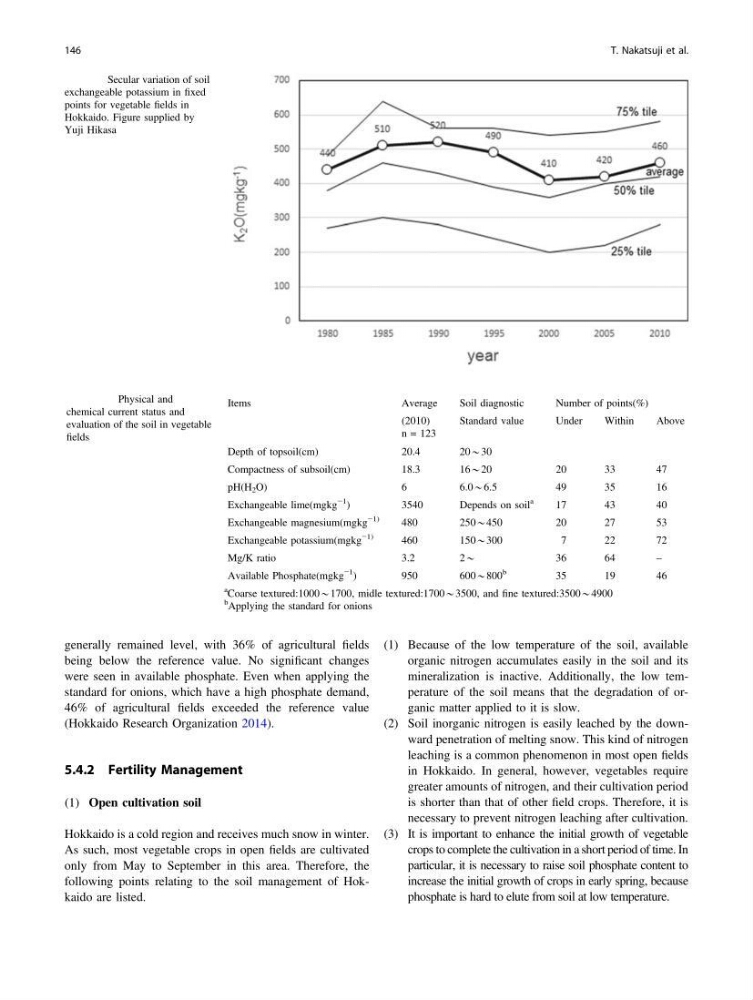
Fig. 5.4 Secular variation of soil
exchangeable potassium in fixed
points for vegetable fields in
Hokkaido. Figure supplied by
Yuji Hikasa
Table 5.4 Physical and
chemical current status and
evaluation of the soil in vegetable
fields
Items
Average
Soil diagnostic
Number of points(%)
(2010)
n = 123
Standard value
Under
Within
Above
Depth of topsoil(cm)
20.4
20*30
Compactness of subsoil(cm)
18.3
16*20
20
33
47
pH(H 2 O)
6
6.0*6.5
49
35
16
Exchangeable lime(mgkg
−1
)
3540
Depends on soil
a
17
43
40
Exchangeable magnesium(mgkg
−1)
480
250*450
20
27
53
Exchangeable potassium(mgkg
−1)
460
150*300
7
22
72
Mg/K ratio
3.2
2*
36
64
–
Available Phosphate(mgkg
−1
)
950
600*800
b
35
19
46
a Coarse textured:1000*1700, midle textured:1700*3500, and fine textured:3500*4900
b
Applying the standard for onions
146
T. Nakatsuji et al.
being below the reference value. No significant changes
were seen in available phosphate. Even when applying the
standard for onions, which have a high phosphate demand,
46% of agricultural fields exceeded the reference value
(Hokkaido Research Organization 2014).
5.4.2 Fertility Management
(1) Open cultivation soil
Hokkaido is a cold region and receives much snow in winter.
As such, most vegetable crops in open fields are cultivated
only from May to September in this area. Therefore, the
following points relating to the soil management of Hokkaido are listed.
(1) Because of the low temperature of the soil, available
organic nitrogen accumulates easily in the soil and its
mineralization is inactive. Additionally, the low temperature of the soil means that the degradation of organic matter applied to it is slow.
(2) Soil inorganic nitrogen is easily leached by the downward penetration of melting snow. This kind of nitrogen
leaching is a common phenomenon in most open fields
in Hokkaido. In general, however, vegetables require
greater amounts of nitrogen, and their cultivation period
is shorter than that of other field crops. Therefore, it is
necessary to prevent nitrogen leaching after cultivation.
(3) It is important to enhance the initial growth of vegetable
crops to complete the cultivation in a short period of time. In
particular, it is necessary to raise soil phosphate content to
increase the initial growth of crops in early spring, because
phosphate is hard to elute from soil at low temperature.
Fig. 5.4 Secular variation of soil
exchangeable potassium in fixed
points for vegetable fields in
Hokkaido. Figure supplied by
Yuji Hikasa
Table 5.4 Physical and
chemical current status and
evaluation of the soil in vegetable
fields
Items
Average
Soil diagnostic
Number of points(%)
(2010)
n = 123
Standard value
Under
Within
Above
Depth of topsoil(cm)
20.4
20*30
Compactness of subsoil(cm)
18.3
16*20
20
33
47
pH(H 2 O)
6
6.0*6.5
49
35
16
Exchangeable lime(mgkg
−1
)
3540
Depends on soil
a
17
43
40
Exchangeable magnesium(mgkg
−1)
480
250*450
20
27
53
Exchangeable potassium(mgkg
−1)
460
150*300
7
22
72
Mg/K ratio
3.2
2*
36
64
–
Available Phosphate(mgkg
−1
)
950
600*800
b
35
19
46
a Coarse textured:1000*1700, midle textured:1700*3500, and fine textured:3500*4900
b
Applying the standard for onions
146
T. Nakatsuji et al.