

5.4 Vegetable Fields
5.4.1 Vegetable Field Soils
(1) Characteristics of the soil in vegetable fields
Large amounts of fertilizer are often used for vegetable or
flower fields in order to improve yield and quality. The
contents of inorganic nitrogen, base, and phosphate are high
in the soils of vegetable and flower fields, resulting in the
accumulation of salt. Such soil is liable to lack micronutrients and may cause various physiological disorders in the
plants.
Regarding soil in greenhouses, the stored water tends to
move upward due to the absence of rainfall, making it easier
for inorganic nitrogen and salt to accumulate on the surface.
If such salt accumulation results in poor growth, a large
amount of irrigation water is used to wash the salt down
toward the subsoil as a corrective measure. However, as
nitrate nitrogen can easily move toward the lower layers if
the amount of irrigation water is great, this often results in a
greater amount of additional fertilizer being required. Furthermore, as the movement of inorganic nitrogen and salt
toward the subsoil caused by irrigation is only temporary
due to the upward movement of the soil water, inorganic
nitrogen and salt will immediately start to accumulate again;
repeating this process will result in the discharge of nutrients, which is a burden on the environment.
(2) Transitional trend of vegetable field soils
In Hokkaido, a survey analysis of the physicochemical
characteristics of agricultural soil was conducted every
5 years from 1979 to 2011, shedding light on the
actual condition of the soil as well as on the direction of
changes.
For example, the transition of the concentration of
exchangeable potassium is shown in Fig. 5.4. Although
significant differences can be seen in some years, it transitioned within the range of 410–520 mg kg
−1 , that is, higher
than the reference value of 150–300 mg kg
−1 .
The main physicochemical characteristics of the soil are
shown in Table 5.4. The depth of topsoil transitioned within
the range of 20–23 cm, while there were no significant
changes in the compactness or bulk density of the subsoil.
However, 47% of agricultural soils had a compactness that
exceeded the reference value, showing the necessity for
regular crushing of the subsoil. While no significant change
was seen in pH (H 2 O), in 49% of agricultural fields the value
was under 6.0, showing the need for acidity correction.
There was no significant change concerning the concentration of exchangeable lime, with 17% of agricultural fields
being under the reference value. Additionally, although the
concentration of exchangeable magnesium continued to
decrease until 2000, its fertilization must be reconsidered.
Exchangeable potassium generally remained level, and the
amount of fertilizer must be reduced, as 72% of agricultural
fields were above the reference value. The Mg/K ratio
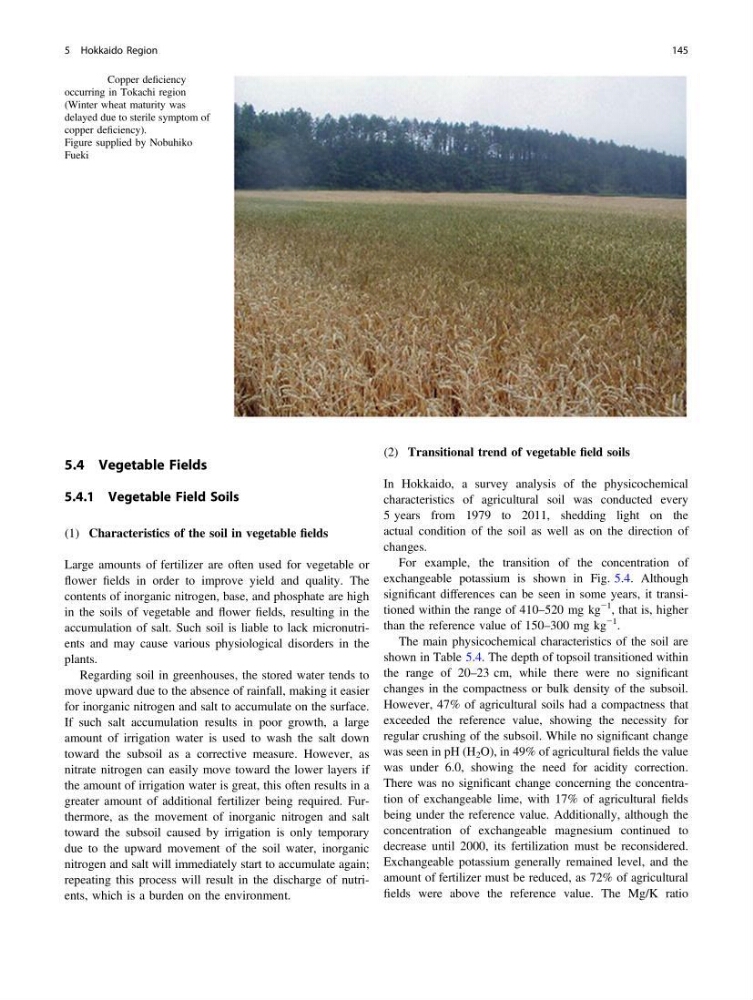
Fig. 5.3 Copper deficiency
occurring in Tokachi region
(Winter wheat maturity was
delayed due to sterile symptom of
copper deficiency).
Figure supplied by Nobuhiko
Fueki
5 Hokkaido Region
145
5.4.1 Vegetable Field Soils
(1) Characteristics of the soil in vegetable fields
Large amounts of fertilizer are often used for vegetable or
flower fields in order to improve yield and quality. The
contents of inorganic nitrogen, base, and phosphate are high
in the soils of vegetable and flower fields, resulting in the
accumulation of salt. Such soil is liable to lack micronutrients and may cause various physiological disorders in the
plants.
Regarding soil in greenhouses, the stored water tends to
move upward due to the absence of rainfall, making it easier
for inorganic nitrogen and salt to accumulate on the surface.
If such salt accumulation results in poor growth, a large
amount of irrigation water is used to wash the salt down
toward the subsoil as a corrective measure. However, as
nitrate nitrogen can easily move toward the lower layers if
the amount of irrigation water is great, this often results in a
greater amount of additional fertilizer being required. Furthermore, as the movement of inorganic nitrogen and salt
toward the subsoil caused by irrigation is only temporary
due to the upward movement of the soil water, inorganic
nitrogen and salt will immediately start to accumulate again;
repeating this process will result in the discharge of nutrients, which is a burden on the environment.
(2) Transitional trend of vegetable field soils
In Hokkaido, a survey analysis of the physicochemical
characteristics of agricultural soil was conducted every
5 years from 1979 to 2011, shedding light on the
actual condition of the soil as well as on the direction of
changes.
For example, the transition of the concentration of
exchangeable potassium is shown in Fig. 5.4. Although
significant differences can be seen in some years, it transitioned within the range of 410–520 mg kg
−1 , that is, higher
than the reference value of 150–300 mg kg
−1 .
The main physicochemical characteristics of the soil are
shown in Table 5.4. The depth of topsoil transitioned within
the range of 20–23 cm, while there were no significant
changes in the compactness or bulk density of the subsoil.
However, 47% of agricultural soils had a compactness that
exceeded the reference value, showing the necessity for
regular crushing of the subsoil. While no significant change
was seen in pH (H 2 O), in 49% of agricultural fields the value
was under 6.0, showing the need for acidity correction.
There was no significant change concerning the concentration of exchangeable lime, with 17% of agricultural fields
being under the reference value. Additionally, although the
concentration of exchangeable magnesium continued to
decrease until 2000, its fertilization must be reconsidered.
Exchangeable potassium generally remained level, and the
amount of fertilizer must be reduced, as 72% of agricultural
fields were above the reference value. The Mg/K ratio
Fig. 5.3 Copper deficiency
occurring in Tokachi region
(Winter wheat maturity was
delayed due to sterile symptom of
copper deficiency).
Figure supplied by Nobuhiko
Fueki
5 Hokkaido Region
145