

six years. The most distinctive characteristic of the 2000
Miyakejima eruption was the emission of SO 2 gas that lasted
for few years. As a result, the accumulated volcanic ash was
acidified, which produced an optimal environment for
iron-oxidizing bacteria. However, during the ensuing decade, the emission of SO 2 gas greatly diminished. This
facilitated an increase in the pH value of sediments and an
associated oxidation of Fe
2+ (conversion to Fe
3+ ), which
caused a reduction in the number of iron-oxidizing bacteria
(Fujimura et al. 2016). In summary, on Miyakejima, pedogenesis on a timescale of a few years in soil of which volcanic ash was the precursor was strongly affected by the
degree of change in the microbial ecosystem, which in turn
was largely affected by SO 2 gas.
In Volcanogenous Regosols, the population of living
organisms (plants and microbes) changes quite dynamically.
If the soil is a survivable environment for living organisms,
the dynamic transition of biota is interlinked with the
dynamic change of the soil. If the ultimate form of the
volcanic ash soil in Japan is Andosol, then the interpretation
of changes over time of the Volcanogenous Regosols scattered around the country would reveal the complete picture
of the soil formation process.
4.10.2 Sandy Regosols
These soils are coarse-textured soils which occur mainly in
slightly elevated lands along the sea coast such as sand
dunes, sand bars, sand banks, and spits. Sandy Regosols
have a sand or loamy sand texture and gravel contents of less
than 35%. Materials are mainly aeolian and partly
marine deposits, and soils show a very poor horizon
differentiation.
These soils are widely found along the coasts on the Sea
of Japan and East China Sea, and on the Pacific Ocean coast
(Fig. 4.53).
Sandy Regosols generally have high permeability and
low water and nutrient storage capacity due to their sandy
texture. On the other hand, Sandy Regosols offer ease of
cultivation, rooting, and harvesting of root and tuber crops.
The lands containing these soils are mostly idle, but some
are used as wind breaks, upland crop fields, and for the
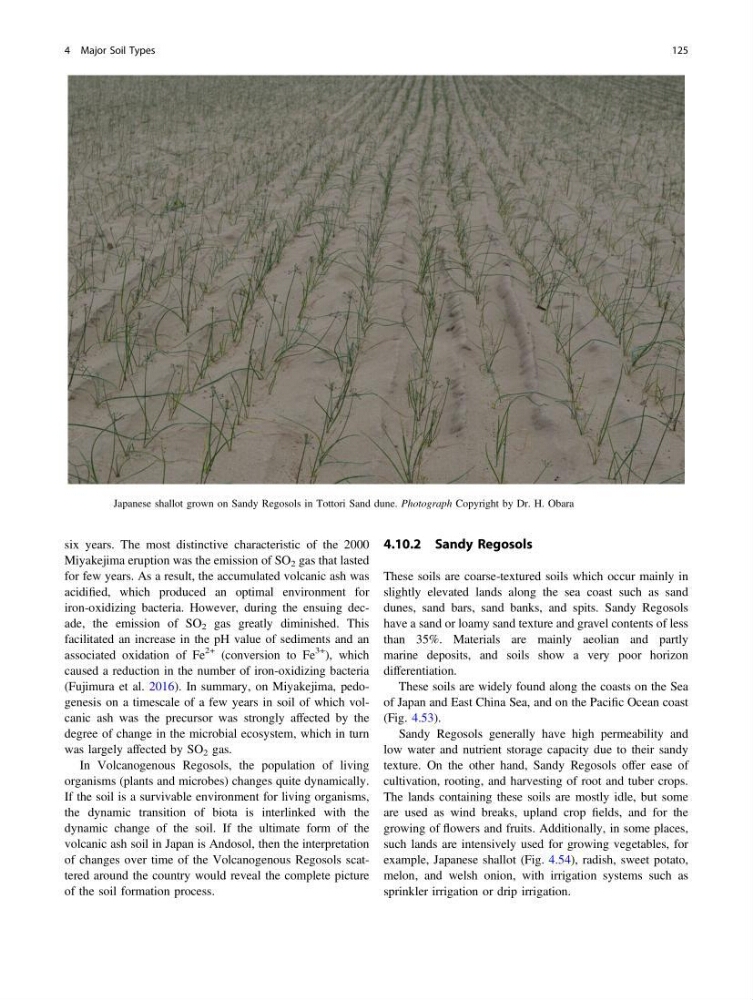
growing of flowers and fruits. Additionally, in some places,
such lands are intensively used for growing vegetables, for
example, Japanese shallot (Fig. 4.54), radish, sweet potato,
melon, and welsh onion, with irrigation systems such as
sprinkler irrigation or drip irrigation.
Fig. 4.54 Japanese shallot grown on Sandy Regosols in Tottori Sand dune. Photograph Copyright by Dr. H. Obara
4 Major Soil Types
125
Miyakejima eruption was the emission of SO 2 gas that lasted
for few years. As a result, the accumulated volcanic ash was
acidified, which produced an optimal environment for
iron-oxidizing bacteria. However, during the ensuing decade, the emission of SO 2 gas greatly diminished. This
facilitated an increase in the pH value of sediments and an
associated oxidation of Fe
2+ (conversion to Fe
3+ ), which
caused a reduction in the number of iron-oxidizing bacteria
(Fujimura et al. 2016). In summary, on Miyakejima, pedogenesis on a timescale of a few years in soil of which volcanic ash was the precursor was strongly affected by the
degree of change in the microbial ecosystem, which in turn
was largely affected by SO 2 gas.
In Volcanogenous Regosols, the population of living
organisms (plants and microbes) changes quite dynamically.
If the soil is a survivable environment for living organisms,
the dynamic transition of biota is interlinked with the
dynamic change of the soil. If the ultimate form of the
volcanic ash soil in Japan is Andosol, then the interpretation
of changes over time of the Volcanogenous Regosols scattered around the country would reveal the complete picture
of the soil formation process.
4.10.2 Sandy Regosols
These soils are coarse-textured soils which occur mainly in
slightly elevated lands along the sea coast such as sand
dunes, sand bars, sand banks, and spits. Sandy Regosols
have a sand or loamy sand texture and gravel contents of less
than 35%. Materials are mainly aeolian and partly
marine deposits, and soils show a very poor horizon
differentiation.
These soils are widely found along the coasts on the Sea
of Japan and East China Sea, and on the Pacific Ocean coast
(Fig. 4.53).
Sandy Regosols generally have high permeability and
low water and nutrient storage capacity due to their sandy
texture. On the other hand, Sandy Regosols offer ease of
cultivation, rooting, and harvesting of root and tuber crops.
The lands containing these soils are mostly idle, but some
are used as wind breaks, upland crop fields, and for the
growing of flowers and fruits. Additionally, in some places,
such lands are intensively used for growing vegetables, for
example, Japanese shallot (Fig. 4.54), radish, sweet potato,
melon, and welsh onion, with irrigation systems such as
sprinkler irrigation or drip irrigation.
Fig. 4.54 Japanese shallot grown on Sandy Regosols in Tottori Sand dune. Photograph Copyright by Dr. H. Obara
4 Major Soil Types
125