

The Haplic subgroup is characterized by the absence of
calcareous property and good to excessive drainage with a
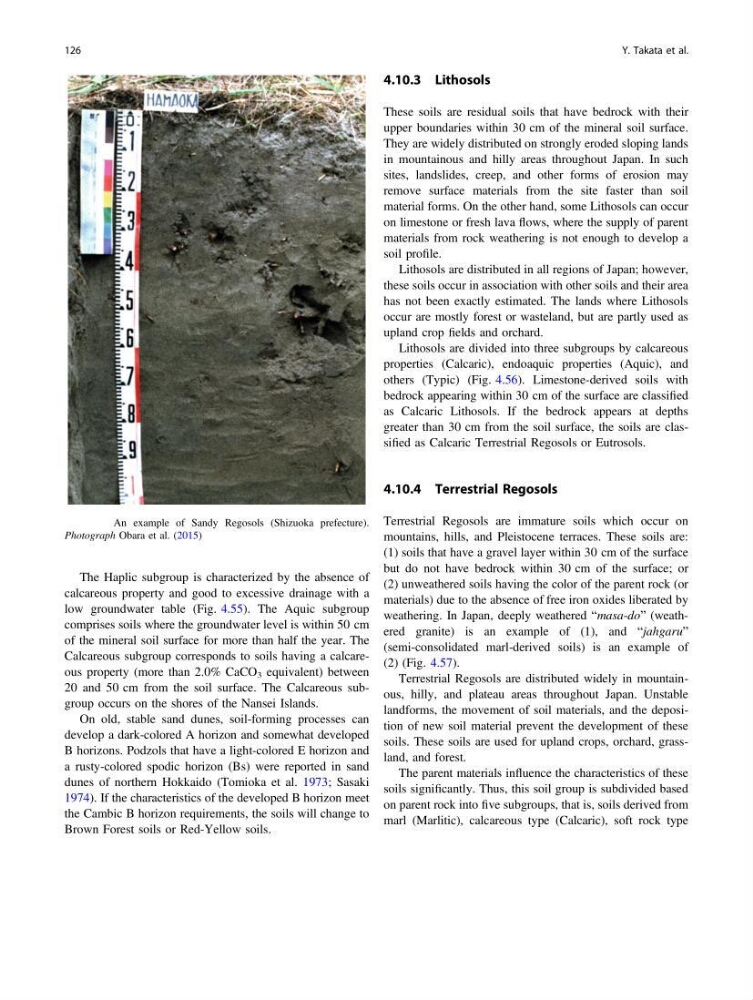
low groundwater table (Fig. 4.55). The Aquic subgroup
comprises soils where the groundwater level is within 50 cm
of the mineral soil surface for more than half the year. The
Calcareous subgroup corresponds to soils having a calcareous property (more than 2.0% CaCO 3 equivalent) between
20 and 50 cm from the soil surface. The Calcareous subgroup occurs on the shores of the Nansei Islands.
On old, stable sand dunes, soil-forming processes can
develop a dark-colored A horizon and somewhat developed
B horizons. Podzols that have a light-colored E horizon and
a rusty-colored spodic horizon (Bs) were reported in sand
dunes of northern Hokkaido (Tomioka et al. 1973; Sasaki
1974). If the characteristics of the developed B horizon meet
the Cambic B horizon requirements, the soils will change to
Brown Forest soils or Red-Yellow soils.
4.10.3 Lithosols
These soils are residual soils that have bedrock with their
upper boundaries within 30 cm of the mineral soil surface.
They are widely distributed on strongly eroded sloping lands
in mountainous and hilly areas throughout Japan. In such
sites, landslides, creep, and other forms of erosion may
remove surface materials from the site faster than soil
material forms. On the other hand, some Lithosols can occur
on limestone or fresh lava flows, where the supply of parent
materials from rock weathering is not enough to develop a
soil profile.
Lithosols are distributed in all regions of Japan; however,
these soils occur in association with other soils and their area
has not been exactly estimated. The lands where Lithosols
occur are mostly forest or wasteland, but are partly used as
upland crop fields and orchard.
Lithosols are divided into three subgroups by calcareous
properties (Calcaric), endoaquic properties (Aquic), and
others (Typic) (Fig. 4.56). Limestone-derived soils with
bedrock appearing within 30 cm of the surface are classified
as Calcaric Lithosols. If the bedrock appears at depths
greater than 30 cm from the soil surface, the soils are classified as Calcaric Terrestrial Regosols or Eutrosols.
4.10.4 Terrestrial Regosols
Terrestrial Regosols are immature soils which occur on
mountains, hills, and Pleistocene terraces. These soils are:
(1) soils that have a gravel layer within 30 cm of the surface
but do not have bedrock within 30 cm of the surface; or
(2) unweathered soils having the color of the parent rock (or
materials) due to the absence of free iron oxides liberated by
weathering. In Japan, deeply weathered “masa-do” (weathered granite) is an example of (1), and “jahgaru”
(semi-consolidated marl-derived soils) is an example of
(2) (Fig. 4.57).
Terrestrial Regosols are distributed widely in mountainous, hilly, and plateau areas throughout Japan. Unstable
landforms, the movement of soil materials, and the deposition of new soil material prevent the development of these
soils. These soils are used for upland crops, orchard, grassland, and forest.
The parent materials influence the characteristics of these
soils significantly. Thus, this soil group is subdivided based
on parent rock into five subgroups, that is, soils derived from
marl (Marlitic), calcareous type (Calcaric), soft rock type
Fig. 4.55 An example of Sandy Regosols (Shizuoka prefecture).
Photograph Obara et al. (2015)
126
Y. Takata et al.
calcareous property and good to excessive drainage with a
low groundwater table (Fig. 4.55). The Aquic subgroup
comprises soils where the groundwater level is within 50 cm
of the mineral soil surface for more than half the year. The
Calcareous subgroup corresponds to soils having a calcareous property (more than 2.0% CaCO 3 equivalent) between
20 and 50 cm from the soil surface. The Calcareous subgroup occurs on the shores of the Nansei Islands.
On old, stable sand dunes, soil-forming processes can
develop a dark-colored A horizon and somewhat developed
B horizons. Podzols that have a light-colored E horizon and
a rusty-colored spodic horizon (Bs) were reported in sand
dunes of northern Hokkaido (Tomioka et al. 1973; Sasaki
1974). If the characteristics of the developed B horizon meet
the Cambic B horizon requirements, the soils will change to
Brown Forest soils or Red-Yellow soils.
4.10.3 Lithosols
These soils are residual soils that have bedrock with their
upper boundaries within 30 cm of the mineral soil surface.
They are widely distributed on strongly eroded sloping lands
in mountainous and hilly areas throughout Japan. In such
sites, landslides, creep, and other forms of erosion may
remove surface materials from the site faster than soil
material forms. On the other hand, some Lithosols can occur
on limestone or fresh lava flows, where the supply of parent
materials from rock weathering is not enough to develop a
soil profile.
Lithosols are distributed in all regions of Japan; however,
these soils occur in association with other soils and their area
has not been exactly estimated. The lands where Lithosols
occur are mostly forest or wasteland, but are partly used as
upland crop fields and orchard.
Lithosols are divided into three subgroups by calcareous
properties (Calcaric), endoaquic properties (Aquic), and
others (Typic) (Fig. 4.56). Limestone-derived soils with
bedrock appearing within 30 cm of the surface are classified
as Calcaric Lithosols. If the bedrock appears at depths
greater than 30 cm from the soil surface, the soils are classified as Calcaric Terrestrial Regosols or Eutrosols.
4.10.4 Terrestrial Regosols
Terrestrial Regosols are immature soils which occur on
mountains, hills, and Pleistocene terraces. These soils are:
(1) soils that have a gravel layer within 30 cm of the surface
but do not have bedrock within 30 cm of the surface; or
(2) unweathered soils having the color of the parent rock (or
materials) due to the absence of free iron oxides liberated by
weathering. In Japan, deeply weathered “masa-do” (weathered granite) is an example of (1), and “jahgaru”
(semi-consolidated marl-derived soils) is an example of
(2) (Fig. 4.57).
Terrestrial Regosols are distributed widely in mountainous, hilly, and plateau areas throughout Japan. Unstable
landforms, the movement of soil materials, and the deposition of new soil material prevent the development of these
soils. These soils are used for upland crops, orchard, grassland, and forest.
The parent materials influence the characteristics of these
soils significantly. Thus, this soil group is subdivided based
on parent rock into five subgroups, that is, soils derived from
marl (Marlitic), calcareous type (Calcaric), soft rock type
Fig. 4.55 An example of Sandy Regosols (Shizuoka prefecture).
Photograph Obara et al. (2015)
126
Y. Takata et al.