

both soil color and type of parent materials (parent rock)
used in former classification systems (e.g., Obara et al. 2011)
have been eliminated. Additionally, it was decided to key
out the Eutrosol soil great group after Fluvic soils and
Stagnic soils in order to exclude high-pH Fluvic soils and
Stagnogley soils from Eutrosols. From the viewpoints of
agricultural use and environmental conservation, this soil
great group was subdivided into Magnesian and Calcareous
groups. Nakao et al. (2011) reported a lower
calcium/magnesium (Ca/Mg) ratio in serpentinitic soils and
proposed the classification of “dark red magnesian soils.”
Maejima et al. (2014) also investigated the genesis and
classification of soils derived from serpentine and confirmed
that exchangeable Ca/Mg ratio was an appropriate criterion
for classifying serpentinitic soils. The exchangeable Ca/Mg
ratio as a new diagnostic property was subsequently introduced to distinguish Magnesian Eutrosols from Calcareous
Eutrosols (Fig. 4.41). Each group is further divided into
Argic (clay accumulation) and Haplic (Cambic) subgroups
according to the presence of clay accumulation in order to
enable comparison between the international and Japanese
soil classification systems.
The soils corresponding to the Eutrosol great group satisfy all of the following requirements:
(1) The top of the Argic horizon or Cambic horizon starts
within 50 cm of the soil surface;
(2) All of the subsurface horizon has a pH (H 2 O) of more
than 5.5 or a base saturation of more than 50%;
(3) Bedrock does not appear within 30 cm of the soil surface.
The Eutrosol great group can be subdivided into two soil
groups, Magnesian and Calcareous, depending on the
exchangeable Ca/Mg ratio.
Magnesian Eutrosols
These soils are Eutrosols which have one or more subhorizons of subsurface horizons having an exchangeable Ca/Mg
ratio of less than 0.1, or all of whose subhorizons have
exchangeable Ca/Mg ratios of less than 1.
Calcareous Eutrosols
Other Eutrosols
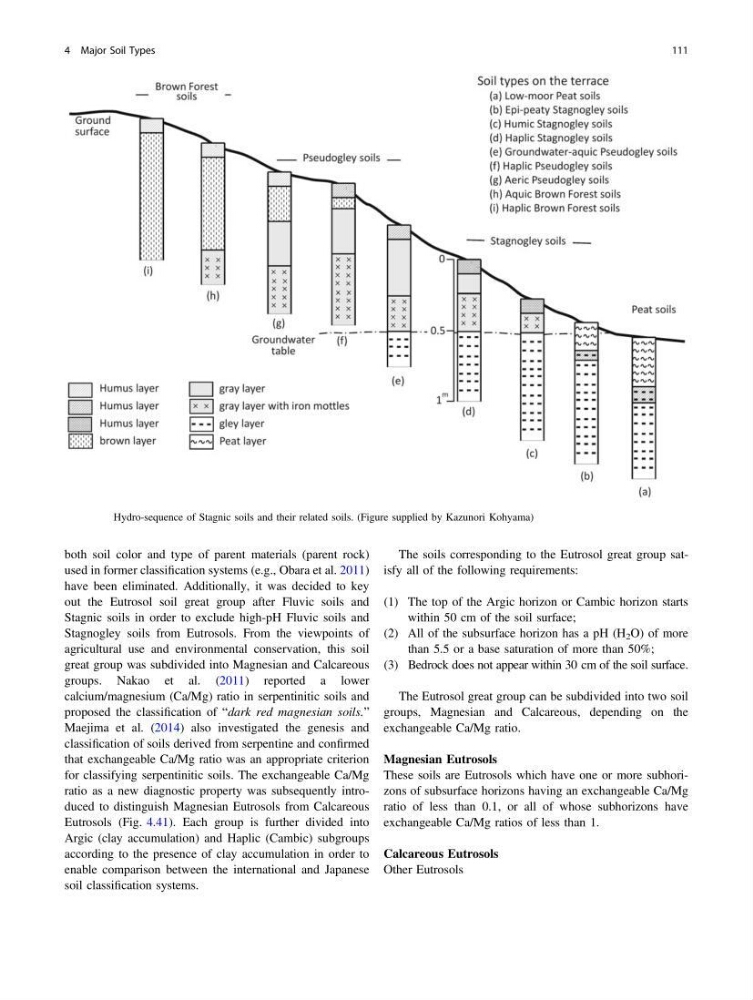
Fig. 4.40 Hydro-sequence of Stagnic soils and their related soils. (Figure supplied by Kazunori Kohyama)
4 Major Soil Types
111
used in former classification systems (e.g., Obara et al. 2011)
have been eliminated. Additionally, it was decided to key
out the Eutrosol soil great group after Fluvic soils and
Stagnic soils in order to exclude high-pH Fluvic soils and
Stagnogley soils from Eutrosols. From the viewpoints of
agricultural use and environmental conservation, this soil
great group was subdivided into Magnesian and Calcareous
groups. Nakao et al. (2011) reported a lower
calcium/magnesium (Ca/Mg) ratio in serpentinitic soils and
proposed the classification of “dark red magnesian soils.”
Maejima et al. (2014) also investigated the genesis and
classification of soils derived from serpentine and confirmed
that exchangeable Ca/Mg ratio was an appropriate criterion
for classifying serpentinitic soils. The exchangeable Ca/Mg
ratio as a new diagnostic property was subsequently introduced to distinguish Magnesian Eutrosols from Calcareous
Eutrosols (Fig. 4.41). Each group is further divided into
Argic (clay accumulation) and Haplic (Cambic) subgroups
according to the presence of clay accumulation in order to
enable comparison between the international and Japanese
soil classification systems.
The soils corresponding to the Eutrosol great group satisfy all of the following requirements:
(1) The top of the Argic horizon or Cambic horizon starts
within 50 cm of the soil surface;
(2) All of the subsurface horizon has a pH (H 2 O) of more
than 5.5 or a base saturation of more than 50%;
(3) Bedrock does not appear within 30 cm of the soil surface.
The Eutrosol great group can be subdivided into two soil
groups, Magnesian and Calcareous, depending on the
exchangeable Ca/Mg ratio.
Magnesian Eutrosols
These soils are Eutrosols which have one or more subhorizons of subsurface horizons having an exchangeable Ca/Mg
ratio of less than 0.1, or all of whose subhorizons have
exchangeable Ca/Mg ratios of less than 1.
Calcareous Eutrosols
Other Eutrosols
Fig. 4.40 Hydro-sequence of Stagnic soils and their related soils. (Figure supplied by Kazunori Kohyama)
4 Major Soil Types
111