

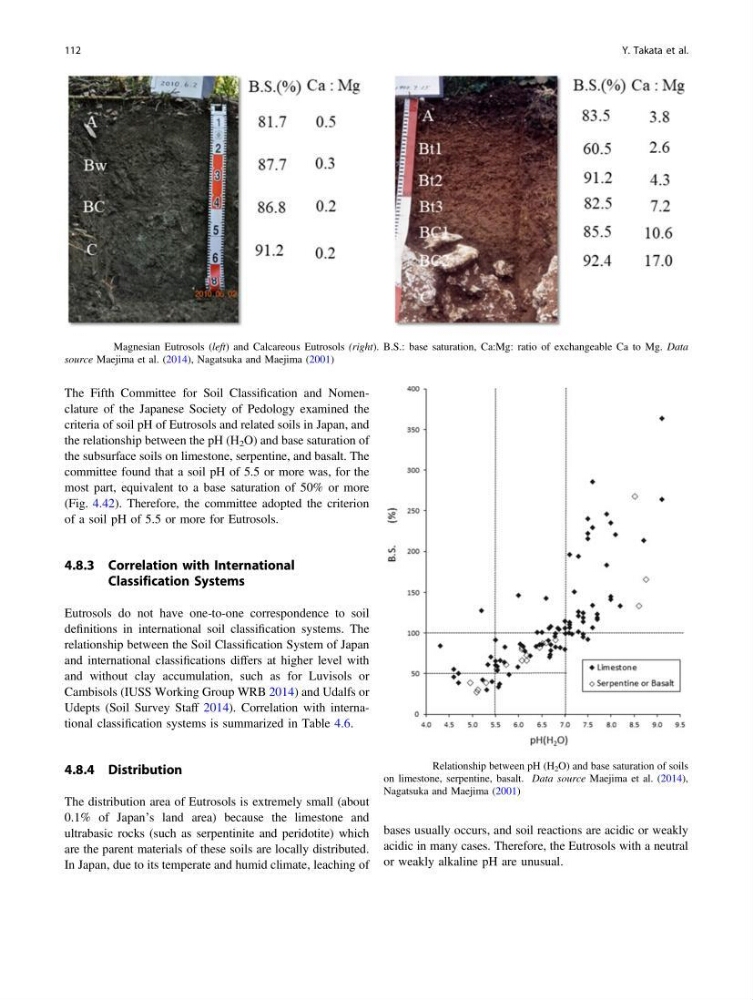
The Fifth Committee for Soil Classification and Nomenclature of the Japanese Society of Pedology examined the
criteria of soil pH of Eutrosols and related soils in Japan, and
the relationship between the pH (H 2 O) and base saturation of
the subsurface soils on limestone, serpentine, and basalt. The
committee found that a soil pH of 5.5 or more was, for the
most part, equivalent to a base saturation of 50% or more
(Fig. 4.42). Therefore, the committee adopted the criterion
of a soil pH of 5.5 or more for Eutrosols.
4.8.3 Correlation with International
Classification Systems
Eutrosols do not have one-to-one correspondence to soil
definitions in international soil classification systems. The
relationship between the Soil Classification System of Japan
and international classifications differs at higher level with
and without clay accumulation, such as for Luvisols or
Cambisols (IUSS Working Group WRB 2014) and Udalfs or
Udepts (Soil Survey Staff 2014). Correlation with international classification systems is summarized in Table 4.6.
4.8.4 Distribution
The distribution area of Eutrosols is extremely small (about
0.1% of Japan’s land area) because the limestone and
ultrabasic rocks (such as serpentinite and peridotite) which
are the parent materials of these soils are locally distributed.
In Japan, due to its temperate and humid climate, leaching of
bases usually occurs, and soil reactions are acidic or weakly
acidic in many cases. Therefore, the Eutrosols with a neutral
or weakly alkaline pH are unusual.
Fig. 4.41 Magnesian Eutrosols (left) and Calcareous Eutrosols (right). B.S.: base saturation, Ca:Mg: ratio of exchangeable Ca to Mg. Data
source Maejima et al. (2014), Nagatsuka and Maejima (2001)
Fig. 4.42 Relationship between pH (H 2 O) and base saturation of soils
on limestone, serpentine, basalt. Data source Maejima et al. (2014),
Nagatsuka and Maejima (2001)
112
Y. Takata et al.
criteria of soil pH of Eutrosols and related soils in Japan, and
the relationship between the pH (H 2 O) and base saturation of
the subsurface soils on limestone, serpentine, and basalt. The
committee found that a soil pH of 5.5 or more was, for the
most part, equivalent to a base saturation of 50% or more
(Fig. 4.42). Therefore, the committee adopted the criterion
of a soil pH of 5.5 or more for Eutrosols.
4.8.3 Correlation with International
Classification Systems
Eutrosols do not have one-to-one correspondence to soil
definitions in international soil classification systems. The
relationship between the Soil Classification System of Japan
and international classifications differs at higher level with
and without clay accumulation, such as for Luvisols or
Cambisols (IUSS Working Group WRB 2014) and Udalfs or
Udepts (Soil Survey Staff 2014). Correlation with international classification systems is summarized in Table 4.6.
4.8.4 Distribution
The distribution area of Eutrosols is extremely small (about
0.1% of Japan’s land area) because the limestone and
ultrabasic rocks (such as serpentinite and peridotite) which
are the parent materials of these soils are locally distributed.
In Japan, due to its temperate and humid climate, leaching of
bases usually occurs, and soil reactions are acidic or weakly
acidic in many cases. Therefore, the Eutrosols with a neutral
or weakly alkaline pH are unusual.
Fig. 4.41 Magnesian Eutrosols (left) and Calcareous Eutrosols (right). B.S.: base saturation, Ca:Mg: ratio of exchangeable Ca to Mg. Data
source Maejima et al. (2014), Nagatsuka and Maejima (2001)
Fig. 4.42 Relationship between pH (H 2 O) and base saturation of soils
on limestone, serpentine, basalt. Data source Maejima et al. (2014),
Nagatsuka and Maejima (2001)
112
Y. Takata et al.