

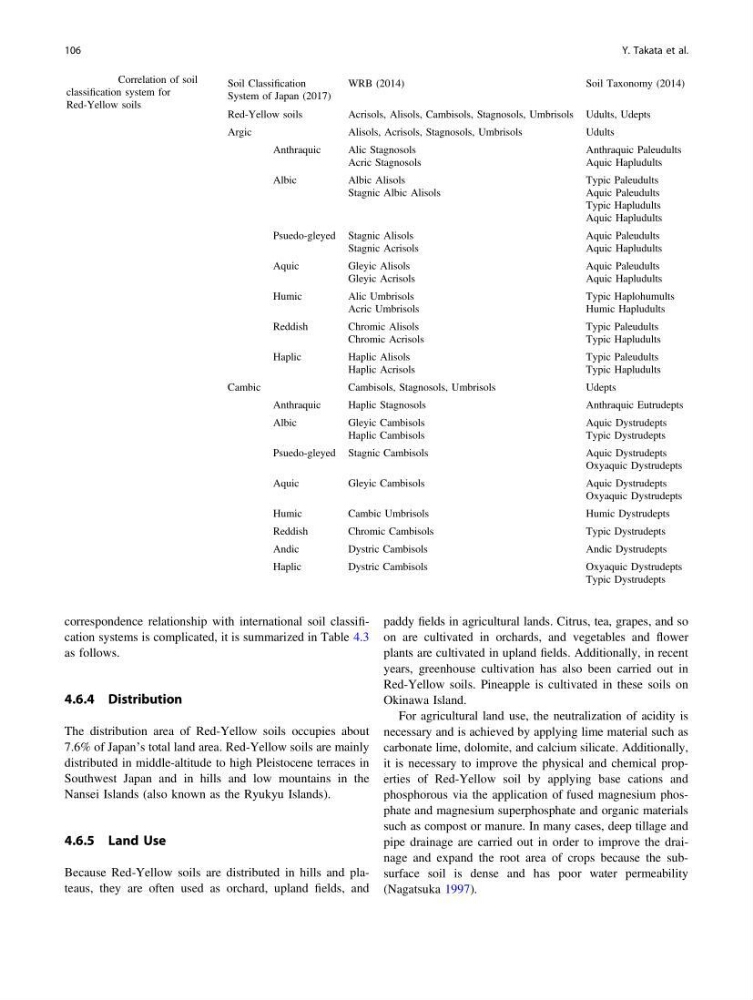
correspondence relationship with international soil classification systems is complicated, it is summarized in Table 4.3
as follows.
4.6.4 Distribution
The distribution area of Red-Yellow soils occupies about
7.6% of Japan’s total land area. Red-Yellow soils are mainly
distributed in middle-altitude to high Pleistocene terraces in
Southwest Japan and in hills and low mountains in the
Nansei Islands (also known as the Ryukyu Islands).
4.6.5 Land Use
Because Red-Yellow soils are distributed in hills and plateaus, they are often used as orchard, upland fields, and
paddy fields in agricultural lands. Citrus, tea, grapes, and so
on are cultivated in orchards, and vegetables and flower
plants are cultivated in upland fields. Additionally, in recent
years, greenhouse cultivation has also been carried out in
Red-Yellow soils. Pineapple is cultivated in these soils on
Okinawa Island.
For agricultural land use, the neutralization of acidity is
necessary and is achieved by applying lime material such as
carbonate lime, dolomite, and calcium silicate. Additionally,
it is necessary to improve the physical and chemical properties of Red-Yellow soil by applying base cations and
phosphorous via the application of fused magnesium phosphate and magnesium superphosphate and organic materials
such as compost or manure. In many cases, deep tillage and
pipe drainage are carried out in order to improve the drainage and expand the root area of crops because the subsurface soil is dense and has poor water permeability
(Nagatsuka 1997).
Table 4.3 Correlation of soil
classification system for
Red-Yellow soils
Soil Classification
System of Japan (2017)
WRB (2014)
Soil Taxonomy (2014)
Red-Yellow soils
Acrisols, Alisols, Cambisols, Stagnosols, Umbrisols Udults, Udepts
Argic
Alisols, Acrisols, Stagnosols, Umbrisols
Udults
Anthraquic
Alic Stagnosols
Acric Stagnosols
Anthraquic Paleudults
Aquic Hapludults
Albic
Albic Alisols
Stagnic Albic Alisols
Typic Paleudults
Aquic Paleudults
Typic Hapludults
Aquic Hapludults
Psuedo-gleyed Stagnic Alisols
Stagnic Acrisols
Aquic Paleudults
Aquic Hapludults
Aquic
Gleyic Alisols
Gleyic Acrisols
Aquic Paleudults
Aquic Hapludults
Humic
Alic Umbrisols
Acric Umbrisols
Typic Haplohumults
Humic Hapludults
Reddish
Chromic Alisols
Chromic Acrisols
Typic Paleudults
Typic Hapludults
Haplic
Haplic Alisols
Haplic Acrisols
Typic Paleudults
Typic Hapludults
Cambic
Cambisols, Stagnosols, Umbrisols
Udepts
Anthraquic
Haplic Stagnosols
Anthraquic Eutrudepts
Albic
Gleyic Cambisols
Haplic Cambisols
Aquic Dystrudepts
Typic Dystrudepts
Psuedo-gleyed Stagnic Cambisols
Aquic Dystrudepts
Oxyaquic Dystrudepts
Aquic
Gleyic Cambisols
Aquic Dystrudepts
Oxyaquic Dystrudepts
Humic
Cambic Umbrisols
Humic Dystrudepts
Reddish
Chromic Cambisols
Typic Dystrudepts
Andic
Dystric Cambisols
Andic Dystrudepts
Haplic
Dystric Cambisols
Oxyaquic Dystrudepts
Typic Dystrudepts
106
Y. Takata et al.
as follows.
4.6.4 Distribution
The distribution area of Red-Yellow soils occupies about
7.6% of Japan’s total land area. Red-Yellow soils are mainly
distributed in middle-altitude to high Pleistocene terraces in
Southwest Japan and in hills and low mountains in the
Nansei Islands (also known as the Ryukyu Islands).
4.6.5 Land Use
Because Red-Yellow soils are distributed in hills and plateaus, they are often used as orchard, upland fields, and
paddy fields in agricultural lands. Citrus, tea, grapes, and so
on are cultivated in orchards, and vegetables and flower
plants are cultivated in upland fields. Additionally, in recent
years, greenhouse cultivation has also been carried out in
Red-Yellow soils. Pineapple is cultivated in these soils on
Okinawa Island.
For agricultural land use, the neutralization of acidity is
necessary and is achieved by applying lime material such as
carbonate lime, dolomite, and calcium silicate. Additionally,
it is necessary to improve the physical and chemical properties of Red-Yellow soil by applying base cations and
phosphorous via the application of fused magnesium phosphate and magnesium superphosphate and organic materials
such as compost or manure. In many cases, deep tillage and
pipe drainage are carried out in order to improve the drainage and expand the root area of crops because the subsurface soil is dense and has poor water permeability
(Nagatsuka 1997).
Table 4.3 Correlation of soil
classification system for
Red-Yellow soils
Soil Classification
System of Japan (2017)
WRB (2014)
Soil Taxonomy (2014)
Red-Yellow soils
Acrisols, Alisols, Cambisols, Stagnosols, Umbrisols Udults, Udepts
Argic
Alisols, Acrisols, Stagnosols, Umbrisols
Udults
Anthraquic
Alic Stagnosols
Acric Stagnosols
Anthraquic Paleudults
Aquic Hapludults
Albic
Albic Alisols
Stagnic Albic Alisols
Typic Paleudults
Aquic Paleudults
Typic Hapludults
Aquic Hapludults
Psuedo-gleyed Stagnic Alisols
Stagnic Acrisols
Aquic Paleudults
Aquic Hapludults
Aquic
Gleyic Alisols
Gleyic Acrisols
Aquic Paleudults
Aquic Hapludults
Humic
Alic Umbrisols
Acric Umbrisols
Typic Haplohumults
Humic Hapludults
Reddish
Chromic Alisols
Chromic Acrisols
Typic Paleudults
Typic Hapludults
Haplic
Haplic Alisols
Haplic Acrisols
Typic Paleudults
Typic Hapludults
Cambic
Cambisols, Stagnosols, Umbrisols
Udepts
Anthraquic
Haplic Stagnosols
Anthraquic Eutrudepts
Albic
Gleyic Cambisols
Haplic Cambisols
Aquic Dystrudepts
Typic Dystrudepts
Psuedo-gleyed Stagnic Cambisols
Aquic Dystrudepts
Oxyaquic Dystrudepts
Aquic
Gleyic Cambisols
Aquic Dystrudepts
Oxyaquic Dystrudepts
Humic
Cambic Umbrisols
Humic Dystrudepts
Reddish
Chromic Cambisols
Typic Dystrudepts
Andic
Dystric Cambisols
Andic Dystrudepts
Haplic
Dystric Cambisols
Oxyaquic Dystrudepts
Typic Dystrudepts
106
Y. Takata et al.