

4.7 Stagnic Soils
Stagnic soils are hydromorphic soils that are influenced by
groundwater or surface water and have gley horizons or gray
horizons with iron mottles in subsoils. While soils with
hydromorphic features distributed in alluvial plains are classified as Fluvic soils, Stagnic soils are distributed in areas with
poor drainage in terraces, hills, and mountainous areas.
Stagnic soils can be divided into Stagnogley soils (mainly
correlated with Gleysols; WRB 2006) and Pseudogley soils
(mainly correlated to Stagnosols; WRB 2006) according to
drainage conditions and groundwater level. While Stagnogley
soils are strongly influenced by groundwater throughout the
year or for most of the year, Pseudogley soils are influenced
by surface water because of the presence of an impermeable
layer that prevents the downward filtration of soil water.
4.7.1 Stagnogley Soils
(1) Formation of Stagnogley soils
Stagnogley soils are distributed in terraces, hills, and
mountainous areas having a shallow groundwater table. Such
areas are found in concave topography or at the bottom of
slopes, where water gathers easily and drainage is poor.
When a shallow groundwater table is present and water saturates a soil for a long time, a reductive condition develops in
the subsoil. As a result, ferric ion is reduced to ferrous ion,
the soil color changes to a blueish color, and a gley horizon
forms. This soil formation process is known as “gleying.”
Gley horizons are easy to identify from field observation,
because the soil has a blueish color and the a,a′-dipyridyl
regent changes to a red color rapidly in gley horizons. The
depth of appearance of gley horizons depends on the depth of
the groundwater table and the length of time that the soil is
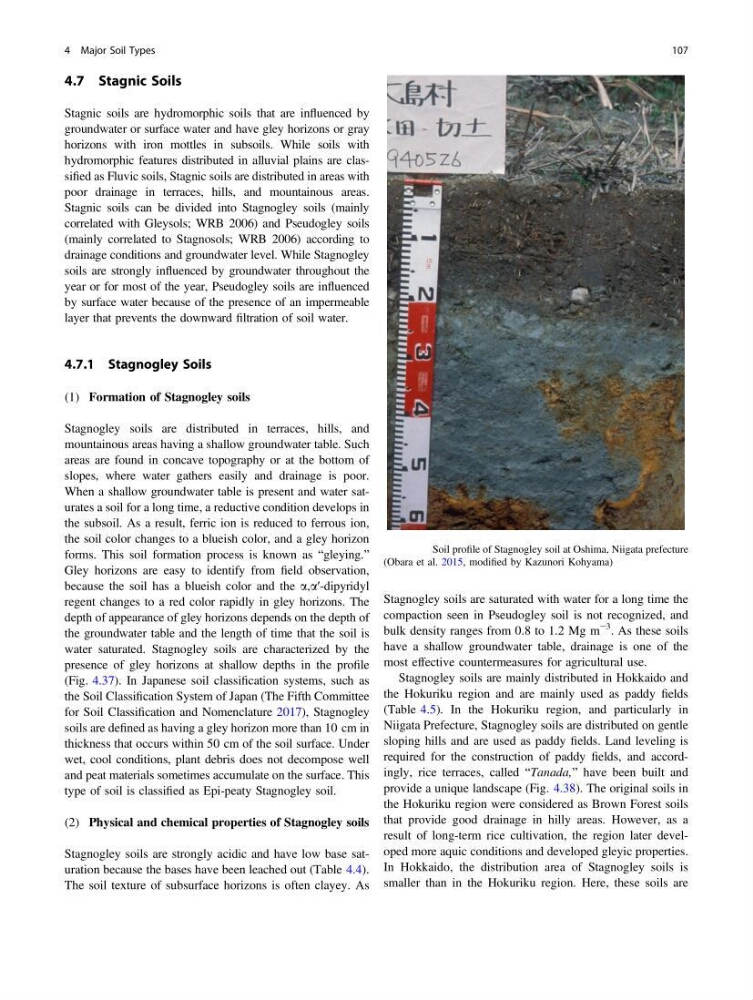
water saturated. Stagnogley soils are characterized by the
presence of gley horizons at shallow depths in the profile
(Fig. 4.37). In Japanese soil classification systems, such as
the Soil Classification System of Japan (The Fifth Committee
for Soil Classification and Nomenclature 2017), Stagnogley
soils are defined as having a gley horizon more than 10 cm in
thickness that occurs within 50 cm of the soil surface. Under
wet, cool conditions, plant debris does not decompose well
and peat materials sometimes accumulate on the surface. This
type of soil is classified as Epi-peaty Stagnogley soil.
(2) Physical and chemical properties of Stagnogley soils
Stagnogley soils are strongly acidic and have low base saturation because the bases have been leached out (Table 4.4).
The soil texture of subsurface horizons is often clayey. As
Stagnogley soils are saturated with water for a long time the
compaction seen in Pseudogley soil is not recognized, and
bulk density ranges from 0.8 to 1.2 Mg m
−3 . As these soils
have a shallow groundwater table, drainage is one of the
most effective countermeasures for agricultural use.
Stagnogley soils are mainly distributed in Hokkaido and
the Hokuriku region and are mainly used as paddy fields
(Table 4.5). In the Hokuriku region, and particularly in
Niigata Prefecture, Stagnogley soils are distributed on gentle
sloping hills and are used as paddy fields. Land leveling is
required for the construction of paddy fields, and accordingly, rice terraces, called “Tanada,” have been built and
provide a unique landscape (Fig. 4.38). The original soils in
the Hokuriku region were considered as Brown Forest soils
that provide good drainage in hilly areas. However, as a
result of long-term rice cultivation, the region later developed more aquic conditions and developed gleyic properties.
In Hokkaido, the distribution area of Stagnogley soils is
smaller than in the Hokuriku region. Here, these soils are
Fig. 4.37 Soil profile of Stagnogley soil at Oshima, Niigata prefecture
(Obara et al. 2015, modified by Kazunori Kohyama)
4 Major Soil Types
107
Stagnic soils are hydromorphic soils that are influenced by
groundwater or surface water and have gley horizons or gray
horizons with iron mottles in subsoils. While soils with
hydromorphic features distributed in alluvial plains are classified as Fluvic soils, Stagnic soils are distributed in areas with
poor drainage in terraces, hills, and mountainous areas.
Stagnic soils can be divided into Stagnogley soils (mainly
correlated with Gleysols; WRB 2006) and Pseudogley soils
(mainly correlated to Stagnosols; WRB 2006) according to
drainage conditions and groundwater level. While Stagnogley
soils are strongly influenced by groundwater throughout the
year or for most of the year, Pseudogley soils are influenced
by surface water because of the presence of an impermeable
layer that prevents the downward filtration of soil water.
4.7.1 Stagnogley Soils
(1) Formation of Stagnogley soils
Stagnogley soils are distributed in terraces, hills, and
mountainous areas having a shallow groundwater table. Such
areas are found in concave topography or at the bottom of
slopes, where water gathers easily and drainage is poor.
When a shallow groundwater table is present and water saturates a soil for a long time, a reductive condition develops in
the subsoil. As a result, ferric ion is reduced to ferrous ion,
the soil color changes to a blueish color, and a gley horizon
forms. This soil formation process is known as “gleying.”
Gley horizons are easy to identify from field observation,
because the soil has a blueish color and the a,a′-dipyridyl
regent changes to a red color rapidly in gley horizons. The
depth of appearance of gley horizons depends on the depth of
the groundwater table and the length of time that the soil is
water saturated. Stagnogley soils are characterized by the
presence of gley horizons at shallow depths in the profile
(Fig. 4.37). In Japanese soil classification systems, such as
the Soil Classification System of Japan (The Fifth Committee
for Soil Classification and Nomenclature 2017), Stagnogley
soils are defined as having a gley horizon more than 10 cm in
thickness that occurs within 50 cm of the soil surface. Under
wet, cool conditions, plant debris does not decompose well
and peat materials sometimes accumulate on the surface. This
type of soil is classified as Epi-peaty Stagnogley soil.
(2) Physical and chemical properties of Stagnogley soils
Stagnogley soils are strongly acidic and have low base saturation because the bases have been leached out (Table 4.4).
The soil texture of subsurface horizons is often clayey. As
Stagnogley soils are saturated with water for a long time the
compaction seen in Pseudogley soil is not recognized, and
bulk density ranges from 0.8 to 1.2 Mg m
−3 . As these soils
have a shallow groundwater table, drainage is one of the
most effective countermeasures for agricultural use.
Stagnogley soils are mainly distributed in Hokkaido and
the Hokuriku region and are mainly used as paddy fields
(Table 4.5). In the Hokuriku region, and particularly in
Niigata Prefecture, Stagnogley soils are distributed on gentle
sloping hills and are used as paddy fields. Land leveling is
required for the construction of paddy fields, and accordingly, rice terraces, called “Tanada,” have been built and
provide a unique landscape (Fig. 4.38). The original soils in
the Hokuriku region were considered as Brown Forest soils
that provide good drainage in hilly areas. However, as a
result of long-term rice cultivation, the region later developed more aquic conditions and developed gleyic properties.
In Hokkaido, the distribution area of Stagnogley soils is
smaller than in the Hokuriku region. Here, these soils are
Fig. 4.37 Soil profile of Stagnogley soil at Oshima, Niigata prefecture
(Obara et al. 2015, modified by Kazunori Kohyama)
4 Major Soil Types
107