

The other is the “paleo-Red soil theory,” whereby Red soil is
deemed to be a relic of paleosols from a past geological age
whose climate was warmer than the present climate. Ohmasa
et al. (1955) first reported the existence of paleo-Red soils in
Japan. Subsequently, Matsui and Kato (1961) proved that
paleo-Red soils were distributed in Southwest as well as
Northwest Japan. At the present, the paleo-Red soil theory is
generally preferred, and research aiming to obtain a more
accurate age for paleo-Red soils has begun. For example,
Akagi et al. (2003) estimated the formation period of
paleo-Red soils in southern Kyushu and found that
paleo-Red soils were formed from 400–500 to 110–130
thousand years ago. Nagatsuka and Maejima (2001) also
estimated the absolute age of soils on a raised coral limestone terrace in Kikai Island and stated that it would take at
least 125,000 years for Red-Yellow soils to develop on coral
limestone under a humid subtropical climate. However,
Araki (1993) suggested that it is impossible to distinguish
between paleo-Red soils and recent Red soils because the
properties of Red-Yellow soils change continuously
depending on whether they are located in a tropical, subtropical, or temperate zone. For instance, the CEC of
red-colored B horizons in Northeast Japan is relatively high
(usually exceeding 25 cmol c kg
−1 clay) while those B
horizons are in the early stage of the weathering process
(Araki 1993).
4.6.2 Classification
The general properties of Red-Yellow soils are a red or
yellow color, low accumulation of organic matter, low base
saturation, and strong weathering. Generally, these soils are
strongly or weakly acidic. Soils corresponding to the
Red-Yellow soil great group satisfy all of the following
requirements:
(1) An “Argic horizon” with “Red-Yellow properties” is
present, having an integrated thickness of 25 cm or
more and starting within 50 cm of the soil surface or the
upper end of “Red-Yellow Cambic horizon,” having an
integrated thickness of 25 cm or more and starting
within 35 cm of the soil surface;
(2) The subsurface horizon has a pH (H 2 O) of less than 5.5
or a base saturation of less than 50%;
(3) Bedrock does not appear within 30 cm of the soil
surface.
The Red-Yellow soil great group can be subdivided into
two soil groups, “Argic” and “Cambic,” depending on the
presence of clay accumulation, in order to allow comparison
between international and Japanese soil classification
systems.
Argic Red-Yellow soils
These soils are Red-Yellow soils which have an argic
horizon.
Cambic Red-Yellow soils
These soils are Red-Yellow soils which have a cambic
horizon.
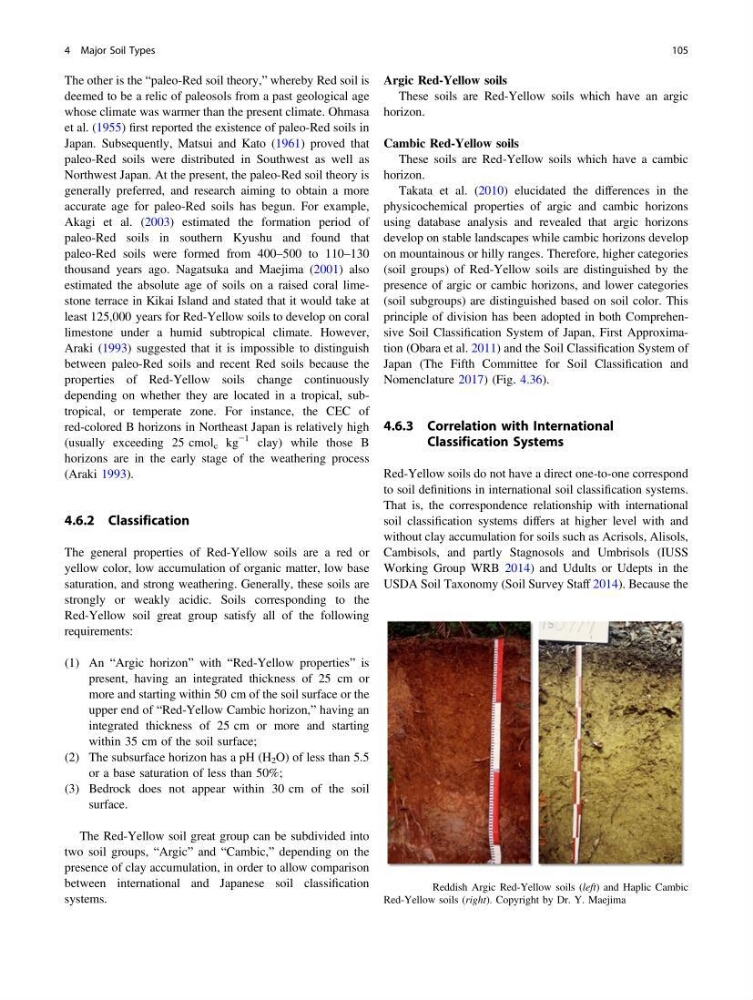
Takata et al. (2010) elucidated the differences in the
physicochemical properties of argic and cambic horizons
using database analysis and revealed that argic horizons
develop on stable landscapes while cambic horizons develop
on mountainous or hilly ranges. Therefore, higher categories
(soil groups) of Red-Yellow soils are distinguished by the
presence of argic or cambic horizons, and lower categories
(soil subgroups) are distinguished based on soil color. This
principle of division has been adopted in both Comprehensive Soil Classification System of Japan, First Approximation (Obara et al. 2011) and the Soil Classification System of
Japan (The Fifth Committee for Soil Classification and
Nomenclature 2017) (Fig. 4.36).
4.6.3 Correlation with International
Classification Systems
Red-Yellow soils do not have a direct one-to-one correspond
to soil definitions in international soil classification systems.
That is, the correspondence relationship with international
soil classification systems differs at higher level with and
without clay accumulation for soils such as Acrisols, Alisols,
Cambisols, and partly Stagnosols and Umbrisols (IUSS
Working Group WRB 2014) and Udults or Udepts in the
USDA Soil Taxonomy (Soil Survey Staff 2014). Because the
Fig. 4.36 Reddish Argic Red-Yellow soils (left) and Haplic Cambic
Red-Yellow soils (right). Copyright by Dr. Y. Maejima
4 Major Soil Types
105
deemed to be a relic of paleosols from a past geological age
whose climate was warmer than the present climate. Ohmasa
et al. (1955) first reported the existence of paleo-Red soils in
Japan. Subsequently, Matsui and Kato (1961) proved that
paleo-Red soils were distributed in Southwest as well as
Northwest Japan. At the present, the paleo-Red soil theory is
generally preferred, and research aiming to obtain a more
accurate age for paleo-Red soils has begun. For example,
Akagi et al. (2003) estimated the formation period of
paleo-Red soils in southern Kyushu and found that
paleo-Red soils were formed from 400–500 to 110–130
thousand years ago. Nagatsuka and Maejima (2001) also
estimated the absolute age of soils on a raised coral limestone terrace in Kikai Island and stated that it would take at
least 125,000 years for Red-Yellow soils to develop on coral
limestone under a humid subtropical climate. However,
Araki (1993) suggested that it is impossible to distinguish
between paleo-Red soils and recent Red soils because the
properties of Red-Yellow soils change continuously
depending on whether they are located in a tropical, subtropical, or temperate zone. For instance, the CEC of
red-colored B horizons in Northeast Japan is relatively high
(usually exceeding 25 cmol c kg
−1 clay) while those B
horizons are in the early stage of the weathering process
(Araki 1993).
4.6.2 Classification
The general properties of Red-Yellow soils are a red or
yellow color, low accumulation of organic matter, low base
saturation, and strong weathering. Generally, these soils are
strongly or weakly acidic. Soils corresponding to the
Red-Yellow soil great group satisfy all of the following
requirements:
(1) An “Argic horizon” with “Red-Yellow properties” is
present, having an integrated thickness of 25 cm or
more and starting within 50 cm of the soil surface or the
upper end of “Red-Yellow Cambic horizon,” having an
integrated thickness of 25 cm or more and starting
within 35 cm of the soil surface;
(2) The subsurface horizon has a pH (H 2 O) of less than 5.5
or a base saturation of less than 50%;
(3) Bedrock does not appear within 30 cm of the soil
surface.
The Red-Yellow soil great group can be subdivided into
two soil groups, “Argic” and “Cambic,” depending on the
presence of clay accumulation, in order to allow comparison
between international and Japanese soil classification
systems.
Argic Red-Yellow soils
These soils are Red-Yellow soils which have an argic
horizon.
Cambic Red-Yellow soils
These soils are Red-Yellow soils which have a cambic
horizon.
Takata et al. (2010) elucidated the differences in the
physicochemical properties of argic and cambic horizons
using database analysis and revealed that argic horizons
develop on stable landscapes while cambic horizons develop
on mountainous or hilly ranges. Therefore, higher categories
(soil groups) of Red-Yellow soils are distinguished by the
presence of argic or cambic horizons, and lower categories
(soil subgroups) are distinguished based on soil color. This
principle of division has been adopted in both Comprehensive Soil Classification System of Japan, First Approximation (Obara et al. 2011) and the Soil Classification System of
Japan (The Fifth Committee for Soil Classification and
Nomenclature 2017) (Fig. 4.36).
4.6.3 Correlation with International
Classification Systems
Red-Yellow soils do not have a direct one-to-one correspond
to soil definitions in international soil classification systems.
That is, the correspondence relationship with international
soil classification systems differs at higher level with and
without clay accumulation for soils such as Acrisols, Alisols,
Cambisols, and partly Stagnosols and Umbrisols (IUSS
Working Group WRB 2014) and Udults or Udepts in the
USDA Soil Taxonomy (Soil Survey Staff 2014). Because the
Fig. 4.36 Reddish Argic Red-Yellow soils (left) and Haplic Cambic
Red-Yellow soils (right). Copyright by Dr. Y. Maejima
4 Major Soil Types
105