

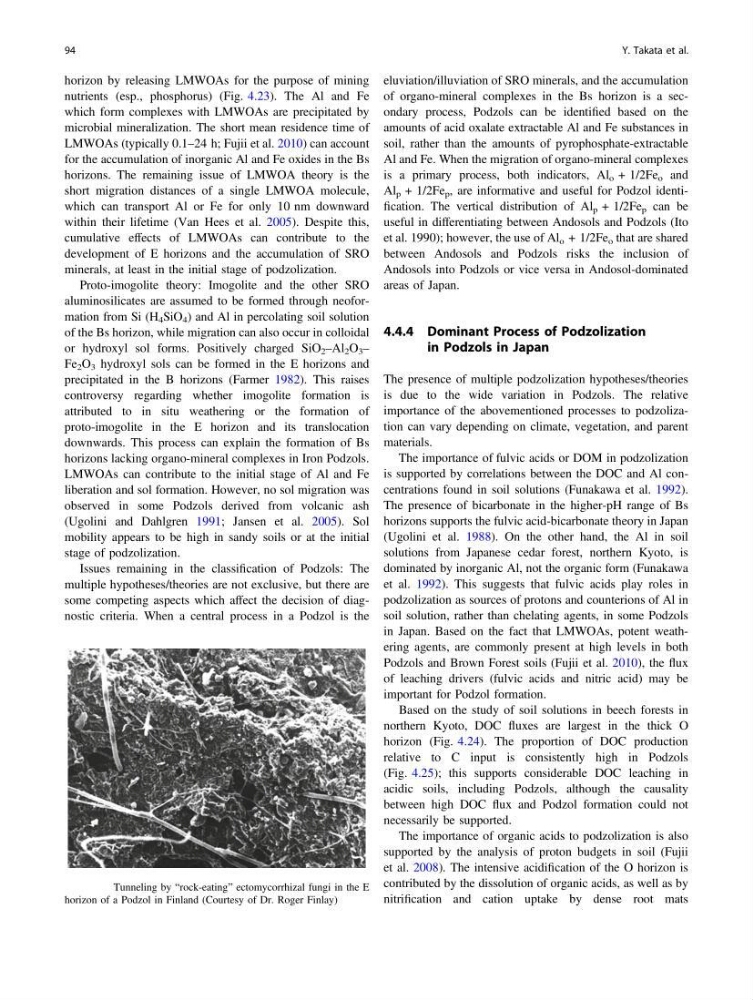
horizon by releasing LMWOAs for the purpose of mining
nutrients (esp., phosphorus) (Fig. 4.23). The Al and Fe
which form complexes with LMWOAs are precipitated by
microbial mineralization. The short mean residence time of
LMWOAs (typically 0.1–24 h; Fujii et al. 2010) can account
for the accumulation of inorganic Al and Fe oxides in the Bs
horizons. The remaining issue of LMWOA theory is the
short migration distances of a single LMWOA molecule,
which can transport Al or Fe for only 10 nm downward
within their lifetime (Van Hees et al. 2005). Despite this,
cumulative effects of LMWOAs can contribute to the
development of E horizons and the accumulation of SRO
minerals, at least in the initial stage of podzolization.
Proto-imogolite theory: Imogolite and the other SRO
aluminosilicates are assumed to be formed through neoformation from Si (H 4 SiO 4 ) and Al in percolating soil solution
of the Bs horizon, while migration can also occur in colloidal
or hydroxyl sol forms. Positively charged SiO 2 –Al 2 O 3 –
Fe 2 O 3 hydroxyl sols can be formed in the E horizons and
precipitated in the B horizons (Farmer 1982). This raises
controversy regarding whether imogolite formation is
attributed to in situ weathering or the formation of
proto-imogolite in the E horizon and its translocation
downwards. This process can explain the formation of Bs
horizons lacking organo-mineral complexes in Iron Podzols.
LMWOAs can contribute to the initial stage of Al and Fe
liberation and sol formation. However, no sol migration was
observed in some Podzols derived from volcanic ash
(Ugolini and Dahlgren 1991; Jansen et al. 2005). Sol
mobility appears to be high in sandy soils or at the initial
stage of podzolization.
Issues remaining in the classification of Podzols: The
multiple hypotheses/theories are not exclusive, but there are
some competing aspects which affect the decision of diagnostic criteria. When a central process in a Podzol is the
eluviation/illuviation of SRO minerals, and the accumulation
of organo-mineral complexes in the Bs horizon is a secondary process, Podzols can be identified based on the
amounts of acid oxalate extractable Al and Fe substances in
soil, rather than the amounts of pyrophosphate-extractable
Al and Fe. When the migration of organo-mineral complexes
is a primary process, both indicators, Al o + 1/2Fe o and
Al p + 1/2Fe p , are informative and useful for Podzol identification. The vertical distribution of Al p + 1/2Fe p can be
useful in differentiating between Andosols and Podzols (Ito
et al. 1990); however, the use of Al o + 1/2Fe o that are shared
between Andosols and Podzols risks the inclusion of
Andosols into Podzols or vice versa in Andosol-dominated
areas of Japan.
4.4.4 Dominant Process of Podzolization
in Podzols in Japan
The presence of multiple podzolization hypotheses/theories
is due to the wide variation in Podzols. The relative
importance of the abovementioned processes to podzolization can vary depending on climate, vegetation, and parent
materials.
The importance of fulvic acids or DOM in podzolization
is supported by correlations between the DOC and Al concentrations found in soil solutions (Funakawa et al. 1992).
The presence of bicarbonate in the higher-pH range of Bs
horizons supports the fulvic acid-bicarbonate theory in Japan
(Ugolini et al. 1988). On the other hand, the Al in soil
solutions from Japanese cedar forest, northern Kyoto, is
dominated by inorganic Al, not the organic form (Funakawa
et al. 1992). This suggests that fulvic acids play roles in
podzolization as sources of protons and counterions of Al in
soil solution, rather than chelating agents, in some Podzols
in Japan. Based on the fact that LMWOAs, potent weathering agents, are commonly present at high levels in both
Podzols and Brown Forest soils (Fujii et al. 2010), the flux
of leaching drivers (fulvic acids and nitric acid) may be
important for Podzol formation.
Based on the study of soil solutions in beech forests in
northern Kyoto, DOC fluxes are largest in the thick O
horizon (Fig. 4.24). The proportion of DOC production
relative to C input is consistently high in Podzols
(Fig. 4.25); this supports considerable DOC leaching in
acidic soils, including Podzols, although the causality
between high DOC flux and Podzol formation could not
necessarily be supported.
The importance of organic acids to podzolization is also
supported by the analysis of proton budgets in soil (Fujii
et al. 2008). The intensive acidification of the O horizon is
contributed by the dissolution of organic acids, as well as by
nitrification and cation uptake by dense root mats
Fig. 4.23 Tunneling by “rock-eating” ectomycorrhizal fungi in the E
horizon of a Podzol in Finland (Courtesy of Dr. Roger Finlay)
94
Y. Takata et al.
nutrients (esp., phosphorus) (Fig. 4.23). The Al and Fe
which form complexes with LMWOAs are precipitated by
microbial mineralization. The short mean residence time of
LMWOAs (typically 0.1–24 h; Fujii et al. 2010) can account
for the accumulation of inorganic Al and Fe oxides in the Bs
horizons. The remaining issue of LMWOA theory is the
short migration distances of a single LMWOA molecule,
which can transport Al or Fe for only 10 nm downward
within their lifetime (Van Hees et al. 2005). Despite this,
cumulative effects of LMWOAs can contribute to the
development of E horizons and the accumulation of SRO
minerals, at least in the initial stage of podzolization.
Proto-imogolite theory: Imogolite and the other SRO
aluminosilicates are assumed to be formed through neoformation from Si (H 4 SiO 4 ) and Al in percolating soil solution
of the Bs horizon, while migration can also occur in colloidal
or hydroxyl sol forms. Positively charged SiO 2 –Al 2 O 3 –
Fe 2 O 3 hydroxyl sols can be formed in the E horizons and
precipitated in the B horizons (Farmer 1982). This raises
controversy regarding whether imogolite formation is
attributed to in situ weathering or the formation of
proto-imogolite in the E horizon and its translocation
downwards. This process can explain the formation of Bs
horizons lacking organo-mineral complexes in Iron Podzols.
LMWOAs can contribute to the initial stage of Al and Fe
liberation and sol formation. However, no sol migration was
observed in some Podzols derived from volcanic ash
(Ugolini and Dahlgren 1991; Jansen et al. 2005). Sol
mobility appears to be high in sandy soils or at the initial
stage of podzolization.
Issues remaining in the classification of Podzols: The
multiple hypotheses/theories are not exclusive, but there are
some competing aspects which affect the decision of diagnostic criteria. When a central process in a Podzol is the
eluviation/illuviation of SRO minerals, and the accumulation
of organo-mineral complexes in the Bs horizon is a secondary process, Podzols can be identified based on the
amounts of acid oxalate extractable Al and Fe substances in
soil, rather than the amounts of pyrophosphate-extractable
Al and Fe. When the migration of organo-mineral complexes
is a primary process, both indicators, Al o + 1/2Fe o and
Al p + 1/2Fe p , are informative and useful for Podzol identification. The vertical distribution of Al p + 1/2Fe p can be
useful in differentiating between Andosols and Podzols (Ito
et al. 1990); however, the use of Al o + 1/2Fe o that are shared
between Andosols and Podzols risks the inclusion of
Andosols into Podzols or vice versa in Andosol-dominated
areas of Japan.
4.4.4 Dominant Process of Podzolization
in Podzols in Japan
The presence of multiple podzolization hypotheses/theories
is due to the wide variation in Podzols. The relative
importance of the abovementioned processes to podzolization can vary depending on climate, vegetation, and parent
materials.
The importance of fulvic acids or DOM in podzolization
is supported by correlations between the DOC and Al concentrations found in soil solutions (Funakawa et al. 1992).
The presence of bicarbonate in the higher-pH range of Bs
horizons supports the fulvic acid-bicarbonate theory in Japan
(Ugolini et al. 1988). On the other hand, the Al in soil
solutions from Japanese cedar forest, northern Kyoto, is
dominated by inorganic Al, not the organic form (Funakawa
et al. 1992). This suggests that fulvic acids play roles in
podzolization as sources of protons and counterions of Al in
soil solution, rather than chelating agents, in some Podzols
in Japan. Based on the fact that LMWOAs, potent weathering agents, are commonly present at high levels in both
Podzols and Brown Forest soils (Fujii et al. 2010), the flux
of leaching drivers (fulvic acids and nitric acid) may be
important for Podzol formation.
Based on the study of soil solutions in beech forests in
northern Kyoto, DOC fluxes are largest in the thick O
horizon (Fig. 4.24). The proportion of DOC production
relative to C input is consistently high in Podzols
(Fig. 4.25); this supports considerable DOC leaching in
acidic soils, including Podzols, although the causality
between high DOC flux and Podzol formation could not
necessarily be supported.
The importance of organic acids to podzolization is also
supported by the analysis of proton budgets in soil (Fujii
et al. 2008). The intensive acidification of the O horizon is
contributed by the dissolution of organic acids, as well as by
nitrification and cation uptake by dense root mats
Fig. 4.23 Tunneling by “rock-eating” ectomycorrhizal fungi in the E
horizon of a Podzol in Finland (Courtesy of Dr. Roger Finlay)
94
Y. Takata et al.