

4.4.3 Podzolization: Eluviation and Illuviation
of Short-Range-Order Al and Fe
To describe the uniqueness of Podzols in Japan, podzolization needs to be discussed in relation to existing theories and
hypotheses.
Fulvic acid theory: Organo-mineral complexes coating
the gains in the Bs horizons suggest that fulvic acids contribute to Al and Fe eluviation/illuviation (De Coninck
1980). Fulvic acids are typically a mixture of high molecular
weight (>1000 D) dissolved organic matter (DOM) with
carboxyl and phenolic functional groups with low charge
density (e.g., 1 mol c per 7 mol C from Ugolini and Sletten
1991). Organic acids do not simply work in mineral dissolution as proton sources (pH effect), but they also form
complexes with Al and Fe through ligand reaction
(Raulund-Rasmussen et al. 1998). The capture of Al and Fe
by organic acids reduces inorganic Al concentrations in soil
solution and leads to undersaturation in relation to aluminosilicate clays (e.g., vermiculite) and further dissolution of
clays (e.g., vermiculite to smectite). Soil solution DOC
concentration could decrease with depth due to sorption and
mineralization. C/Al or Fe molar ratios of 30 are required for
mobilization, but a C/(Al + Fe) ratio of 3 results in precipitation (Mokma and Buurman 1982; Jansen et al. 2005). The
gradual increase of pH with depth can result in Al polymerization and the precipitation of SRO minerals. This can
explain the accumulation of organo-mineral complexes in
the upper part of the Bs horizon; however, fulvic acid theory
fails to explain the accumulation of inorganic SRO Al and
Fe oxides in the deeper part of the Bs horizon due to the
recalcitrance of fulvic acids. An example of the measured
mean residence time of fulvic acids (high-molecular-weight
DOM) is 1.7 years (Qualls and Bridgham 2005), but
complexation and precipitation can increase mean residence
times to decades to hundreds of years (Harrison et al. 2000).
The low capacity for chelation and low decomposability of
fulvic acids cannot fully explain the illuviation of SRO
minerals.
Fulvic acid-bicarbonate theory: To explain the accumulation of inorganic SRO minerals in the Bs horizon, fulvic
acid-bicarbonate theory has been postulated based on soil
solution studies collected by lysimeters (Ugolini and
Dahlgren 1987). Fulvic acids contribute to Al- and
Fe-leaching through congruent dissolution, while bicarbonate contributes to in situ weathering (incongruent dissolution) and the accumulation of inorganic SRO minerals in the
higher-pH range of the Bs horizon. The pH rise in the B
horizons is caused by proton consumption due to the mineralization and sorption of organic acids and nitrate uptake
by plants. This theory has been developed by the study of
Podzolized Andisols in Hakkoda (Japan) as well as the
Washington Cascades (USA) (Ugolini et al. 1988; Ugolini
and Sletten 1991).
Low-molecular-weight organic acid theory: Soil solutions
extracted by laboratory centrifugation contain some
low-molecular-weight organic acids (LMWOAs; <1000 D),
such as citric, malic, and oxalic acids, with high charge
density (1 mol c per 1 to 2 mol C). Although the soil solution
concentrations and percentages of LMWOAs in DOC are
small (<50 µM and <10%, respectively), LMWOAs can
nevertheless account for up to 50% of organically bonded Al
and Fe due to the high charge density and chelating abilities
of LMWOAs (Lundström et al. 2000). The LMWOAs can
be exuded from roots, microorganisms, decomposed litters
and humus, canopy leaching, lichen, and moss (Van Hees
et al. 2005). In particular, some ectomycorrhizal fungi called
“rock-eating fungi” can produce tunnels in the Podzol E
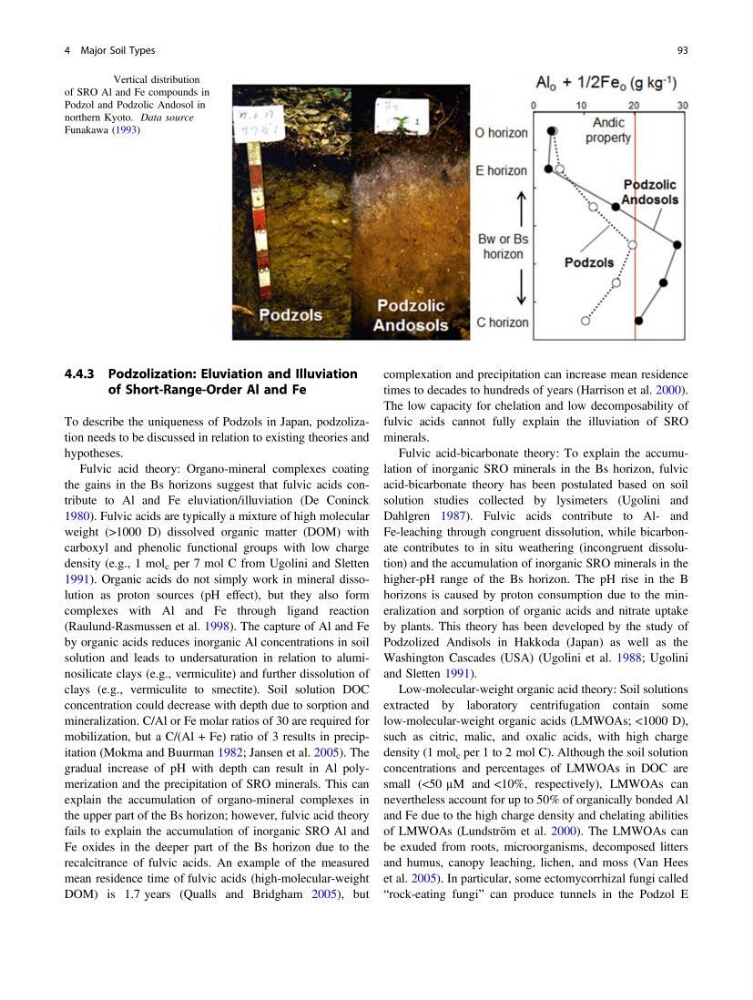
Fig. 4.22 Vertical distribution
of SRO Al and Fe compounds in
Podzol and Podzolic Andosol in
northern Kyoto. Data source
Funakawa (1993)
4 Major Soil Types
93
of Short-Range-Order Al and Fe
To describe the uniqueness of Podzols in Japan, podzolization needs to be discussed in relation to existing theories and
hypotheses.
Fulvic acid theory: Organo-mineral complexes coating
the gains in the Bs horizons suggest that fulvic acids contribute to Al and Fe eluviation/illuviation (De Coninck
1980). Fulvic acids are typically a mixture of high molecular
weight (>1000 D) dissolved organic matter (DOM) with
carboxyl and phenolic functional groups with low charge
density (e.g., 1 mol c per 7 mol C from Ugolini and Sletten
1991). Organic acids do not simply work in mineral dissolution as proton sources (pH effect), but they also form
complexes with Al and Fe through ligand reaction
(Raulund-Rasmussen et al. 1998). The capture of Al and Fe
by organic acids reduces inorganic Al concentrations in soil
solution and leads to undersaturation in relation to aluminosilicate clays (e.g., vermiculite) and further dissolution of
clays (e.g., vermiculite to smectite). Soil solution DOC
concentration could decrease with depth due to sorption and
mineralization. C/Al or Fe molar ratios of 30 are required for
mobilization, but a C/(Al + Fe) ratio of 3 results in precipitation (Mokma and Buurman 1982; Jansen et al. 2005). The
gradual increase of pH with depth can result in Al polymerization and the precipitation of SRO minerals. This can
explain the accumulation of organo-mineral complexes in
the upper part of the Bs horizon; however, fulvic acid theory
fails to explain the accumulation of inorganic SRO Al and
Fe oxides in the deeper part of the Bs horizon due to the
recalcitrance of fulvic acids. An example of the measured
mean residence time of fulvic acids (high-molecular-weight
DOM) is 1.7 years (Qualls and Bridgham 2005), but
complexation and precipitation can increase mean residence
times to decades to hundreds of years (Harrison et al. 2000).
The low capacity for chelation and low decomposability of
fulvic acids cannot fully explain the illuviation of SRO
minerals.
Fulvic acid-bicarbonate theory: To explain the accumulation of inorganic SRO minerals in the Bs horizon, fulvic
acid-bicarbonate theory has been postulated based on soil
solution studies collected by lysimeters (Ugolini and
Dahlgren 1987). Fulvic acids contribute to Al- and
Fe-leaching through congruent dissolution, while bicarbonate contributes to in situ weathering (incongruent dissolution) and the accumulation of inorganic SRO minerals in the
higher-pH range of the Bs horizon. The pH rise in the B
horizons is caused by proton consumption due to the mineralization and sorption of organic acids and nitrate uptake
by plants. This theory has been developed by the study of
Podzolized Andisols in Hakkoda (Japan) as well as the
Washington Cascades (USA) (Ugolini et al. 1988; Ugolini
and Sletten 1991).
Low-molecular-weight organic acid theory: Soil solutions
extracted by laboratory centrifugation contain some
low-molecular-weight organic acids (LMWOAs; <1000 D),
such as citric, malic, and oxalic acids, with high charge
density (1 mol c per 1 to 2 mol C). Although the soil solution
concentrations and percentages of LMWOAs in DOC are
small (<50 µM and <10%, respectively), LMWOAs can
nevertheless account for up to 50% of organically bonded Al
and Fe due to the high charge density and chelating abilities
of LMWOAs (Lundström et al. 2000). The LMWOAs can
be exuded from roots, microorganisms, decomposed litters
and humus, canopy leaching, lichen, and moss (Van Hees
et al. 2005). In particular, some ectomycorrhizal fungi called
“rock-eating fungi” can produce tunnels in the Podzol E
Fig. 4.22 Vertical distribution
of SRO Al and Fe compounds in
Podzol and Podzolic Andosol in
northern Kyoto. Data source
Funakawa (1993)
4 Major Soil Types
93