

horizon (pH < 5.9). Global classification systems adopt
Al o + 1/2Fe o as the diagnostic property, while the amount of
pyrophosphate-extractable Al and Fe (Al p + 1/2Fe p ) is used
in some local classifications. The latter assumes migration of
organo-mineral complexes (fulvic acid theory) while the
former includes accumulation of inorganic SRO Al- and
Fe-containing substances liberated from chelating organic
acids (low-molecular weight organic acid theory) and the
migration of sols in acidic condition (proto-imogolite
hypothesis). The Bs horizon potentially consists of several
B horizons: an upper Bh horizon rich in humus, followed by
Bhir horizons rich in humus–Fe complexes, and deeper Bir
horizons rich in inorganic Al and Fe oxides (e.g., imogolite
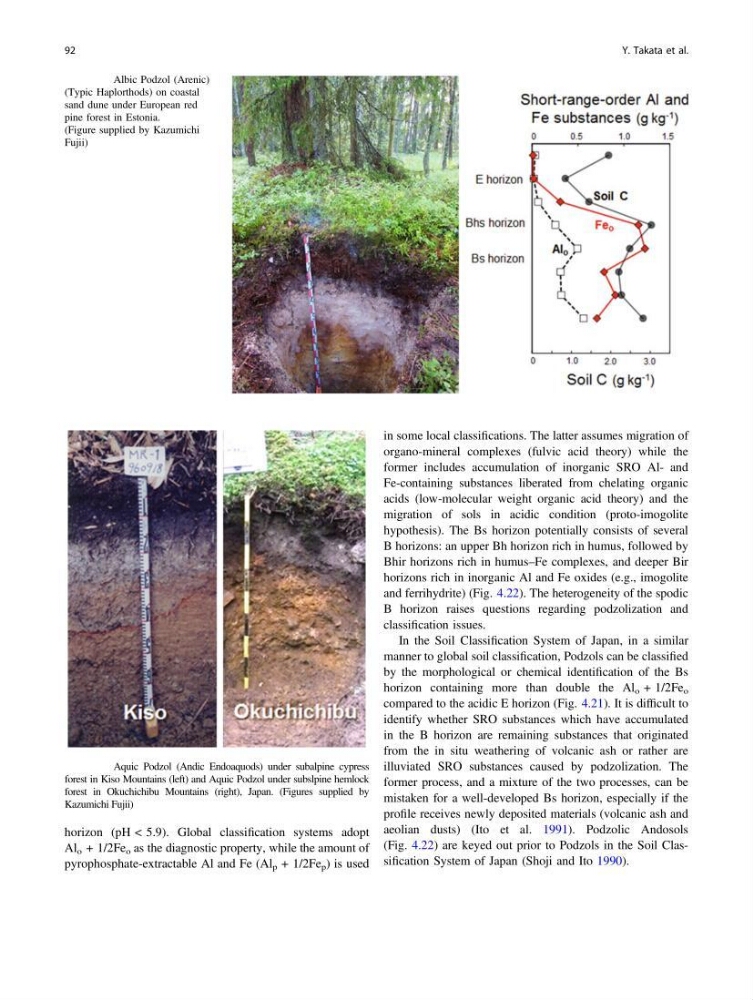
and ferrihydrite) (Fig. 4.22). The heterogeneity of the spodic
B horizon raises questions regarding podzolization and
classification issues.
In the Soil Classification System of Japan, in a similar
manner to global soil classification, Podzols can be classified
by the morphological or chemical identification of the Bs
horizon containing more than double the Al o + 1/2Fe o
compared to the acidic E horizon (Fig. 4.21). It is difficult to
identify whether SRO substances which have accumulated
in the B horizon are remaining substances that originated
from the in situ weathering of volcanic ash or rather are
illuviated SRO substances caused by podzolization. The
former process, and a mixture of the two processes, can be
mistaken for a well-developed Bs horizon, especially if the
profile receives newly deposited materials (volcanic ash and
aeolian dusts) (Ito et al. 1991). Podzolic Andosols
(Fig. 4.22) are keyed out prior to Podzols in the Soil Classification System of Japan (Shoji and Ito 1990).
Fig. 4.20 Albic Podzol (Arenic)
(Typic Haplorthods) on coastal
sand dune under European red
pine forest in Estonia.
(Figure supplied by Kazumichi
Fujii)
Fig. 4.21 Aquic Podzol (Andic Endoaquods) under subalpine cypress
forest in Kiso Mountains (left) and Aquic Podzol under subslpine hemlock
forest in Okuchichibu Mountains (right), Japan. (Figures supplied by
Kazumichi Fujii)
92
Y. Takata et al.
Al o + 1/2Fe o as the diagnostic property, while the amount of
pyrophosphate-extractable Al and Fe (Al p + 1/2Fe p ) is used
in some local classifications. The latter assumes migration of
organo-mineral complexes (fulvic acid theory) while the
former includes accumulation of inorganic SRO Al- and
Fe-containing substances liberated from chelating organic
acids (low-molecular weight organic acid theory) and the
migration of sols in acidic condition (proto-imogolite
hypothesis). The Bs horizon potentially consists of several
B horizons: an upper Bh horizon rich in humus, followed by
Bhir horizons rich in humus–Fe complexes, and deeper Bir
horizons rich in inorganic Al and Fe oxides (e.g., imogolite
and ferrihydrite) (Fig. 4.22). The heterogeneity of the spodic
B horizon raises questions regarding podzolization and
classification issues.
In the Soil Classification System of Japan, in a similar
manner to global soil classification, Podzols can be classified
by the morphological or chemical identification of the Bs
horizon containing more than double the Al o + 1/2Fe o
compared to the acidic E horizon (Fig. 4.21). It is difficult to
identify whether SRO substances which have accumulated
in the B horizon are remaining substances that originated
from the in situ weathering of volcanic ash or rather are
illuviated SRO substances caused by podzolization. The
former process, and a mixture of the two processes, can be
mistaken for a well-developed Bs horizon, especially if the
profile receives newly deposited materials (volcanic ash and
aeolian dusts) (Ito et al. 1991). Podzolic Andosols
(Fig. 4.22) are keyed out prior to Podzols in the Soil Classification System of Japan (Shoji and Ito 1990).
Fig. 4.20 Albic Podzol (Arenic)
(Typic Haplorthods) on coastal
sand dune under European red
pine forest in Estonia.
(Figure supplied by Kazumichi
Fujii)
Fig. 4.21 Aquic Podzol (Andic Endoaquods) under subalpine cypress
forest in Kiso Mountains (left) and Aquic Podzol under subslpine hemlock
forest in Okuchichibu Mountains (right), Japan. (Figures supplied by
Kazumichi Fujii)
92
Y. Takata et al.