

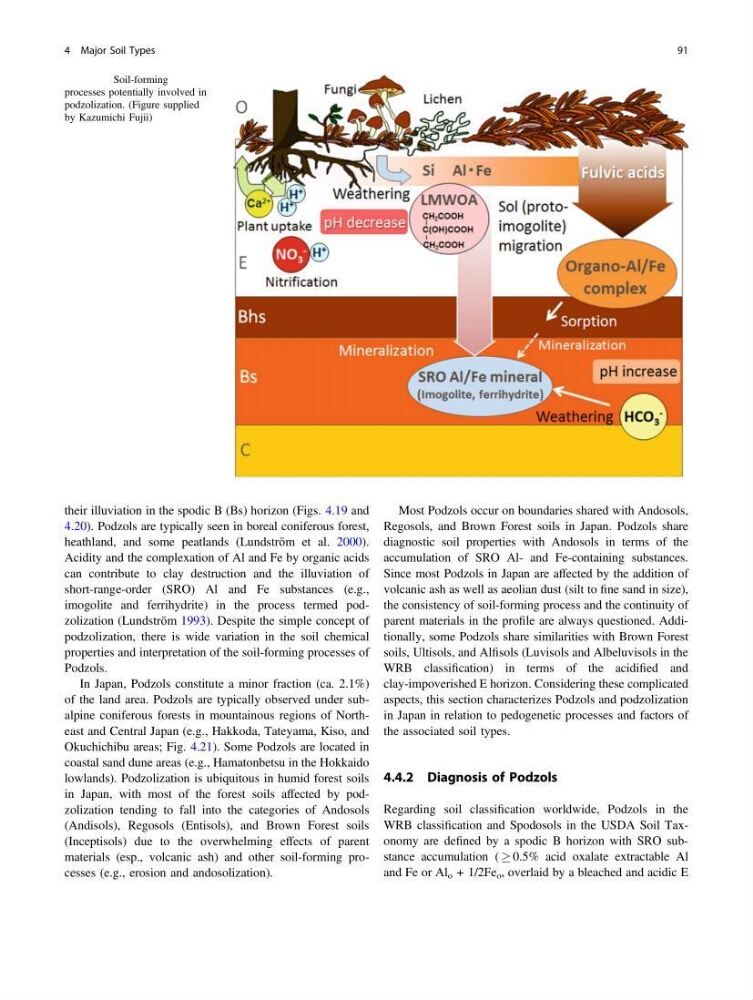
their illuviation in the spodic B (Bs) horizon (Figs. 4.19 and
4.20). Podzols are typically seen in boreal coniferous forest,
heathland, and some peatlands (Lundström et al. 2000).
Acidity and the complexation of Al and Fe by organic acids
can contribute to clay destruction and the illuviation of
short-range-order (SRO) Al and Fe substances (e.g.,
imogolite and ferrihydrite) in the process termed podzolization (Lundström 1993). Despite the simple concept of
podzolization, there is wide variation in the soil chemical
properties and interpretation of the soil-forming processes of
Podzols.
In Japan, Podzols constitute a minor fraction (ca. 2.1%)
of the land area. Podzols are typically observed under subalpine coniferous forests in mountainous regions of Northeast and Central Japan (e.g., Hakkoda, Tateyama, Kiso, and
Okuchichibu areas; Fig. 4.21). Some Podzols are located in
coastal sand dune areas (e.g., Hamatonbetsu in the Hokkaido
lowlands). Podzolization is ubiquitous in humid forest soils
in Japan, with most of the forest soils affected by podzolization tending to fall into the categories of Andosols
(Andisols), Regosols (Entisols), and Brown Forest soils
(Inceptisols) due to the overwhelming effects of parent
materials (esp., volcanic ash) and other soil-forming processes (e.g., erosion and andosolization).
Most Podzols occur on boundaries shared with Andosols,
Regosols, and Brown Forest soils in Japan. Podzols share
diagnostic soil properties with Andosols in terms of the
accumulation of SRO Al- and Fe-containing substances.
Since most Podzols in Japan are affected by the addition of
volcanic ash as well as aeolian dust (silt to fine sand in size),
the consistency of soil-forming process and the continuity of
parent materials in the profile are always questioned. Additionally, some Podzols share similarities with Brown Forest
soils, Ultisols, and Alfisols (Luvisols and Albeluvisols in the
WRB classification) in terms of the acidified and
clay-impoverished E horizon. Considering these complicated
aspects, this section characterizes Podzols and podzolization
in Japan in relation to pedogenetic processes and factors of
the associated soil types.
4.4.2 Diagnosis of Podzols
Regarding soil classification worldwide, Podzols in the
WRB classification and Spodosols in the USDA Soil Taxonomy are defined by a spodic B horizon with SRO substance accumulation ( ! 0.5% acid oxalate extractable Al
and Fe or Al o + 1/2Fe o , overlaid by a bleached and acidic E
Fig. 4.19 Soil-forming
processes potentially involved in
podzolization. (Figure supplied
by Kazumichi Fujii)
4 Major Soil Types
91
4.20). Podzols are typically seen in boreal coniferous forest,
heathland, and some peatlands (Lundström et al. 2000).
Acidity and the complexation of Al and Fe by organic acids
can contribute to clay destruction and the illuviation of
short-range-order (SRO) Al and Fe substances (e.g.,
imogolite and ferrihydrite) in the process termed podzolization (Lundström 1993). Despite the simple concept of
podzolization, there is wide variation in the soil chemical
properties and interpretation of the soil-forming processes of
Podzols.
In Japan, Podzols constitute a minor fraction (ca. 2.1%)
of the land area. Podzols are typically observed under subalpine coniferous forests in mountainous regions of Northeast and Central Japan (e.g., Hakkoda, Tateyama, Kiso, and
Okuchichibu areas; Fig. 4.21). Some Podzols are located in
coastal sand dune areas (e.g., Hamatonbetsu in the Hokkaido
lowlands). Podzolization is ubiquitous in humid forest soils
in Japan, with most of the forest soils affected by podzolization tending to fall into the categories of Andosols
(Andisols), Regosols (Entisols), and Brown Forest soils
(Inceptisols) due to the overwhelming effects of parent
materials (esp., volcanic ash) and other soil-forming processes (e.g., erosion and andosolization).
Most Podzols occur on boundaries shared with Andosols,
Regosols, and Brown Forest soils in Japan. Podzols share
diagnostic soil properties with Andosols in terms of the
accumulation of SRO Al- and Fe-containing substances.
Since most Podzols in Japan are affected by the addition of
volcanic ash as well as aeolian dust (silt to fine sand in size),
the consistency of soil-forming process and the continuity of
parent materials in the profile are always questioned. Additionally, some Podzols share similarities with Brown Forest
soils, Ultisols, and Alfisols (Luvisols and Albeluvisols in the
WRB classification) in terms of the acidified and
clay-impoverished E horizon. Considering these complicated
aspects, this section characterizes Podzols and podzolization
in Japan in relation to pedogenetic processes and factors of
the associated soil types.
4.4.2 Diagnosis of Podzols
Regarding soil classification worldwide, Podzols in the
WRB classification and Spodosols in the USDA Soil Taxonomy are defined by a spodic B horizon with SRO substance accumulation ( ! 0.5% acid oxalate extractable Al
and Fe or Al o + 1/2Fe o , overlaid by a bleached and acidic E
Fig. 4.19 Soil-forming
processes potentially involved in
podzolization. (Figure supplied
by Kazumichi Fujii)
4 Major Soil Types
91