

names derive from “ando soils” which denotes dark (black)
soil in Japanese (Shoji et al. 1993a).
(2) Characteristics of morphology
Soil organic matter accumulation is a distinctive property of
Andosols (Wada 1985). The morphological characteristics of
soil profiles in Japanese Andosols are as follows: (1) the
formation of a humic horizon rich in organic matter and dark
in color; (2) mainly under forest vegetation, the formation of
a humic horizon rich in organic matter and brown in color;
(3) the formation of a cumulic humic horizon; and (4) the
formation of a buried humic horizon.
The accumulation of large amounts of humus and the
development of a cumulic profile morphology (cumulic
humus horizon, formation of buried humus horizon) are a
pedogenetic process that is specific to Andosols, whose
parent material is mainly volcanic ash. Due to intermittent
ashfall accompanying with volcanic activity and the supply
of large amounts of organic matter from vegetation, humic
horizons develop upward, resulting in the development of a
cumulic profile morphology. When volcanic deposits of a
single short eruptive cycle are thick, the outermost humic
horizon is buried by a newly formed volcanic ash layer
(formation of buried humic horizon). In contrast, when
volcanic deposits of a single short eruptive cycle are thin,
humus accumulates in a whole newly formed volcanic ash
layer, which connects with the underlying old humus horizon and forms a thick humus horizon.
Volcanic ash is prone to weathering (Shoji et al. 1993b)
because volcanic glass, which is an abundant component of
volcanic ash, has a very high specific surface area. Silica and
aluminum (Al) dissolved from volcanic glass react rapidly,
and form short-range order minerals (allophane and
imogolite) which become main clay minerals. On the one
hand, Al bonds with organic matter supplied from plant
debris, resulting in the formation of a stable Al–humus
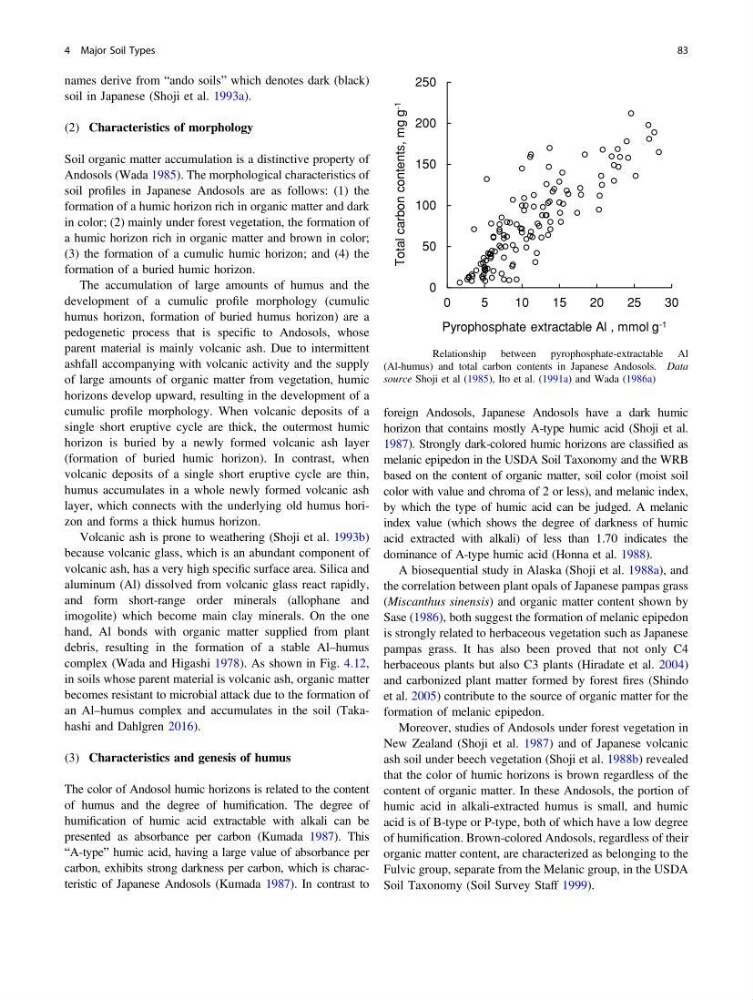
complex (Wada and Higashi 1978). As shown in Fig. 4.12,
in soils whose parent material is volcanic ash, organic matter
becomes resistant to microbial attack due to the formation of
an Al–humus complex and accumulates in the soil (Takahashi and Dahlgren 2016).
(3) Characteristics and genesis of humus
The color of Andosol humic horizons is related to the content
of humus and the degree of humification. The degree of
humification of humic acid extractable with alkali can be
presented as absorbance per carbon (Kumada 1987). This
“A-type” humic acid, having a large value of absorbance per
carbon, exhibits strong darkness per carbon, which is characteristic of Japanese Andosols (Kumada 1987). In contrast to
foreign Andosols, Japanese Andosols have a dark humic
horizon that contains mostly A-type humic acid (Shoji et al.
1987). Strongly dark-colored humic horizons are classified as
melanic epipedon in the USDA Soil Taxonomy and the WRB
based on the content of organic matter, soil color (moist soil
color with value and chroma of 2 or less), and melanic index,
by which the type of humic acid can be judged. A melanic
index value (which shows the degree of darkness of humic
acid extracted with alkali) of less than 1.70 indicates the
dominance of A-type humic acid (Honna et al. 1988).
A biosequential study in Alaska (Shoji et al. 1988a), and
the correlation between plant opals of Japanese pampas grass
(Miscanthus sinensis) and organic matter content shown by
Sase (1986), both suggest the formation of melanic epipedon
is strongly related to herbaceous vegetation such as Japanese
pampas grass. It has also been proved that not only C4
herbaceous plants but also C3 plants (Hiradate et al. 2004)
and carbonized plant matter formed by forest fires (Shindo
et al. 2005) contribute to the source of organic matter for the
formation of melanic epipedon.
Moreover, studies of Andosols under forest vegetation in
New Zealand (Shoji et al. 1987) and of Japanese volcanic
ash soil under beech vegetation (Shoji et al. 1988b) revealed
that the color of humic horizons is brown regardless of the
content of organic matter. In these Andosols, the portion of
humic acid in alkali-extracted humus is small, and humic
acid is of B-type or P-type, both of which have a low degree
of humification. Brown-colored Andosols, regardless of their
organic matter content, are characterized as belonging to the
Fulvic group, separate from the Melanic group, in the USDA
Soil Taxonomy (Soil Survey Staff 1999).
0
50
100
150
200
250
0
5
10
15
20
25
30
Total carbon contents, mg g -1
Pyrophosphate extractable Al , mmol g -1
Fig. 4.12 Relationship between pyrophosphate-extractable Al
(Al-humus) and total carbon contents in Japanese Andosols. Data
source Shoji et al (1985), Ito et al. (1991a) and Wada (1986a)
4 Major Soil Types
83
soil in Japanese (Shoji et al. 1993a).
(2) Characteristics of morphology
Soil organic matter accumulation is a distinctive property of
Andosols (Wada 1985). The morphological characteristics of
soil profiles in Japanese Andosols are as follows: (1) the
formation of a humic horizon rich in organic matter and dark
in color; (2) mainly under forest vegetation, the formation of
a humic horizon rich in organic matter and brown in color;
(3) the formation of a cumulic humic horizon; and (4) the
formation of a buried humic horizon.
The accumulation of large amounts of humus and the
development of a cumulic profile morphology (cumulic
humus horizon, formation of buried humus horizon) are a
pedogenetic process that is specific to Andosols, whose
parent material is mainly volcanic ash. Due to intermittent
ashfall accompanying with volcanic activity and the supply
of large amounts of organic matter from vegetation, humic
horizons develop upward, resulting in the development of a
cumulic profile morphology. When volcanic deposits of a
single short eruptive cycle are thick, the outermost humic
horizon is buried by a newly formed volcanic ash layer
(formation of buried humic horizon). In contrast, when
volcanic deposits of a single short eruptive cycle are thin,
humus accumulates in a whole newly formed volcanic ash
layer, which connects with the underlying old humus horizon and forms a thick humus horizon.
Volcanic ash is prone to weathering (Shoji et al. 1993b)
because volcanic glass, which is an abundant component of
volcanic ash, has a very high specific surface area. Silica and
aluminum (Al) dissolved from volcanic glass react rapidly,
and form short-range order minerals (allophane and
imogolite) which become main clay minerals. On the one
hand, Al bonds with organic matter supplied from plant
debris, resulting in the formation of a stable Al–humus
complex (Wada and Higashi 1978). As shown in Fig. 4.12,
in soils whose parent material is volcanic ash, organic matter
becomes resistant to microbial attack due to the formation of
an Al–humus complex and accumulates in the soil (Takahashi and Dahlgren 2016).
(3) Characteristics and genesis of humus
The color of Andosol humic horizons is related to the content
of humus and the degree of humification. The degree of
humification of humic acid extractable with alkali can be
presented as absorbance per carbon (Kumada 1987). This
“A-type” humic acid, having a large value of absorbance per
carbon, exhibits strong darkness per carbon, which is characteristic of Japanese Andosols (Kumada 1987). In contrast to
foreign Andosols, Japanese Andosols have a dark humic
horizon that contains mostly A-type humic acid (Shoji et al.
1987). Strongly dark-colored humic horizons are classified as
melanic epipedon in the USDA Soil Taxonomy and the WRB
based on the content of organic matter, soil color (moist soil
color with value and chroma of 2 or less), and melanic index,
by which the type of humic acid can be judged. A melanic
index value (which shows the degree of darkness of humic
acid extracted with alkali) of less than 1.70 indicates the
dominance of A-type humic acid (Honna et al. 1988).
A biosequential study in Alaska (Shoji et al. 1988a), and
the correlation between plant opals of Japanese pampas grass
(Miscanthus sinensis) and organic matter content shown by
Sase (1986), both suggest the formation of melanic epipedon
is strongly related to herbaceous vegetation such as Japanese
pampas grass. It has also been proved that not only C4
herbaceous plants but also C3 plants (Hiradate et al. 2004)
and carbonized plant matter formed by forest fires (Shindo
et al. 2005) contribute to the source of organic matter for the
formation of melanic epipedon.
Moreover, studies of Andosols under forest vegetation in
New Zealand (Shoji et al. 1987) and of Japanese volcanic
ash soil under beech vegetation (Shoji et al. 1988b) revealed
that the color of humic horizons is brown regardless of the
content of organic matter. In these Andosols, the portion of
humic acid in alkali-extracted humus is small, and humic
acid is of B-type or P-type, both of which have a low degree
of humification. Brown-colored Andosols, regardless of their
organic matter content, are characterized as belonging to the
Fulvic group, separate from the Melanic group, in the USDA
Soil Taxonomy (Soil Survey Staff 1999).
0
50
100
150
200
250
0
5
10
15
20
25
30
Total carbon contents, mg g -1
Pyrophosphate extractable Al , mmol g -1
Fig. 4.12 Relationship between pyrophosphate-extractable Al
(Al-humus) and total carbon contents in Japanese Andosols. Data
source Shoji et al (1985), Ito et al. (1991a) and Wada (1986a)
4 Major Soil Types
83