

(4) Physical, chemical, and clay mineralogical
characteristics
Andosols are unique among soil types in terms of their
physical and chemical properties (Shoji et al. 1993a), namely
(1) their fluffy and light texture; (2) their high water-holding
capacity; (3) their high reactivity with fluorine and high
phosphate absorption; (4) their high cation exchange
capacity (CEC) and predominated variable charge (the
charged amount depends on pH); and (5) their low holding
strength of basic cation and acid under humid climate. These
unique properties are closely related to the presence of
short-range order minerals such as allophane, imogolite,
and/or humus.
The five unique physical and chemical properties
explained above are derived from the existence and nature of
short-range order minerals and large amounts of humus
(Wada 1985). Short-range order minerals (allophane,
imogolite, and ferrihydrite) and humus largely contribute to
the fluffiness and low bulk density, as well as the high
water-holding capacity, of Andosols, through the formation
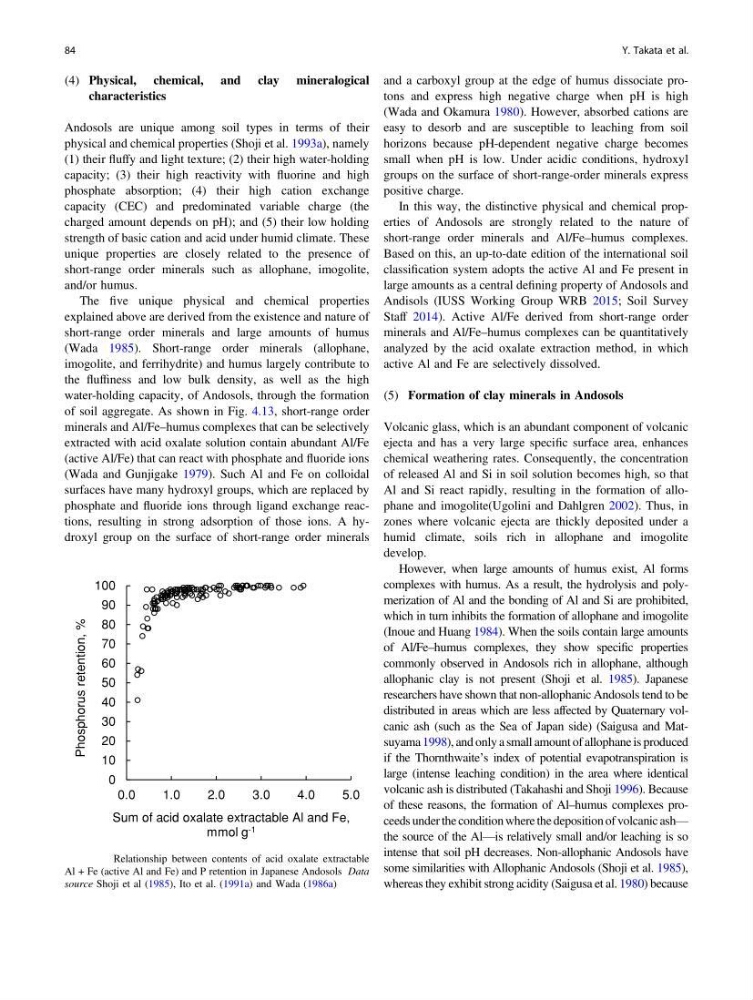
of soil aggregate. As shown in Fig. 4.13, short-range order
minerals and Al/Fe–humus complexes that can be selectively
extracted with acid oxalate solution contain abundant Al/Fe
(active Al/Fe) that can react with phosphate and fluoride ions
(Wada and Gunjigake 1979). Such Al and Fe on colloidal
surfaces have many hydroxyl groups, which are replaced by
phosphate and fluoride ions through ligand exchange reactions, resulting in strong adsorption of those ions. A hydroxyl group on the surface of short-range order minerals
and a carboxyl group at the edge of humus dissociate protons and express high negative charge when pH is high
(Wada and Okamura 1980). However, absorbed cations are
easy to desorb and are susceptible to leaching from soil
horizons because pH-dependent negative charge becomes
small when pH is low. Under acidic conditions, hydroxyl
groups on the surface of short-range-order minerals express
positive charge.
In this way, the distinctive physical and chemical properties of Andosols are strongly related to the nature of
short-range order minerals and Al/Fe–humus complexes.
Based on this, an up-to-date edition of the international soil
classification system adopts the active Al and Fe present in
large amounts as a central defining property of Andosols and
Andisols (IUSS Working Group WRB 2015; Soil Survey
Staff 2014). Active Al/Fe derived from short-range order
minerals and Al/Fe–humus complexes can be quantitatively
analyzed by the acid oxalate extraction method, in which
active Al and Fe are selectively dissolved.
(5) Formation of clay minerals in Andosols
Volcanic glass, which is an abundant component of volcanic
ejecta and has a very large specific surface area, enhances
chemical weathering rates. Consequently, the concentration
of released Al and Si in soil solution becomes high, so that
Al and Si react rapidly, resulting in the formation of allophane and imogolite(Ugolini and Dahlgren 2002). Thus, in
zones where volcanic ejecta are thickly deposited under a
humid climate, soils rich in allophane and imogolite
develop.
However, when large amounts of humus exist, Al forms
complexes with humus. As a result, the hydrolysis and polymerization of Al and the bonding of Al and Si are prohibited,
which in turn inhibits the formation of allophane and imogolite
(Inoue and Huang 1984). When the soils contain large amounts
of Al/Fe–humus complexes, they show specific properties
commonly observed in Andosols rich in allophane, although
allophanic clay is not present (Shoji et al. 1985). Japanese
researchers have shown that non-allophanic Andosols tend to be
distributed in areas which are less affected by Quaternary volcanic ash (such as the Sea of Japan side) (Saigusa and Matsuyama 1998), and only a small amount of allophane is produced
if the Thornthwaite’s index of potential evapotranspiration is
large (intense leaching condition) in the area where identical
volcanic ash is distributed (Takahashi and Shoji 1996). Because
of these reasons, the formation of Al–humus complexes proceeds under the condition where the deposition of volcanic ash—
the source of the Al—is relatively small and/or leaching is so
intense that soil pH decreases. Non-allophanic Andosols have
some similarities with Allophanic Andosols (Shoji et al. 1985),
whereas they exhibit strong acidity (Saigusa et al. 1980) because
0
10
20
30
40
50
60
70
80
90
100
0.0
1.0
2.0
3.0
4.0
5.0
Phosphorus retention, %
Sum of acid oxalate extractable Al and Fe,
mmol g -1
Fig. 4.13 Relationship between contents of acid oxalate extractable
Al + Fe (active Al and Fe) and P retention in Japanese Andosols Data
source Shoji et al (1985), Ito et al. (1991a) and Wada (1986a)
84
Y. Takata et al.
characteristics
Andosols are unique among soil types in terms of their
physical and chemical properties (Shoji et al. 1993a), namely
(1) their fluffy and light texture; (2) their high water-holding
capacity; (3) their high reactivity with fluorine and high
phosphate absorption; (4) their high cation exchange
capacity (CEC) and predominated variable charge (the
charged amount depends on pH); and (5) their low holding
strength of basic cation and acid under humid climate. These
unique properties are closely related to the presence of
short-range order minerals such as allophane, imogolite,
and/or humus.
The five unique physical and chemical properties
explained above are derived from the existence and nature of
short-range order minerals and large amounts of humus
(Wada 1985). Short-range order minerals (allophane,
imogolite, and ferrihydrite) and humus largely contribute to
the fluffiness and low bulk density, as well as the high
water-holding capacity, of Andosols, through the formation
of soil aggregate. As shown in Fig. 4.13, short-range order
minerals and Al/Fe–humus complexes that can be selectively
extracted with acid oxalate solution contain abundant Al/Fe
(active Al/Fe) that can react with phosphate and fluoride ions
(Wada and Gunjigake 1979). Such Al and Fe on colloidal
surfaces have many hydroxyl groups, which are replaced by
phosphate and fluoride ions through ligand exchange reactions, resulting in strong adsorption of those ions. A hydroxyl group on the surface of short-range order minerals
and a carboxyl group at the edge of humus dissociate protons and express high negative charge when pH is high
(Wada and Okamura 1980). However, absorbed cations are
easy to desorb and are susceptible to leaching from soil
horizons because pH-dependent negative charge becomes
small when pH is low. Under acidic conditions, hydroxyl
groups on the surface of short-range-order minerals express
positive charge.
In this way, the distinctive physical and chemical properties of Andosols are strongly related to the nature of
short-range order minerals and Al/Fe–humus complexes.
Based on this, an up-to-date edition of the international soil
classification system adopts the active Al and Fe present in
large amounts as a central defining property of Andosols and
Andisols (IUSS Working Group WRB 2015; Soil Survey
Staff 2014). Active Al/Fe derived from short-range order
minerals and Al/Fe–humus complexes can be quantitatively
analyzed by the acid oxalate extraction method, in which
active Al and Fe are selectively dissolved.
(5) Formation of clay minerals in Andosols
Volcanic glass, which is an abundant component of volcanic
ejecta and has a very large specific surface area, enhances
chemical weathering rates. Consequently, the concentration
of released Al and Si in soil solution becomes high, so that
Al and Si react rapidly, resulting in the formation of allophane and imogolite(Ugolini and Dahlgren 2002). Thus, in
zones where volcanic ejecta are thickly deposited under a
humid climate, soils rich in allophane and imogolite
develop.
However, when large amounts of humus exist, Al forms
complexes with humus. As a result, the hydrolysis and polymerization of Al and the bonding of Al and Si are prohibited,
which in turn inhibits the formation of allophane and imogolite
(Inoue and Huang 1984). When the soils contain large amounts
of Al/Fe–humus complexes, they show specific properties
commonly observed in Andosols rich in allophane, although
allophanic clay is not present (Shoji et al. 1985). Japanese
researchers have shown that non-allophanic Andosols tend to be
distributed in areas which are less affected by Quaternary volcanic ash (such as the Sea of Japan side) (Saigusa and Matsuyama 1998), and only a small amount of allophane is produced
if the Thornthwaite’s index of potential evapotranspiration is
large (intense leaching condition) in the area where identical
volcanic ash is distributed (Takahashi and Shoji 1996). Because
of these reasons, the formation of Al–humus complexes proceeds under the condition where the deposition of volcanic ash—
the source of the Al—is relatively small and/or leaching is so
intense that soil pH decreases. Non-allophanic Andosols have
some similarities with Allophanic Andosols (Shoji et al. 1985),
whereas they exhibit strong acidity (Saigusa et al. 1980) because
0
10
20
30
40
50
60
70
80
90
100
0.0
1.0
2.0
3.0
4.0
5.0
Phosphorus retention, %
Sum of acid oxalate extractable Al and Fe,
mmol g -1
Fig. 4.13 Relationship between contents of acid oxalate extractable
Al + Fe (active Al and Fe) and P retention in Japanese Andosols Data
source Shoji et al (1985), Ito et al. (1991a) and Wada (1986a)
84
Y. Takata et al.