

There was even a time when Organic soils were present in
central Tokyo, in valleys where seepage peatlands formed;
in metropolitan Tokyo, certain place names carry the word
“ya”, such as Shibuya and Setagaya, which shows that such
places were originally “yachi,” meaning peatlands in Japanese (Sakaguchi 1974).
4.2.5 Future of Organic Soil in Japan
Most of Japan’s peatlands are Low-moor Peat soils that
formed in the Holocene under cool climates in the northern
regions of Hokkaido or Tohoku in back swamps of alluvial
plains or marshy grounds after marine regression in the
Holocene, with common reed and Japanese alder as the main
component plant species, whereas high-moor peatland and
transitional-moor peatland are relatively scarce. Frequent
inputs of inorganic materials such as sand and clays are
common from the flooding of rivers and volcanic ash
deposition; these accelerate decomposition and humification
and contain large quantities of Si and Fe. By contrast,
regions
adjacent
to
young
volcanoes
have
terrestrialization-type peatlands in shallow lakes and marshes that were formed in catchment basins and swales created by lava and mud flows in mountainous and highland
areas, and which are scattered across Japan at small scales.
Paludization-type peatlands in alluvial plains and lowlands have been used as agricultural land and residential
areas; this ceases the formation and accumulation of peats,
and these peatlands are therefore referred to as “disappearing
peatlands.” “Living peatlands,” which remain in parts of the
lowlands and mountainous areas of Hokkaido and the
mountainous areas of Honshu and Kyushu, play important
roles in the storage of groundwater, the prevention of
flooding, the sequestration of soil carbon, and the maintenance of biodiversity. Therefore, understanding the formation and distribution of Organic soils in Japan is important
for environmental conservation.
4.3 Andosols
4.3.1 Genesis and Characteristics
(1) Terminology of Andosols
Soils that are mainly derived from volcanic ejecta or tephra
and form during a long period of pedogenetic soil formation
process have unique and distinctive properties among soils,
such as their fluffy and light surface properties, high humus
content, and very high phosphorus-fixing capacity. Such
soils are called “Kurobokudo” (i.e., Kuroboku soil), which
means black (kuro) and fluffy (boku) soil in Japanese. These
soils are widely distributed and are representative soils in the
arable land of Japan. According to the World Reference
Base for Soil Resources (FAO 2015) (WRB) and the USDA
Soil Taxonomy (Soil Survey Staff 1999), these soils are
classified as Andosols and Andisols, respectively; these
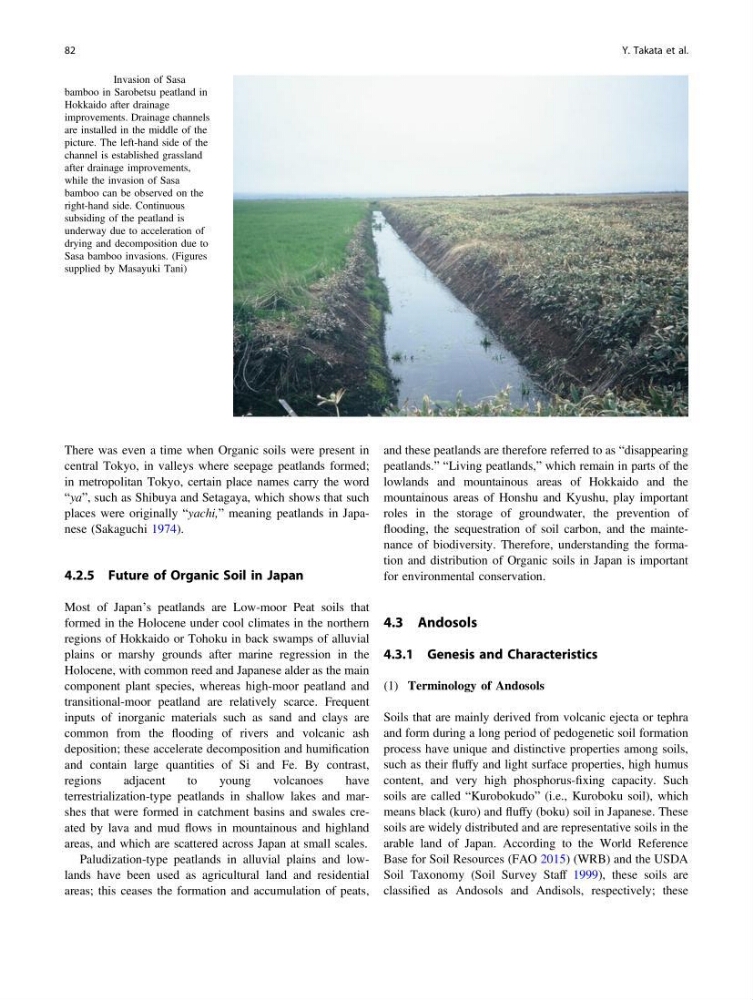
Fig. 4.11 Invasion of Sasa
bamboo in Sarobetsu peatland in
Hokkaido after drainage
improvements. Drainage channels
are installed in the middle of the
picture. The left-hand side of the
channel is established grassland
after drainage improvements,
while the invasion of Sasa
bamboo can be observed on the
right-hand side. Continuous
subsiding of the peatland is
underway due to acceleration of
drying and decomposition due to
Sasa bamboo invasions. (Figures
supplied by Masayuki Tani)
82
Y. Takata et al.
central Tokyo, in valleys where seepage peatlands formed;
in metropolitan Tokyo, certain place names carry the word
“ya”, such as Shibuya and Setagaya, which shows that such
places were originally “yachi,” meaning peatlands in Japanese (Sakaguchi 1974).
4.2.5 Future of Organic Soil in Japan
Most of Japan’s peatlands are Low-moor Peat soils that
formed in the Holocene under cool climates in the northern
regions of Hokkaido or Tohoku in back swamps of alluvial
plains or marshy grounds after marine regression in the
Holocene, with common reed and Japanese alder as the main
component plant species, whereas high-moor peatland and
transitional-moor peatland are relatively scarce. Frequent
inputs of inorganic materials such as sand and clays are
common from the flooding of rivers and volcanic ash
deposition; these accelerate decomposition and humification
and contain large quantities of Si and Fe. By contrast,
regions
adjacent
to
young
volcanoes
have
terrestrialization-type peatlands in shallow lakes and marshes that were formed in catchment basins and swales created by lava and mud flows in mountainous and highland
areas, and which are scattered across Japan at small scales.
Paludization-type peatlands in alluvial plains and lowlands have been used as agricultural land and residential
areas; this ceases the formation and accumulation of peats,
and these peatlands are therefore referred to as “disappearing
peatlands.” “Living peatlands,” which remain in parts of the
lowlands and mountainous areas of Hokkaido and the
mountainous areas of Honshu and Kyushu, play important
roles in the storage of groundwater, the prevention of
flooding, the sequestration of soil carbon, and the maintenance of biodiversity. Therefore, understanding the formation and distribution of Organic soils in Japan is important
for environmental conservation.
4.3 Andosols
4.3.1 Genesis and Characteristics
(1) Terminology of Andosols
Soils that are mainly derived from volcanic ejecta or tephra
and form during a long period of pedogenetic soil formation
process have unique and distinctive properties among soils,
such as their fluffy and light surface properties, high humus
content, and very high phosphorus-fixing capacity. Such
soils are called “Kurobokudo” (i.e., Kuroboku soil), which
means black (kuro) and fluffy (boku) soil in Japanese. These
soils are widely distributed and are representative soils in the
arable land of Japan. According to the World Reference
Base for Soil Resources (FAO 2015) (WRB) and the USDA
Soil Taxonomy (Soil Survey Staff 1999), these soils are
classified as Andosols and Andisols, respectively; these
Fig. 4.11 Invasion of Sasa
bamboo in Sarobetsu peatland in
Hokkaido after drainage
improvements. Drainage channels
are installed in the middle of the
picture. The left-hand side of the
channel is established grassland
after drainage improvements,
while the invasion of Sasa
bamboo can be observed on the
right-hand side. Continuous
subsiding of the peatland is
underway due to acceleration of
drying and decomposition due to
Sasa bamboo invasions. (Figures
supplied by Masayuki Tani)
82
Y. Takata et al.