

Natural Resources, Climate Change and Governance
143
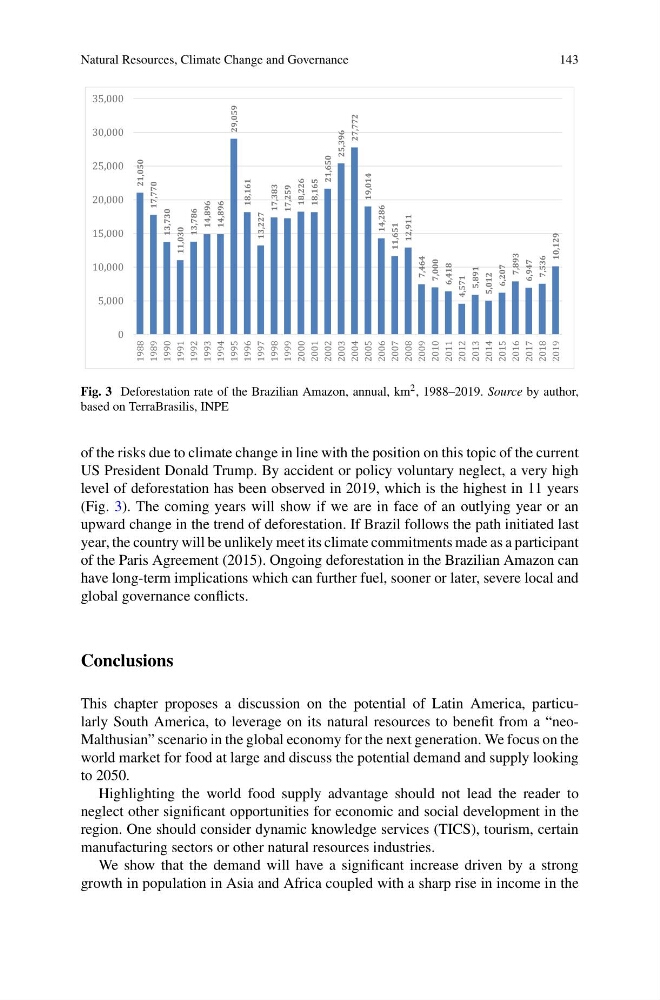
Fig. 3 Deforestation rate of the Brazilian Amazon, annual, km 2 , 1988–2019. Source by author,
based on TerraBrasilis, INPE
of the risks due to climate change in line with the position on this topic of the current
US President Donald Trump. By accident or policy voluntary neglect, a very high
level of deforestation has been observed in 2019, which is the highest in 11 years
(Fig. 3). The coming years will show if we are in face of an outlying year or an
upward change in the trend of deforestation. If Brazil follows the path initiated last
year, the country will be unlikely meet its climate commitments made as a participant
of the Paris Agreement (2015). Ongoing deforestation in the Brazilian Amazon can
have long-term implications which can further fuel, sooner or later, severe local and
global governance conflicts.
Conclusions
This chapter proposes a discussion on the potential of Latin America, particularly South America, to leverage on its natural resources to benefit from a “neoMalthusian” scenario in the global economy for the next generation. We focus on the
world market for food at large and discuss the potential demand and supply looking
to 2050.
Highlighting the world food supply advantage should not lead the reader to
neglect other significant opportunities for economic and social development in the
region. One should consider dynamic knowledge services (TICS), tourism, certain
manufacturing sectors or other natural resources industries.
We show that the demand will have a significant increase driven by a strong
growth in population in Asia and Africa coupled with a sharp rise in income in the
143
Fig. 3 Deforestation rate of the Brazilian Amazon, annual, km 2 , 1988–2019. Source by author,
based on TerraBrasilis, INPE
of the risks due to climate change in line with the position on this topic of the current
US President Donald Trump. By accident or policy voluntary neglect, a very high
level of deforestation has been observed in 2019, which is the highest in 11 years
(Fig. 3). The coming years will show if we are in face of an outlying year or an
upward change in the trend of deforestation. If Brazil follows the path initiated last
year, the country will be unlikely meet its climate commitments made as a participant
of the Paris Agreement (2015). Ongoing deforestation in the Brazilian Amazon can
have long-term implications which can further fuel, sooner or later, severe local and
global governance conflicts.
Conclusions
This chapter proposes a discussion on the potential of Latin America, particularly South America, to leverage on its natural resources to benefit from a “neoMalthusian” scenario in the global economy for the next generation. We focus on the
world market for food at large and discuss the potential demand and supply looking
to 2050.
Highlighting the world food supply advantage should not lead the reader to
neglect other significant opportunities for economic and social development in the
region. One should consider dynamic knowledge services (TICS), tourism, certain
manufacturing sectors or other natural resources industries.
We show that the demand will have a significant increase driven by a strong
growth in population in Asia and Africa coupled with a sharp rise in income in the