

“Multiple Dividends with Climate Change Policies: Evidence …
105
welfare of the poor. The grossing-up reduction of labour costs represents a decrease
in domestic costs vis-à-vis the international costs, and that is why we observe an
improvement of the trade balance.
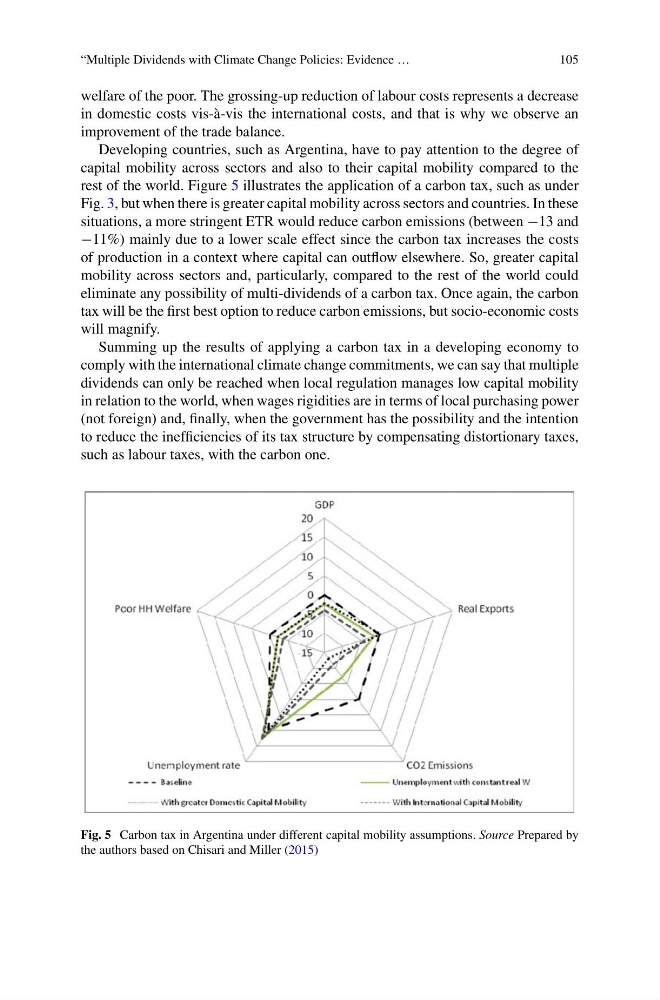
Developing countries, such as Argentina, have to pay attention to the degree of
capital mobility across sectors and also to their capital mobility compared to the
rest of the world. Figure 5 illustrates the application of a carbon tax, such as under
Fig. 3, but when there is greater capital mobility across sectors and countries. In these
situations, a more stringent ETR would reduce carbon emissions (between −13 and
−11%) mainly due to a lower scale effect since the carbon tax increases the costs
of production in a context where capital can outflow elsewhere. So, greater capital
mobility across sectors and, particularly, compared to the rest of the world could
eliminate any possibility of multi-dividends of a carbon tax. Once again, the carbon
tax will be the first best option to reduce carbon emissions, but socio-economic costs
will magnify.
Summing up the results of applying a carbon tax in a developing economy to
comply with the international climate change commitments, we can say that multiple
dividends can only be reached when local regulation manages low capital mobility
in relation to the world, when wages rigidities are in terms of local purchasing power
(not foreign) and, finally, when the government has the possibility and the intention
to reduce the inefficiencies of its tax structure by compensating distortionary taxes,
such as labour taxes, with the carbon one.
Fig. 5 Carbon tax in Argentina under different capital mobility assumptions. Source Prepared by
the authors based on Chisari and Miller (2015)
105
welfare of the poor. The grossing-up reduction of labour costs represents a decrease
in domestic costs vis-à-vis the international costs, and that is why we observe an
improvement of the trade balance.
Developing countries, such as Argentina, have to pay attention to the degree of
capital mobility across sectors and also to their capital mobility compared to the
rest of the world. Figure 5 illustrates the application of a carbon tax, such as under
Fig. 3, but when there is greater capital mobility across sectors and countries. In these
situations, a more stringent ETR would reduce carbon emissions (between −13 and
−11%) mainly due to a lower scale effect since the carbon tax increases the costs
of production in a context where capital can outflow elsewhere. So, greater capital
mobility across sectors and, particularly, compared to the rest of the world could
eliminate any possibility of multi-dividends of a carbon tax. Once again, the carbon
tax will be the first best option to reduce carbon emissions, but socio-economic costs
will magnify.
Summing up the results of applying a carbon tax in a developing economy to
comply with the international climate change commitments, we can say that multiple
dividends can only be reached when local regulation manages low capital mobility
in relation to the world, when wages rigidities are in terms of local purchasing power
(not foreign) and, finally, when the government has the possibility and the intention
to reduce the inefficiencies of its tax structure by compensating distortionary taxes,
such as labour taxes, with the carbon one.
Fig. 5 Carbon tax in Argentina under different capital mobility assumptions. Source Prepared by
the authors based on Chisari and Miller (2015)