

106
M. P. Ramos and O. O. Chisari
Trade Liberalization on EGS as Second-Best ETR
Even though the carbon tax appears as the first best ETR to reduce carbon emissions, we have realized that the implementation of multiple dividends for developing
economies is constrained to the presence of inefficiencies in the tax structure, particular factors markets conditions and the government’s possibility for tax compensation
(not higher fiscal deficit).
So, some other options appear as ETRs, for instance, through tariff reforms. Given
the discussion in the multilateral arena (the Doha Round), by the APEC and currently
in a plurilateral way by a small group of countries, concerning the incentives for
trade in EGS, we evaluate the consequences of an EGA in the case of Argentina.
This scenario could be an alternative to the carbon tax for developing countries
to indirectly tackle climate change commitments, while looking for other socioeconomic dividends.
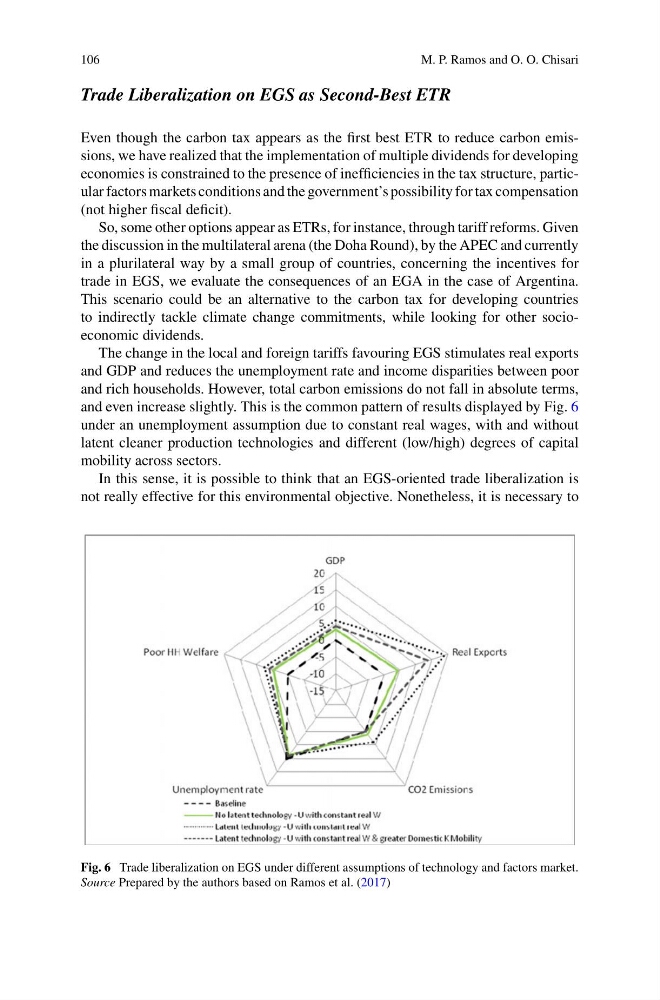
The change in the local and foreign tariffs favouring EGS stimulates real exports
and GDP and reduces the unemployment rate and income disparities between poor
and rich households. However, total carbon emissions do not fall in absolute terms,
and even increase slightly. This is the common pattern of results displayed by Fig. 6
under an unemployment assumption due to constant real wages, with and without
latent cleaner production technologies and different (low/high) degrees of capital
mobility across sectors.
In this sense, it is possible to think that an EGS-oriented trade liberalization is
not really effective for this environmental objective. Nonetheless, it is necessary to
Fig. 6 Trade liberalization on EGS under different assumptions of technology and factors market.
Source Prepared by the authors based on Ramos et al. (2017)
M. P. Ramos and O. O. Chisari
Trade Liberalization on EGS as Second-Best ETR
Even though the carbon tax appears as the first best ETR to reduce carbon emissions, we have realized that the implementation of multiple dividends for developing
economies is constrained to the presence of inefficiencies in the tax structure, particular factors markets conditions and the government’s possibility for tax compensation
(not higher fiscal deficit).
So, some other options appear as ETRs, for instance, through tariff reforms. Given
the discussion in the multilateral arena (the Doha Round), by the APEC and currently
in a plurilateral way by a small group of countries, concerning the incentives for
trade in EGS, we evaluate the consequences of an EGA in the case of Argentina.
This scenario could be an alternative to the carbon tax for developing countries
to indirectly tackle climate change commitments, while looking for other socioeconomic dividends.
The change in the local and foreign tariffs favouring EGS stimulates real exports
and GDP and reduces the unemployment rate and income disparities between poor
and rich households. However, total carbon emissions do not fall in absolute terms,
and even increase slightly. This is the common pattern of results displayed by Fig. 6
under an unemployment assumption due to constant real wages, with and without
latent cleaner production technologies and different (low/high) degrees of capital
mobility across sectors.
In this sense, it is possible to think that an EGS-oriented trade liberalization is
not really effective for this environmental objective. Nonetheless, it is necessary to
Fig. 6 Trade liberalization on EGS under different assumptions of technology and factors market.
Source Prepared by the authors based on Ramos et al. (2017)