

182
• Transportation
• Vector control
• Waste disposal
• Water pollution
Geophysical disasters –mainly the earthquakes all over the world – were the
cause of death of more people compared to other natural hazards from 1997 to 2017
with a death toll of 747,000, aggravated by the vulnerability to the Haiti earthquake
of 2010 besides the Indian Ocean tsunami of 2004 (CRED and UNISDR 2018).
In contrast, the earthquake in New Zealand in 2010, which had a scale similar to
that of the earthquake in Haiti, affected 300,000 people without loss of human life
due to New Zealand’s high levels of preparedness and strict building codes.
Investment in seismic risk reduction in Iran, particularly in safe school buildings,
has also resulted in the reduction in the nation’s mortality due to earthquake, in spite
of the country being located in an active seismic zone (CRED and UNISDR 2018).
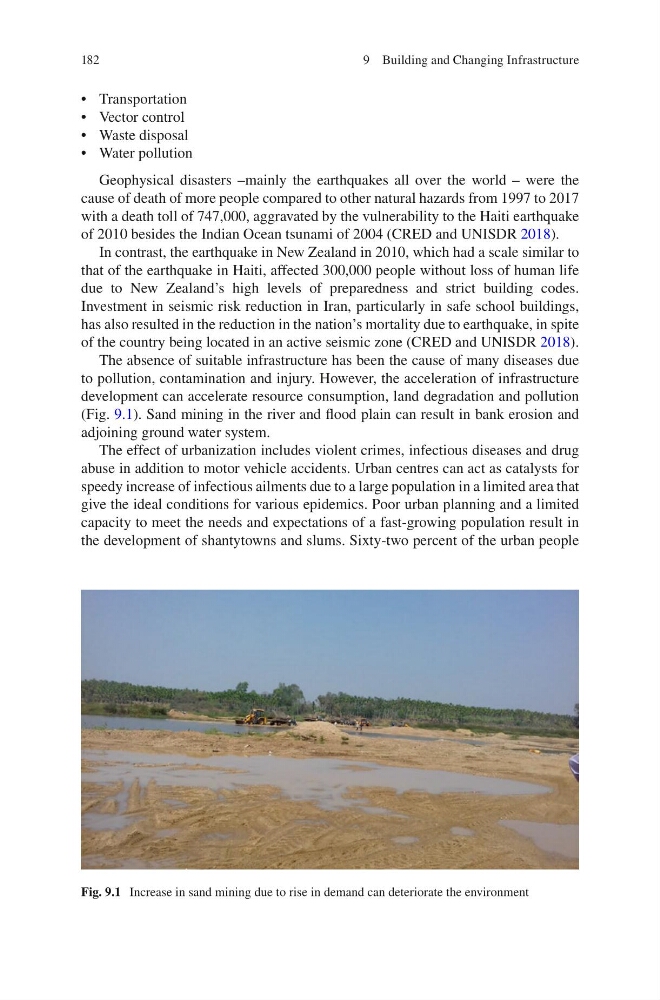
The absence of suitable infrastructure has been the cause of many diseases due
to pollution, contamination and injury. However, the acceleration of infrastructure
development can accelerate resource consumption, land degradation and pollution
(Fig. 9.1). Sand mining in the river and flood plain can result in bank erosion and
adjoining ground water system.
The effect of urbanization includes violent crimes, infectious diseases and drug
abuse in addition to motor vehicle accidents. Urban centres can act as catalysts for
speedy increase of infectious ailments due to a large population in a limited area that
give the ideal conditions for various epidemics. Poor urban planning and a limited
capacity to meet the needs and expectations of a fast-growing population result in
the development of shantytowns and slums. Sixty-two percent of the urban people
Fig. 9.1 Increase in sand mining due to rise in demand can deteriorate the environment
9 Building and Changing Infrastructure
• Transportation
• Vector control
• Waste disposal
• Water pollution
Geophysical disasters –mainly the earthquakes all over the world – were the
cause of death of more people compared to other natural hazards from 1997 to 2017
with a death toll of 747,000, aggravated by the vulnerability to the Haiti earthquake
of 2010 besides the Indian Ocean tsunami of 2004 (CRED and UNISDR 2018).
In contrast, the earthquake in New Zealand in 2010, which had a scale similar to
that of the earthquake in Haiti, affected 300,000 people without loss of human life
due to New Zealand’s high levels of preparedness and strict building codes.
Investment in seismic risk reduction in Iran, particularly in safe school buildings,
has also resulted in the reduction in the nation’s mortality due to earthquake, in spite
of the country being located in an active seismic zone (CRED and UNISDR 2018).
The absence of suitable infrastructure has been the cause of many diseases due
to pollution, contamination and injury. However, the acceleration of infrastructure
development can accelerate resource consumption, land degradation and pollution
(Fig. 9.1). Sand mining in the river and flood plain can result in bank erosion and
adjoining ground water system.
The effect of urbanization includes violent crimes, infectious diseases and drug
abuse in addition to motor vehicle accidents. Urban centres can act as catalysts for
speedy increase of infectious ailments due to a large population in a limited area that
give the ideal conditions for various epidemics. Poor urban planning and a limited
capacity to meet the needs and expectations of a fast-growing population result in
the development of shantytowns and slums. Sixty-two percent of the urban people
Fig. 9.1 Increase in sand mining due to rise in demand can deteriorate the environment
9 Building and Changing Infrastructure