

166
8.4 Treatment
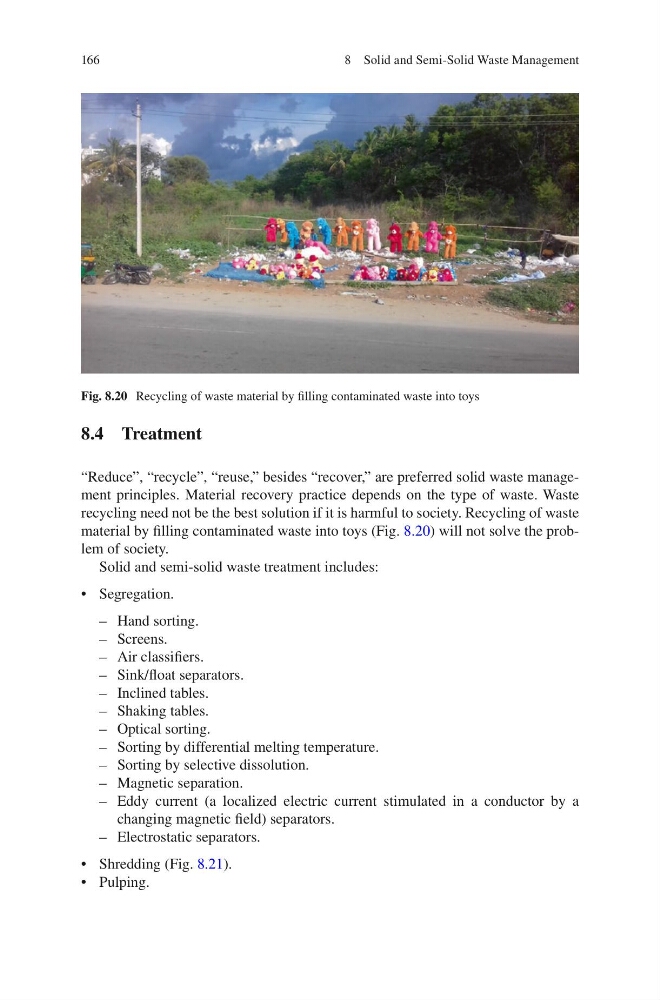
“Reduce”, “recycle”, “reuse,” besides “recover,” are preferred solid waste management principles. Material recovery practice depends on the type of waste. Waste
recycling need not be the best solution if it is harmful to society. Recycling of waste
material by filling contaminated waste into toys (Fig. 8.20) will not solve the problem of society.
Solid and semi-solid waste treatment includes:
• Segregation.
– Hand sorting.
– Screens.
– Air classifiers.
– Sink/float separators.
– Inclined tables.
– Shaking tables.
– Optical sorting.
– Sorting by differential melting temperature.
– Sorting by selective dissolution.
– Magnetic separation.
– Eddy current (a localized electric current stimulated in a conductor by a
changing magnetic field) separators.
– Electrostatic separators.
• Shredding (Fig. 8.21).
• Pulping.
Fig. 8.20 Recycling of waste material by filling contaminated waste into toys
8 Solid and Semi-Solid Waste Management
8.4 Treatment
“Reduce”, “recycle”, “reuse,” besides “recover,” are preferred solid waste management principles. Material recovery practice depends on the type of waste. Waste
recycling need not be the best solution if it is harmful to society. Recycling of waste
material by filling contaminated waste into toys (Fig. 8.20) will not solve the problem of society.
Solid and semi-solid waste treatment includes:
• Segregation.
– Hand sorting.
– Screens.
– Air classifiers.
– Sink/float separators.
– Inclined tables.
– Shaking tables.
– Optical sorting.
– Sorting by differential melting temperature.
– Sorting by selective dissolution.
– Magnetic separation.
– Eddy current (a localized electric current stimulated in a conductor by a
changing magnetic field) separators.
– Electrostatic separators.
• Shredding (Fig. 8.21).
• Pulping.
Fig. 8.20 Recycling of waste material by filling contaminated waste into toys
8 Solid and Semi-Solid Waste Management