

167
• Crushing.
• Baling.
• Ballistic separators.
• Reuse and recycle.
• Aerobic and anaerobic treatment.
• Composting.
• Road making.
• Stabilization (making physically more secure or stable by mixing with solidification agent before disposal).
• Deactivation (blending corrosive and explosive wastes with suitable chemicals
before disposal).
• Metal removal and recovery.
• Aqueous treatment.
• Immobilization/encapsulation (physically immobilizable waste by cementing
material) (Fig.8.22).
• Chemical disinfection (Fig. 8.23).
• Thermal disinfection (Fig. 8.24).
• Plastic granulating.
• Methenization (process of converting biodegradable waste into methane).
Some of the waste from industry poses the greatest challenge as some of the
industrial operation generates huge quantity of hazardous waste that demands high
safety precaution. The international laws have led to stringent laws at national level
making new ventures in waste management sectors.
While there is increase in new waste management facilities, there is also increase
in co-processing of waste in existing cement kilns making the cement production
profitable due to reduction in raw material procurement by feeding high calorific
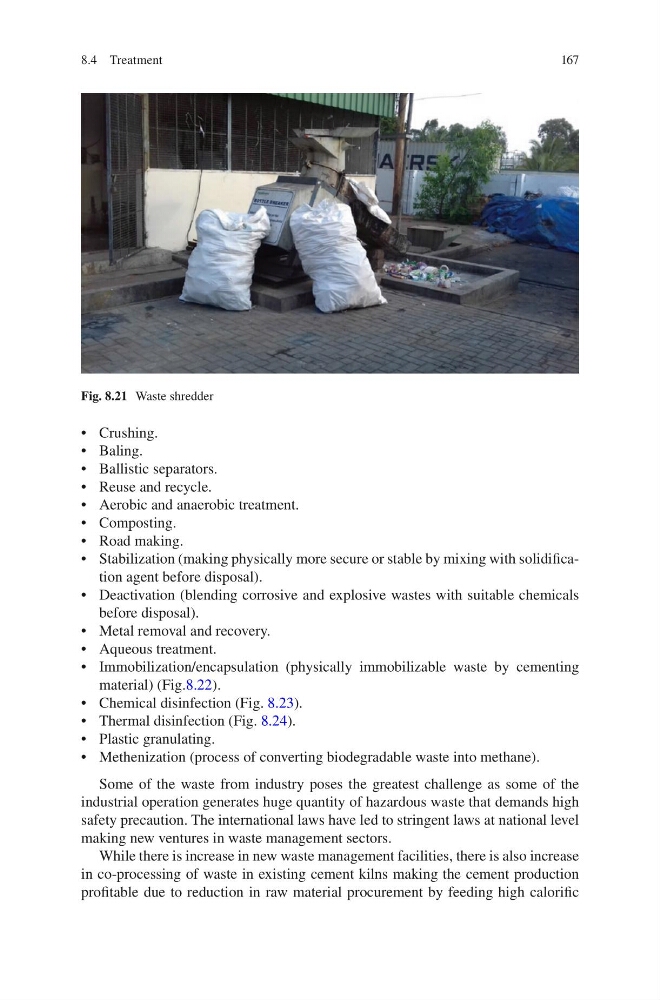
Fig. 8.21 Waste shredder
8.4 Treatment
• Crushing.
• Baling.
• Ballistic separators.
• Reuse and recycle.
• Aerobic and anaerobic treatment.
• Composting.
• Road making.
• Stabilization (making physically more secure or stable by mixing with solidification agent before disposal).
• Deactivation (blending corrosive and explosive wastes with suitable chemicals
before disposal).
• Metal removal and recovery.
• Aqueous treatment.
• Immobilization/encapsulation (physically immobilizable waste by cementing
material) (Fig.8.22).
• Chemical disinfection (Fig. 8.23).
• Thermal disinfection (Fig. 8.24).
• Plastic granulating.
• Methenization (process of converting biodegradable waste into methane).
Some of the waste from industry poses the greatest challenge as some of the
industrial operation generates huge quantity of hazardous waste that demands high
safety precaution. The international laws have led to stringent laws at national level
making new ventures in waste management sectors.
While there is increase in new waste management facilities, there is also increase
in co-processing of waste in existing cement kilns making the cement production
profitable due to reduction in raw material procurement by feeding high calorific
Fig. 8.21 Waste shredder
8.4 Treatment