

2 Review of Socio-Economic Development Pathway Scenarios …
27
Table 2.1 (continued)
Socio-economic
categories
Elements of the scenario (O’neill
et al. 2014)
Interpreted elements in DRR and
CCA case
Institutions and
governance
• Existence, type and effectiveness
of national/regional/global
institutions
• Ibid
• Degree of participation
• Community engagement
(Opitz-Stapleton and MacClune
2012)
• Rule of law
Ibid
• Corruptions (Birkmann et al.
2015)
Technological
development
• Type (e.g. slow, rapid,
transformational) and direction
(e.g. environmental, efficiency,
productivity improving) of
technological progress
• Early Warning System (EWS)
• Diffusion of innovation in
particular sectors, e.g. energy
supply, distribution and demand,
industry, transport, agriculture
Broader societal
factors
• Attitudes and world views to
environment/sustainability/equity
• Preparedness
• Lifestyles (i.e. diets)
• Social capital
• Societal tension and conflict levels
Policies
• Non-climate policies ( i.e. policies
on development, technology
policies, urban planning,
transportation, energy security,
environmental policies to protect
air, soil and water quality) and
policy objectives (e.g. welfare
improvement)
• Relevant policies regarding CC
and DRR
and CCM), socio-cultural aspects (i.e. welfare, health, education, social capital and
human development), technology (i.e. technology in early warning systems) and
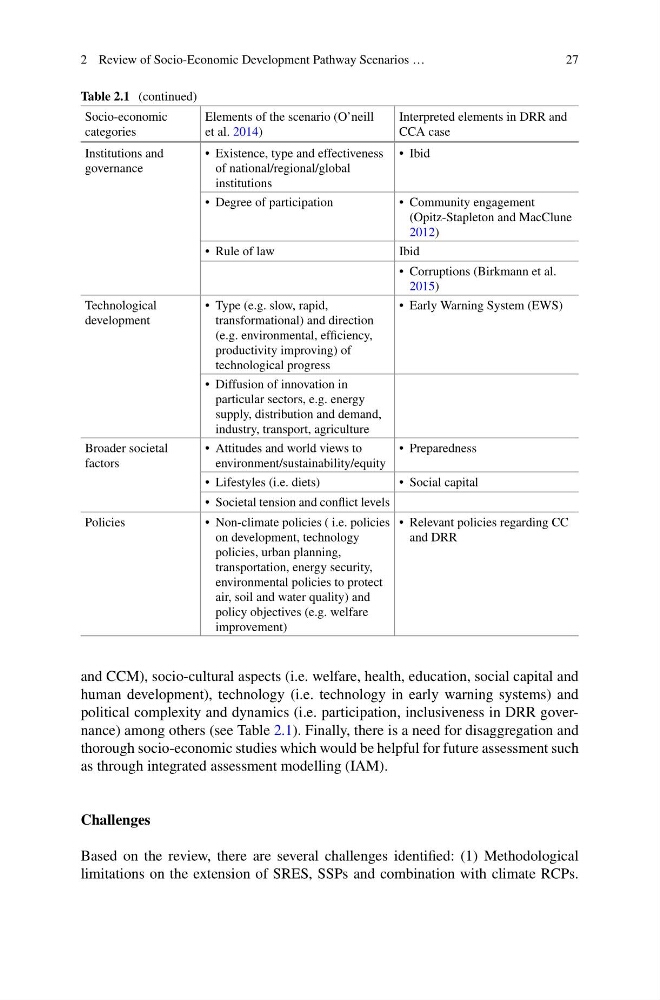
political complexity and dynamics (i.e. participation, inclusiveness in DRR governance) among others (see Table 2.1). Finally, there is a need for disaggregation and
thorough socio-economic studies which would be helpful for future assessment such
as through integrated assessment modelling (IAM).
Challenges
Based on the review, there are several challenges identified: (1) Methodological
limitations on the extension of SRES, SSPs and combination with climate RCPs.
27
Table 2.1 (continued)
Socio-economic
categories
Elements of the scenario (O’neill
et al. 2014)
Interpreted elements in DRR and
CCA case
Institutions and
governance
• Existence, type and effectiveness
of national/regional/global
institutions
• Ibid
• Degree of participation
• Community engagement
(Opitz-Stapleton and MacClune
2012)
• Rule of law
Ibid
• Corruptions (Birkmann et al.
2015)
Technological
development
• Type (e.g. slow, rapid,
transformational) and direction
(e.g. environmental, efficiency,
productivity improving) of
technological progress
• Early Warning System (EWS)
• Diffusion of innovation in
particular sectors, e.g. energy
supply, distribution and demand,
industry, transport, agriculture
Broader societal
factors
• Attitudes and world views to
environment/sustainability/equity
• Preparedness
• Lifestyles (i.e. diets)
• Social capital
• Societal tension and conflict levels
Policies
• Non-climate policies ( i.e. policies
on development, technology
policies, urban planning,
transportation, energy security,
environmental policies to protect
air, soil and water quality) and
policy objectives (e.g. welfare
improvement)
• Relevant policies regarding CC
and DRR
and CCM), socio-cultural aspects (i.e. welfare, health, education, social capital and
human development), technology (i.e. technology in early warning systems) and
political complexity and dynamics (i.e. participation, inclusiveness in DRR governance) among others (see Table 2.1). Finally, there is a need for disaggregation and
thorough socio-economic studies which would be helpful for future assessment such
as through integrated assessment modelling (IAM).
Challenges
Based on the review, there are several challenges identified: (1) Methodological
limitations on the extension of SRES, SSPs and combination with climate RCPs.