

232
C. S. Goh and S. H. J. T. Lee
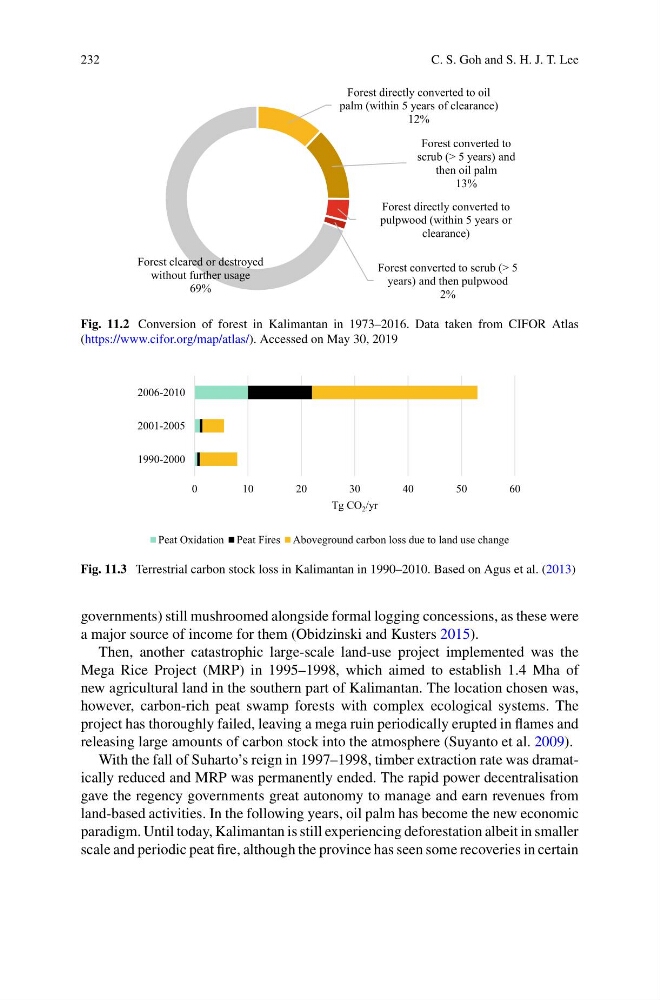
Forest directly converted to oil
palm (within 5 years of clearance)
12%
Forest converted to
scrub (> 5 years) and
then oil palm
13%
Forest directly converted to
pulpwood (within 5 years or
clearance)
Forest converted to scrub (> 5
years) and then pulpwood
2%
Forest cleared or destroyed
without further usage
69%
Fig. 11.2 Conversion of forest in Kalimantan in 1973–2016. Data taken from CIFOR Atlas
(https://www.cifor.org/map/atlas/). Accessed on May 30, 2019
0
1 0
2 0
3 0
4 0
5 0
6 0
1990-2000
2001-2005
2006-2010
Tg CO 2 /yr
Peat Oxidation Peat Fires Aboveground carbon loss due to land use change
Fig. 11.3 Terrestrial carbon stock loss in Kalimantan in 1990–2010. Based on Agus et al. (2013)
governments) still mushroomed alongside formal logging concessions, as these were
a major source of income for them (Obidzinski and Kusters 2015).
Then, another catastrophic large-scale land-use project implemented was the
Mega Rice Project (MRP) in 1995–1998, which aimed to establish 1.4 Mha of
new agricultural land in the southern part of Kalimantan. The location chosen was,
however, carbon-rich peat swamp forests with complex ecological systems. The
project has thoroughly failed, leaving a mega ruin periodically erupted in flames and
releasing large amounts of carbon stock into the atmosphere (Suyanto et al. 2009).
With the fall of Suharto’s reign in 1997–1998, timber extraction rate was dramatically reduced and MRP was permanently ended. The rapid power decentralisation
gave the regency governments great autonomy to manage and earn revenues from
land-based activities. In the following years, oil palm has become the new economic
paradigm. Until today, Kalimantan is still experiencing deforestation albeit in smaller
scale and periodic peat fire, although the province has seen some recoveries in certain
C. S. Goh and S. H. J. T. Lee
Forest directly converted to oil
palm (within 5 years of clearance)
12%
Forest converted to
scrub (> 5 years) and
then oil palm
13%
Forest directly converted to
pulpwood (within 5 years or
clearance)
Forest converted to scrub (> 5
years) and then pulpwood
2%
Forest cleared or destroyed
without further usage
69%
Fig. 11.2 Conversion of forest in Kalimantan in 1973–2016. Data taken from CIFOR Atlas
(https://www.cifor.org/map/atlas/). Accessed on May 30, 2019
0
1 0
2 0
3 0
4 0
5 0
6 0
1990-2000
2001-2005
2006-2010
Tg CO 2 /yr
Peat Oxidation Peat Fires Aboveground carbon loss due to land use change
Fig. 11.3 Terrestrial carbon stock loss in Kalimantan in 1990–2010. Based on Agus et al. (2013)
governments) still mushroomed alongside formal logging concessions, as these were
a major source of income for them (Obidzinski and Kusters 2015).
Then, another catastrophic large-scale land-use project implemented was the
Mega Rice Project (MRP) in 1995–1998, which aimed to establish 1.4 Mha of
new agricultural land in the southern part of Kalimantan. The location chosen was,
however, carbon-rich peat swamp forests with complex ecological systems. The
project has thoroughly failed, leaving a mega ruin periodically erupted in flames and
releasing large amounts of carbon stock into the atmosphere (Suyanto et al. 2009).
With the fall of Suharto’s reign in 1997–1998, timber extraction rate was dramatically reduced and MRP was permanently ended. The rapid power decentralisation
gave the regency governments great autonomy to manage and earn revenues from
land-based activities. In the following years, oil palm has become the new economic
paradigm. Until today, Kalimantan is still experiencing deforestation albeit in smaller
scale and periodic peat fire, although the province has seen some recoveries in certain