

11 Transforming Exploitative Land-Based Economy to Reduce …
231
Sect. “Land-Use History in Kalimantan”. Then, four strategies proposed for transforming exploitative land-based activities are elaborated in Sect. “Reconciling Development and Conservation: Proposals, Progress and Problems”. The chapter ends with
a discussion in Sect. “Discussion”.
Land-Use History in Kalimantan
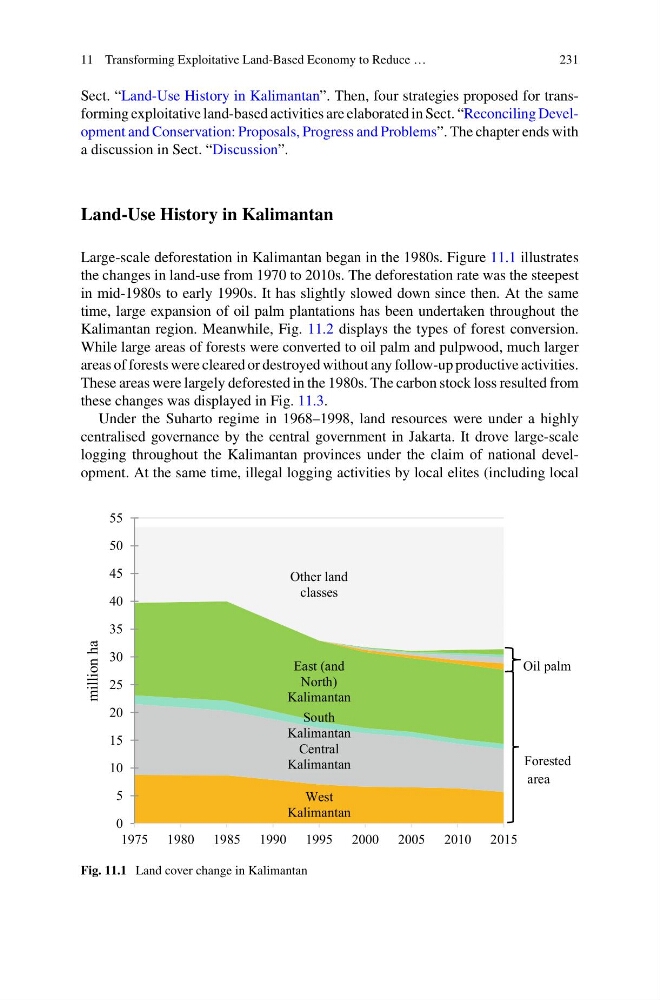
Large-scale deforestation in Kalimantan began in the 1980s. Figure 11.1 illustrates
the changes in land-use from 1970 to 2010s. The deforestation rate was the steepest
in mid-1980s to early 1990s. It has slightly slowed down since then. At the same
time, large expansion of oil palm plantations has been undertaken throughout the
Kalimantan region. Meanwhile, Fig. 11.2 displays the types of forest conversion.
While large areas of forests were converted to oil palm and pulpwood, much larger
areas of forests were cleared or destroyed without any follow-up productive activities.
These areas were largely deforested in the 1980s. The carbon stock loss resulted from
these changes was displayed in Fig. 11.3.
Under the Suharto regime in 1968–1998, land resources were under a highly
centralised governance by the central government in Jakarta. It drove large-scale
logging throughout the Kalimantan provinces under the claim of national development. At the same time, illegal logging activities by local elites (including local
West
Kalimantan
Central
Kalimantan
South
Kalimantan
East (and
North)
Kalimantan
Other land
classes
0
5
10
15
20
25
30
35
40
45
50
55
1975 1980 1985 1990 1995 2000 2005 2010 2015
million ha
Forested
area
Oil palm
Fig. 11.1 Land cover change in Kalimantan
231
Sect. “Land-Use History in Kalimantan”. Then, four strategies proposed for transforming exploitative land-based activities are elaborated in Sect. “Reconciling Development and Conservation: Proposals, Progress and Problems”. The chapter ends with
a discussion in Sect. “Discussion”.
Land-Use History in Kalimantan
Large-scale deforestation in Kalimantan began in the 1980s. Figure 11.1 illustrates
the changes in land-use from 1970 to 2010s. The deforestation rate was the steepest
in mid-1980s to early 1990s. It has slightly slowed down since then. At the same
time, large expansion of oil palm plantations has been undertaken throughout the
Kalimantan region. Meanwhile, Fig. 11.2 displays the types of forest conversion.
While large areas of forests were converted to oil palm and pulpwood, much larger
areas of forests were cleared or destroyed without any follow-up productive activities.
These areas were largely deforested in the 1980s. The carbon stock loss resulted from
these changes was displayed in Fig. 11.3.
Under the Suharto regime in 1968–1998, land resources were under a highly
centralised governance by the central government in Jakarta. It drove large-scale
logging throughout the Kalimantan provinces under the claim of national development. At the same time, illegal logging activities by local elites (including local
West
Kalimantan
Central
Kalimantan
South
Kalimantan
East (and
North)
Kalimantan
Other land
classes
0
5
10
15
20
25
30
35
40
45
50
55
1975 1980 1985 1990 1995 2000 2005 2010 2015
million ha
Forested
area
Oil palm
Fig. 11.1 Land cover change in Kalimantan